
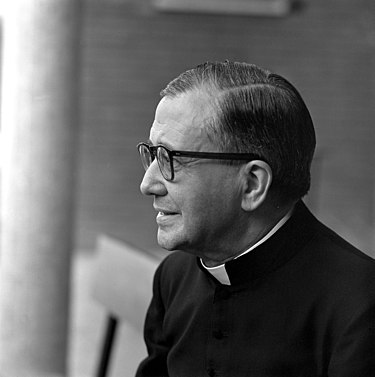
Saints John and Paul – and Josemaria
We usually try to commemorate the saints in the current, public liturgical calendar, but now and again, we will mention those more hidden, even if they have a long and venerable history of being honoured in the Church, or are of particular significance for our era.
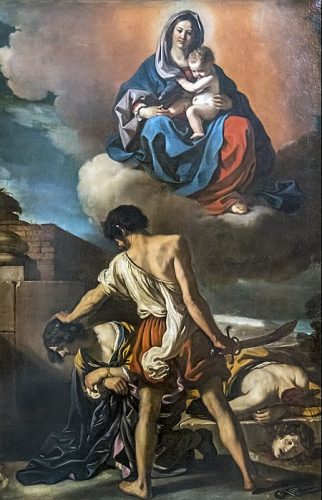
Wikipedia.org
Such are Saints John and Paul, two martyrs of the early Church, put to death on this day, June 26th, likely in 362 A.D., under Emperor Julian the Apostate, a year before his own death, ironically enough, on this same day exactly one later. Who would have thought? Certain Julian didn’t. Yet as the bitterly anti-Catholic Julian – he had lost his faith as a young lad witnessing his family slain by ‘Christian’ soldiers – lay dying from the wound of a spear, he murmured ‘Thou hast conquered, O pale Galilean!’.
Christ has conquered, and He will conquer, putting all things under His feet Our two martyrs were highly venerated in the early Church, such that they were placed in the Roman canon, still to this day. Of course, I am rather partial to their name(s), and visited their basilica on my walking pilgrimage through Rome a few summers ago. The basilica of Saints John and Paul is not far from the Circus Maximus, hidden away behind a wall, and originally built over the early Roman home of the martyrs in 398, remains of which one can still see. If they are now hidden from the gaze of our modern, world, they are not hidden in the sight of God, Who will soon proclaim His truth, for which they died, from the housetops.
Opus Dei, the personal prelature dedicated to the sanctification of the lay apostolate, celebrates their founder on this day, Saint Josemaria Escriva (1902 – 1975), the Spanish priest who, in a vision on October 2nd, 1928 – the feast of the Guardian Angels – perceived his mission: To inspire and lead the laity, who make up about 99.8% of the Church, to sanctify themselves and the world by their secular work and day-to-day mundane activities. As he said:
Either we learn to find the Lord in the ordinary everyday life or else we shall never find him
To do ordinary things in an extraordinary way, presaging the message of the Second Vatican Council, enunciated clearly the document on the lay apostolate, Apostolicam Actuositatem:
They (the laity) exercise the apostolate in fact by their activity directed to the evangelization and sanctification of men and to the penetrating and perfecting (perfundendum ac perficiendum) of the temporal order through the spirit of the Gospel. In this way, their temporal activity openly bears witness to Christ and promotes the salvation of men. Since the laity, in accordance with their state of life, live in the midst of the world and its concerns, they are called by God to exercise their apostolate in the world like leaven, with the ardor of the spirit of Christ.
For all of the seriousness of its mission, and dedication to a disciplined life, Father Escriva always emanated warmth, compassion, humour – he loved telling jokes, and off-the-cuff responses. He had a deep capacity for friendship and entering into a dialogue with all those he met. But, as in every saint, behind that developed human personality was a deep and disciplined ‘asceticism’, of keeping himself focused on God, by a schedule of prayer and work, by obedience, and doing the duty of the moment.
One bishop said of Monsignor Escriva: The distinctive notes of his character are his energy and his capacity for organization and government; with an ability to pass unnoticed. He has shown himself most obedient to the Church hierarchy — one very special hallmark of his priestly work is the way he fosters, in speech and in writing, in public and in private, love for Holy Mother Church and for the Roman Pontiff. As well, that he was an exemplary priest, chosen by God for apostolic enterprises; humble, prudent, self-sacrificing in work, docile to his bishop, of outstanding intelligence and with a very solid spiritual and doctrinal formation.
While Cardinal Ratzinger said of his work: I have always been impressed by Josemaría Escrivá’s explanation of the name ‘Opus Dei’: an explanation … gives us an idea of the founder’s spiritual profile. Escrivá knew he had to found something, but he was also conscious that what he was founding was not his own work, that he himself did not invent anything and that the Lord was merely making use of him. So it was not his work, but Opus Dei (God’s Work). [This] gives us to understand that he was in a permanent dialogue, a real contact with the One who created us and works for us and with us… If therefore St Josemaría speaks of the common vocation to holiness, it seems to me that he is basically drawing on his own personal experience, not of having done incredible things himself, but of having let God work. Therefore a renewal, a force for good was born in the world even if human weaknesses will always remain.
And remain they will. But Christ overcomes and heals our weakness, even our deepest and most humiliating sins, as the leper in the Gospel begs: Domine, si vis, potes me mundare! – Lord, if you will, you can make me clean!
And the Lord replies simply: ‘Volo. Mundare’. I will. Be clean. So it was, so it is, and so it shall be, unto the end. All we need do, is ask. ‘Domine, si vis…

Carney’s Amoral Majority
After five defections – euphemistically described as ‘crossing the floor’ – and three by-elections, Mark Carney and his Liberals how have their coveted majority. One wonders what bowls of pottage were offered in back-room deals. In the archaic monarchical system that is the Dominion of Canada, this majority allows the newly-minted Prime Minister to rule[…]Continue reading→

Saint Kateri , Canada’s Protectress
This was the title given to Saint Kateri Tekakwitha, by Pope Benedict XVI, when he canonized her on October 28th, 2012, along with six others, in Saint Peter’ Square (she had been beatified by Pope John Paul II back in 1980). With Saint Joseph as our protector, along with the Canadian martyrs, we seem to[…]Continue reading→

A Tale of Two Benedicts
A grace-filled Holy Week to all our readers! As we await and prepare for the Resurrection about to dawn upon us, we might keep in mind two Benedicts: Pope Emeritus Benedict XVI, requiescat in pace, elected on this day in 2005; and today’s commemoration of the mystic pilgrim, Benedict Joseph Labre, who died on this[…]Continue reading→

My Name is Bernadette
April 16th is a propitious day, for besides the anniversary of Father de Valk’s death, who founded Catholic Insight in its print form decades ago, and the commemoration of the ‘two Benedicts’, mentioned in accompanying posts, today we also recall Saint Bernadette Soubirous, the young visionary to whom the Virgin Mary appeared numerous times at[…]Continue reading→

Saint Lydwina of Schiedam and Suffering Joyfully
Saint Lydwina of Schiedam (1380 – 1433) was one of the countless and glorious ‘victim souls’ in the history of the Church, those whose lives are filled with suffering, often of an unimaginable intensity, but who suffer joyfully. She was a fifteen-year old Dutch girl, out skating one day, when she fell and broke one[…]Continue reading→

The Glorious Martyrdoms of Martin and Maximus
As we enter into Eastertide, we recall on this 13th of April Pope Saint Martin I (+655), one of the noblest, if most tragic, of the successors of Saint Peter. Born in Umbria, Italy, he was of noble lineage, with great intelligence combined with charity and love of the poor and the Church. While still[…]Continue reading→

Canonizing Sister Faustina and Divine Mercy
HOMILY OF THE HOLY FATHER MASS IN ST PETER’S SQUARE FOR THE CANONIZATION OF SR MARY FAUSTINA KOWALSKA Sunday, 30 April 2000 1. “Confitemini Domino quoniam bonus, quoniam in saeculum misericordia eius”; “Give thanks to the Lord for he is good; his steadfast love endures for ever” (Ps 118: 1). So the Church sings on the Octave of[…]Continue reading→

Saint Stanislaus of Szczepanów
We celebrate Saint Stanislaus today (+ April 11, 1079), in light of this Easter Octave, a bishop and martyr who accepted the episcopacy only at the direct order of Pope Alexander II. He proved a wise and courageous leader of his flock, put to death by his own king, Boleslaus, for rebuking the monarch’s ‘immoral[…]Continue reading→
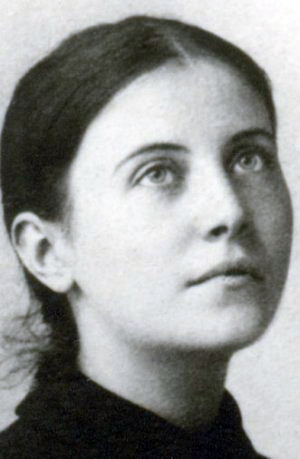
Saint Gemma Galgani
On this April 11th, in 1903 – the same year that the Italian Guiseppe Sarto was elected Pope later that summer as Pius X – a lovely, young Italian woman died, by the name of Gemma Galgani. She lived a brief life of 24 years, as did a number of other young saints, including Pier[…]Continue reading→
An Ideological and Improper Translation
I noticed something odd with the psalm reading at Mass the other day. Our bishops’ conference here in Canada has decreed that the Mass in English – Novus Ordo – use the ‘NRSV’, the ‘New Revised Standard Version’, an ‘updated’ translation of the original RSV, first published in 1952. This ‘new translation’ has the tendency[…]Continue reading→