

The Place and Purpose of Private Revelation
On this memorial of Our Lady of Fatima, it is perhaps requisite to say a few words about revelation – A reader wrote recently that Catholics spend too much time on private sort, and not enough on public, that is, the Deposit of Faith, Scripture and Tradition, all that God has revealed to one and all for our salvation.
Point taken. Catholics should be reading their Bibles regularly, as well as delving into the Fathers, Doctors and Saints of the Church, a rich and limitless treasure, vastly underutilized. There is a tendency to burrow into the rabbit holes of private revelation, which, we should recall, only exists for the sake of this public revelation. As the Catechism puts it:
Throughout the ages, there have been so-called “private” revelations, some of which have been recognized by the authority of the Church. They do not belong, however, to the deposit of faith. It is not their role to improve or complete Christ’s definitive Revelation, but to help live more fully by it in a certain period of history. Guided by the Magisterium of the Church, the sensus fidelium knows how to discern and welcome in these revelations whatever constitutes an authentic call of Christ or his saints to the Church. (CCC, 67)
The purpose of all revelation is to lead us to heaven. Public revelation does so more directly, and is more necessary (which is why it has been revealed by God – in fact, it is His very Word). Even here, though, some of this Revelation is more necessary than other. The Gospels are more directly applicable than the genealogies and legal prescriptions in the Book of Chronicles. And as far as Tradition goes, the doctrines of the Trinity of Persons and the Holy Eucharist are more central than the condemnation of Monothelitism in the 7th century. But all is of value, even if this help to deepen our knowledge and love of the ‘Mystery of Christ’.
We may make an analogous distinction with private revelation – some is more approved, and deemed more necessary and worthy of devotion, than others. The revelation of Our Lady of Fatima, of Lourdes and of Guadalupe have received innumerable papal approbation, their messages timely, to the point, relevant and consistent with what God has already revealed. There are other revelations are more have more local applicability, or for a given time and era. After all, God speaking to each of us in prayer is a kind of ‘private’ revelation, given to us personally, cor ad cor loquitur, to quote Cardinal Newman. Only sometimes do these conversations become more ‘public’.
Then we have private revelation that are more dubious, even disconcerting. To take but one recent example from last February: Apparition of Pope Benedict to Colombian nun, revealing his real Testament, confirming that he was the last legitimate Pope on earth.
If Pope Benedict wanted to give us his ‘real’ Testament, he would have given it to us here on Earth, would he not? And as far as the legitimacy of any pope, is not that determined by the legal structure of the Church (as part of public Revelation)? Regardless of what think of him, there is nothing therein that the current pontiff is not the real pontiff. Some Popes we must just endure. And what is one to think of the Pope Emeritus now claiming he was ‘locked up in solitary confinement’, rather than choosing such a quasi-eremtical life of his own will?
Whatever the veracity of such, revelations that undermine or contradict God’s word may be rejected outright:
Christian faith cannot accept “revelations” that claim to surpass or correct the Revelation of which Christ is the fulfilment, as is the case in certain non-Christian religions and also in certain recent sects which base themselves on such “revelations”. (ibid.)
Here we may include such as things as the ‘angel’ Maroni’s alleged message to Joseph Smith, or of ‘Gabriel’s’ words to Muhammad in that desert cave a millennium before that, or even of Luther’s interior certainty to remove whole sections of Scripture as ‘uncanonical’.
Within the Catholic fold, there are all sorts of lurid prophecies and prognostications out there, but we should take to heart Christ’s words, not to let our hearts be troubled, nor to give in to fear. Private revelation should be used only as it is deemed helpful and supportive of our living out the truths of public revelation – the Mass and the other sacraments, striving for holiness in our daily duties – which is the main point, as Our Lady (and other saints) have always emphasized. All the Truth necessary for our salvation has already been given to us, as Saint John of the Cross puts it, and we will end this reflection with the words of the Carmelite, for we could not put it better:
In giving us his Son, his only Word (for he possesses no other), he spoke everything to us at once in this sole Word – and he has no more to say. . . because what he spoke before to the prophets in parts, he has now spoken all at once by giving us the All Who is His Son. Any person questioning God or desiring some vision or revelation would be guilty not only of foolish behaviour but also of offending him, by not fixing his eyes entirely upon Christ and by living with the desire for some other novelty (CCC, 67)

Carney’s Amoral Majority
After five defections – euphemistically described as ‘crossing the floor’ – and three by-elections, Mark Carney and his Liberals how have their coveted majority. One wonders what bowls of pottage were offered in back-room deals. In the archaic monarchical system that is the Dominion of Canada, this majority allows the newly-minted Prime Minister to rule[…]Continue reading→

Saint Kateri , Canada’s Protectress
This was the title given to Saint Kateri Tekakwitha, by Pope Benedict XVI, when he canonized her on October 28th, 2012, along with six others, in Saint Peter’ Square (she had been beatified by Pope John Paul II back in 1980). With Saint Joseph as our protector, along with the Canadian martyrs, we seem to[…]Continue reading→

A Tale of Two Benedicts
A grace-filled Holy Week to all our readers! As we await and prepare for the Resurrection about to dawn upon us, we might keep in mind two Benedicts: Pope Emeritus Benedict XVI, requiescat in pace, elected on this day in 2005; and today’s commemoration of the mystic pilgrim, Benedict Joseph Labre, who died on this[…]Continue reading→

My Name is Bernadette
April 16th is a propitious day, for besides the anniversary of Father de Valk’s death, who founded Catholic Insight in its print form decades ago, and the commemoration of the ‘two Benedicts’, mentioned in accompanying posts, today we also recall Saint Bernadette Soubirous, the young visionary to whom the Virgin Mary appeared numerous times at[…]Continue reading→

Saint Lydwina of Schiedam and Suffering Joyfully
Saint Lydwina of Schiedam (1380 – 1433) was one of the countless and glorious ‘victim souls’ in the history of the Church, those whose lives are filled with suffering, often of an unimaginable intensity, but who suffer joyfully. She was a fifteen-year old Dutch girl, out skating one day, when she fell and broke one[…]Continue reading→

The Glorious Martyrdoms of Martin and Maximus
As we enter into Eastertide, we recall on this 13th of April Pope Saint Martin I (+655), one of the noblest, if most tragic, of the successors of Saint Peter. Born in Umbria, Italy, he was of noble lineage, with great intelligence combined with charity and love of the poor and the Church. While still[…]Continue reading→

Saint Stanislaus of Szczepanów
We celebrate Saint Stanislaus today (+ April 11, 1079), in light of this Easter Octave, a bishop and martyr who accepted the episcopacy only at the direct order of Pope Alexander II. He proved a wise and courageous leader of his flock, put to death by his own king, Boleslaus, for rebuking the monarch’s ‘immoral[…]Continue reading→

Saint Gemma Galgani
On this April 11th, in 1903 – the same year that the Italian Guiseppe Sarto was elected Pope later that summer as Pius X – a lovely, young Italian woman died, by the name of Gemma Galgani. She lived a brief life of 24 years, as did a number of other young saints, including Pier[…]Continue reading→

An Ideological and Improper Translation
I noticed something odd with the psalm reading at Mass the other day. Our bishops’ conference here in Canada has decreed that the Mass in English – Novus Ordo – use the ‘NRSV’, the ‘New Revised Standard Version’, an ‘updated’ translation of the original RSV, first published in 1952. This ‘new translation’ has the tendency[…]Continue reading→
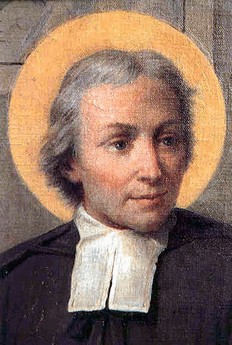
Saint Jean-Baptiste de la Salle: A Teacher for Teachers
Jean-Baptiste de la Salle (1651 – 1719), a French nobleman, ordained a priest, founded the first order in the Church’s history entirely without priests, and this came about almost by accident. I say ‘almost’, for, of course, there are no accidents with God. Destined for ordination from an early age, Jean-Baptiste never looked back, even[…]Continue reading→