
The Holy Spirit, Fidelity and Martyrdom
‘But the Advocate, the Holy Spirit, whom my Father will send in my name, will teach you everything and remind you of all that I have said to you’ (Jn. 14:24).
Our Gospel text is taken from Our Lord’s High Priestly Prayer, offered at the Last Supper. The Holy Spirit, who will be revealed as a Divine Person at Pentecost, is spoken of as the Advocate; indeed as the Church’s great defender and as her living memory, for He reminds us of all that Our Lord has spoken and taught. Of herself the Church is powerless without the aid of the Holy Spirit, in whose power the Sacraments are celebrated and the truth of the faith is handed on through the ages. ‘When the Spirit of truth comes, he will guide you into all the truth’ (Jn. 16:13). The Church remains faithful to the truth of Christ, regardless of circumstances; and we, the members of God’s Holy Church must bear our share of the hardship which the Gospel entails as we endeavour to remain faithful to this immutable truth. We can only do this with the strength that comes from God (Cf. 2 Tim. 1:8). Calls for the Church to change her teachings are nothing new and claims that attempt to legitimise novelties are also nothing new. St. Paul was very explicit in his warning: But even if we, or an angel from heaven, should preach to you a gospel contrary to that which we preached to you, let him be accursed (Gal. 1:8).
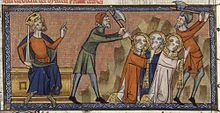
In our day, as the foundations of our Christian civilization are openly attacked, we must gather our courage for the witness that our Catholic Faith demands of us. In a work written around the year 180, called A Treatise Against Heresies, St. Irenaeus, Bishop of Lyons in France, one of the earliest defenders of our Faith or Apologists as they are called, observed: The Church, which has spread everywhere, even to the ends of the earth, received the faith from the apostles and their disciples….The Church, spread throughout the whole world, received this preaching and this faith and now preserves it carefully, dwelling as it were in one house. Having one soul and one heart, the Church holds this faith, preaches it and teaches it consistently as though by a single voice. For though there are different languages, there is but one tradition. The faith and the tradition of the churches founded in Germany are no different from those among the Spanish and the Celts, in the East, in Egypt, in Libya and elsewhere in the Mediterranean world…. Now of those who speak with authority in the churches, no preacher however forceful will utter anything different – for no one is above the Master – nor will a less forceful preacher diminish what has been handed down. Since our faith is everywhere the same, no one who can say more augments it, nor can anyone who says less diminish it. (The Liturgy of the Hours, Vol. 2, p.1784). Similarly, the works of St. Clement of Rome (+99), St. Ignatius of Antioch (+108) and St. Justin Martyr (+165) bear witness that the Faith that the Catholic Church professes today is the Faith that they professed in their day, and for which they all died as Martyrs.
A persecution against Christians is raging in the world today. In our own country, the government is stripping our emblems of Christian symbols, and violence against churches and Christian institutions is deemed understandable. Increasingly those who are faithful to the truth of the Gospel and especially the moral law of God find themselves marginalized, ostracized, persecuted and cancelled. There is no clearer example of this than the dilemma faced by health care providers and medical institutions in the face of legislation that violates the most basic principles of human dignity or by teachers experiencing hostility for their defence of the Catholic Faith. The war against faith is now also a war against reason.
I have referenced and quoted a work written in a time in human history that can only be described as brutal. The transformation of these brutal cultures was the arduous work of evangelization, catechesis and most especially the recognition of the individual as worthy of rights and dignity. This is the fruit of a Christian culture; and even if many, if not most, of the nations of the Western world are no longer willing to acknowledge their Judeo-Christian foundations, the evidence of history is incontrovertible: no institution has done more for the spiritual and physical well-being of humanity than the Catholic Church. Another ancient Christian text written around the same time as The Treatise Against Heresies, a work called A Letter to Diognetus, bears witness to the positive influence of Christians. Christians are indistinguishable from other men either by nationality, language or customs. They do not inhabit separate cities of their own, or speak a strange dialect, or follow some outlandish way of life…. And yet there is something extraordinary about their lives…Like others they marry and have children, but they not expose them. They share their meals, but not their wives. They live in the flesh, but are not governed by the desires of the flesh….Christian love all men, but all men persecute them….As the soul benefits from the deprivation of food and drink, so Christians flourish under persecution. Such is the Christian’s lofty and divinely appointed function, from which he is not permitted to excuse himself (The Liturgy of the Hours, Vol. 2, p.840-842).
Our faithful witness is needed in our day. The outright rejection of the Christian order that holds Christian charity as its highest value has resulted in an increasingly cold and calculating social construct in which life is expendable and to our horror and shame in this country, the slaughter of the unborn is a point of national pride for some of our politicians. Where is the outcry and moral outrage? How can anyone in good conscience support such politicians? Our judgment as a nation will be rightly severe. The two ancient texts that I have quoted bear witness to the enduing truth of Christ Our Saviour; and this truth must continue to guide us lest we fall away and betray our Saviour and betray our very selves also.
We must bear our share of the hardship which the Gospel entails. The world has no future and we certainly have no future without accepting the life that only God can bestow on us through grace. This alone will allow us to live and experience the unselfish love and service that take us beyond worldly self-centeredness and enable us to proclaim to the whole world the saving message of Jesus Christ. And this requires both words and deeds. May the Holy Spirit, the Advocate, keep us ever-mindful of all that Our Lord has taught us; especially the truth of our human worth and dignity. May He strengthen us in our witness and fidelity to the truth of Christ; to whom be all praise, honour and glory, now and forever more.

Remembering Father Alphonse de Valk
(Today marks the sixth anniversary of the death of Father Alphonse de Valk, C.S.B., a faithful, courageous and indefatigable Basilian priest, pro-life-and-family apostle, and the founder of Catholic Insight magazine. Here is what we wrote those on his entering into eternity five years ago, as we continue to remember him in our prayers and thoughts)[…]Continue reading→

Divine Mercy Sunday – An Echo of Every Mass
Reach out your hand and put it in my side. Do not doubt but believe’… ‘My Lord and my God!’ (Jn. 20:18)). Today is Divine Mercy Sunday, and as we celebrate the end of the Easter Octave, we contemplate the wounded side of our Saviour, the Church’s source of life. On Good Friday in the[…]Continue reading→

Saint Stanislaus of Szczepanów
We celebrate Saint Stanislaus today (+ April 11, 1079), in light of this Easter Octave, a bishop and martyr who accepted the episcopacy only at the direct order of Pope Alexander II. He proved a wise and courageous leader of his flock, put to death by his own king, Boleslaus, for rebuking the monarch’s ‘immoral[…]Continue reading→

First Holy Communion: Sermon from May 16, 1943
Here is a sermon from the good old days by +Rev. Msgr. Vincent Nicholas Foy (August 14, 1915 – March 13, 2017), from 1943. Readers may recall that Pope Saint Pius X, by the decree Quam Singulari in 1910, lowered the customary age of reception of Holy Communion – after the rigours of the plague[…]Continue reading→

In the Glorious Light of Easter, Alleluia!
Set your minds on things that are above, not on things that are on earth, for you have died, and your life is hidden with Christ in God. When Christ who is your life is revealed, then you also will be revealed with him in glory (Col. 3:3-4). The Resurrection of Our Lord and Saviour[…]Continue reading→

An Ancient Homily for Holy Saturday
The time between Good Friday and Easter Sunday is one of waiting, in silence, as the world wonders – anticipates – what will happen, after the death of Christ. We re-live this time each year in the anamnesis of our liturgy, and in turn look forward to the glorious re-creation of all things at the[…]Continue reading→

Europe’s Long Descent
(As we meditate on this day on Christ’s burial, and His descent into hell, it is fitting to ponder here with contributor Peter Marcus how the world seems to be heading there as well. The difference is that, although God cannot ‘redeem’ hell, nor those therein, He can and did redeem the world. There is[…]Continue reading→
Pope Saint John Paul II’s First Good Friday Homily
ADDRESS OF HIS HOLINESS JOHN PAUL II AT THE CONCLUSION OF THE STATIONS OF THE CROSS AT THE COLOSSEUM Good Friday, 13 April 1979 When we make the Way of the Cross from one station to the next, in spirit we are always at the spot wherethis journey had its “historical” place: where it[…]Continue reading→
A Meditation for Good Friday: How To Undo the Effects of Sin?
Cardinal Newman, now Saint John Henry Newman, was a towering figure of nineteenth-century Catholicism who is almost universally admired. I say “almost” because not everyone likes him. I knew a priest once, Arthur Caulkins, who has become disenchanted with Newman. As an undergraduate Arthur had been enamoured of Newman, and this interest continued when he[…]Continue reading→
Pope Benedict’s Last Holy Thursday Homily
MASS OF THE LORD’S SUPPER HOMILY OF HIS HOLINESS BENEDICT XVI Basilica of St John Lateran Holy Thursday, 5 April 2012 Photo Gallery (Video) Dear Brothers and Sisters! Holy Thursday is not only the day of the institution of the Most Holy Eucharist, whose splendour bathes all else and in some ways draws it to[…]Continue reading→