
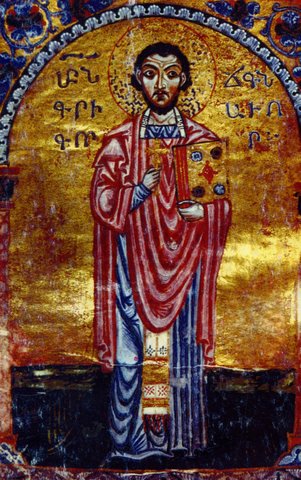
Saint Gregory Narek, Mystic, Monk and Doctor
The Armenian monk Gregory Narek (Grigor Narekatsi), whose life spanned the latter half of the 11th century (ca. 950 – 1003), was enrolled amongst the elite Doctors of the Church by Pope Francis in 2015, and soon afterwards placed in the universal liturgical calendar.
His life was externally uneventful, at least in a worldly sense. Raised in a pious household on the shore of Lake Van (now in modern Turkey), as a young man he joined the monastery of Narekavank not far from his home, and spent the rest of his life in prayer, good works, contemplation and, the fruit thereof, his writing. His most famous work, and perhaps the greatest work of Armenian literature, is The Book of Lamentations, a mystical treatise of 95 chapters and 10,000 lines, difficult to put into one category. One may describe it as a theological meditation and introspection, perhaps, along the lines of Augustine’s Confessions. It is said that every household in Armenia once had one – and perhaps still does – to which even miraculous healing properties were ascribed. Many sleep with a copy under their pillows. Certainly, Saint Gregory’s inspiration, and his words, helped the Armenians keep their faith and hope alive in the midst of much pain and suffering in their history, not least the genocide during the First World War at the hands of the Islamic Turks, who also destroyed Narekavank monastery, which had endured for over a thousand years.
Gregory also wrote other works, including a commentary on the Song of Songs – his first treatise as a young man – and numerous homilies, hymns and panegyrics. He held to the doctrine of the perpetual virginity of Mary, the Immaculate Conception, and the Assumption of Our Lady – the latter two defined in the 19th and 20th centuries.
It has been said that Saint Gregory downplayed the need for the institutional Church, emphasizing more the relation of the individual soul to God. I suppose each Doctor has his particular focus – Augustine, of grace, and so on. But Gregory never denied the need for the Church, and was orthodox. As well, at the end of the day, and the end of our lives, the Church was founded as a means to the end of the salvation of each soul, created by God for eternal glory – and our own focus on that unfailing promise should help us see our way through the travails of this fragmented world, the form of which is already passing away.
Saint Gregory Narek focused on the one thing necessary, and chose the better part.
Ora pro nobis!

Carney’s Amoral Majority
After five defections – euphemistically described as ‘crossing the floor’ – and three by-elections, Mark Carney and his Liberals how have their coveted majority. One wonders what bowls of pottage were offered in back-room deals. In the archaic monarchical system that is the Dominion of Canada, this majority allows the newly-minted Prime Minister to rule[…]Continue reading→

Saint Kateri , Canada’s Protectress
This was the title given to Saint Kateri Tekakwitha, by Pope Benedict XVI, when he canonized her on October 28th, 2012, along with six others, in Saint Peter’ Square (she had been beatified by Pope John Paul II back in 1980). With Saint Joseph as our protector, along with the Canadian martyrs, we seem to[…]Continue reading→

A Tale of Two Benedicts
A grace-filled Holy Week to all our readers! As we await and prepare for the Resurrection about to dawn upon us, we might keep in mind two Benedicts: Pope Emeritus Benedict XVI, requiescat in pace, elected on this day in 2005; and today’s commemoration of the mystic pilgrim, Benedict Joseph Labre, who died on this[…]Continue reading→

My Name is Bernadette
April 16th is a propitious day, for besides the anniversary of Father de Valk’s death, who founded Catholic Insight in its print form decades ago, and the commemoration of the ‘two Benedicts’, mentioned in accompanying posts, today we also recall Saint Bernadette Soubirous, the young visionary to whom the Virgin Mary appeared numerous times at[…]Continue reading→

Saint Lydwina of Schiedam and Suffering Joyfully
Saint Lydwina of Schiedam (1380 – 1433) was one of the countless and glorious ‘victim souls’ in the history of the Church, those whose lives are filled with suffering, often of an unimaginable intensity, but who suffer joyfully. She was a fifteen-year old Dutch girl, out skating one day, when she fell and broke one[…]Continue reading→

The Glorious Martyrdoms of Martin and Maximus
As we enter into Eastertide, we recall on this 13th of April Pope Saint Martin I (+655), one of the noblest, if most tragic, of the successors of Saint Peter. Born in Umbria, Italy, he was of noble lineage, with great intelligence combined with charity and love of the poor and the Church. While still[…]Continue reading→

Canonizing Sister Faustina and Divine Mercy
HOMILY OF THE HOLY FATHER MASS IN ST PETER’S SQUARE FOR THE CANONIZATION OF SR MARY FAUSTINA KOWALSKA Sunday, 30 April 2000 1. “Confitemini Domino quoniam bonus, quoniam in saeculum misericordia eius”; “Give thanks to the Lord for he is good; his steadfast love endures for ever” (Ps 118: 1). So the Church sings on the Octave of[…]Continue reading→

Saint Stanislaus of Szczepanów
We celebrate Saint Stanislaus today (+ April 11, 1079), in light of this Easter Octave, a bishop and martyr who accepted the episcopacy only at the direct order of Pope Alexander II. He proved a wise and courageous leader of his flock, put to death by his own king, Boleslaus, for rebuking the monarch’s ‘immoral[…]Continue reading→

Saint Gemma Galgani
On this April 11th, in 1903 – the same year that the Italian Guiseppe Sarto was elected Pope later that summer as Pius X – a lovely, young Italian woman died, by the name of Gemma Galgani. She lived a brief life of 24 years, as did a number of other young saints, including Pier[…]Continue reading→
An Ideological and Improper Translation
I noticed something odd with the psalm reading at Mass the other day. Our bishops’ conference here in Canada has decreed that the Mass in English – Novus Ordo – use the ‘NRSV’, the ‘New Revised Standard Version’, an ‘updated’ translation of the original RSV, first published in 1952. This ‘new translation’ has the tendency[…]Continue reading→