
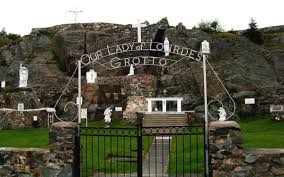
The Salvific Message of Lourdes
Our Lady of Lourdes is one of the few visions of the Virgin Mary to be placed in the public Liturgical calendar of the universal Church, along with her appearances at Fatima and Guadalupe. All three have in common that the visionaries to whom Our Lady manifested herself were simple, unlettered peasants, the anawim, the ‘poor of the Earth’, humble, expecting not much from life, faithful to the Church, pious and morally pure – and all of them went on to become saints. As the priest says in Franz Werfel’s adaptation of the story – the play adaptation of which our College year presented in 2020 – once one has seen the Blessed Virgin, a veritable glimpse of heaven, how can one return to a secular, worldly life?
On a cold winter day in 1858 in the south of France – looking outside at the frigid temperatures here in Canada, I realize that ‘cold’ is a rather relative term – the Virgin Mary appeared to fourteen-year old unlettered peasant girl, Bernadette Soubirous, as she was gathering firewood with her siblings near the town dump as Massabielle, outside the little village of Lourdes, nestled in the foothill of the Pyrenees. In her own simple and guileless words:
I came back towards the grotto and started taking off my stockings. I had hardly taken off the first stocking when I heard a sound like a gust of wind. Then I turned my head towards the meadow. I saw the trees quite still: I went on taking off my stockings. I heard the same sound again. As I raised my head to look at the grotto, I saw a lady dressed in white, wearing a white dress, a blue girdle and a yellow rose on each foot, the same color as the chain of her rosary; the beads of the rosary were white….From the niche, or rather the dark alcove behind it, came a dazzling light
Bernadette did not know who the ‘Lady’ was, only that she was beautiful, prayerful and mesmerizing. She would pray the Rosary with Bernadette, but without moving her lips; and offered Bernadette various teachings, prophecies and ‘secrets’. Our Lady appeared seventeen times, culminating on the solemnity of the Annunciation, March 25th. When Bernadette finally asked who she was, the Lady replied in the French patois of the region, que soy era immaculada concepciou, “I am the ‘Immaculate Conception”, a dogma that had been defined and proclaimed by Bd. Pius IX four years earlier, on December 8th, 1854.
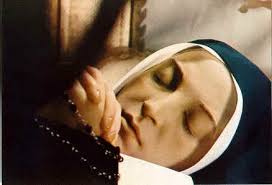 Our Lady asked for a chapel to be built, where miraculous waters would flow, something that seemed impossible in the remote, out-of-the way place. But, sure enough, a spring began to flow, still going strong to this day at forty litres a minute, and Lourdes has now become one of the foremost pilgrimage sites in the world, welcoming four to six million visitors per year, a beacon of hope for those seeking healing, physical or spiritual. Saint Bernadette’s body lies incorrupt in the convent of Nevers, where she spent the brief remainder of life as a professed religious, dying at the tender age of 36 her own battle of intense suffering of tuberculosis and bone cancer on the 16th of April, 1879. As Our Lady prophesied to the young visionary, ‘I do not promise to make you happy in this life, but the next...’
This is also the universal day of the sick, always a propos, but especially so in our own time. As Pope Saint John Paul II taught, our world has lost the true sense and purpose of suffering, a natural consequence of the loss of a supernatural perspective, of Man’s eternal destiny. Hence, all our thoughts, desires, dreams are focused on this life alone, so brief, so limited, a subtle form of despair and the slothful sorrow of acedia. Hence, the desire for a quick and painless death, assisted suicide, to go oh-so-gently into that great goodnight when the roses lose their bloom, and life its lustre. And, as readers may now be aware, here in Canada, we have euthanasia almost on demand, as we sink further into the quicksand of the culture of death.
But despair not. The great Pope taught in Evangelium Vitae that this temporal existence is only a ‘penultimate’ good, to be used well in preparation for our ultimate good, eternal life. Without this dimension, life – to say nothing of the suffering it brings – cannot make sense, or the only sense is that there is none. Hence, the bizarre philosophy of such proponents of hopelessness as David Benatar, who claims, in an ironic application of the words of Christ about Judas, that the best thing for any human is never to have been born.
But every life is of value, even those filled with the most suffering, as, again, John Paul taught so eloquently and profoundly in his masterpiece on the infinite value of suffering, Salvifici Doloris, promulgated on this day in 1984. Well, well worth a read, and one wise Jesuit priest remarked that this Apostolic Letter may be amongst the most important and prophetic works of the Holy Father’s corpus.
Christ has invited all of us to participate in His own salvific work, and we should unite our prayers this day, and throughout the year, with those of the sick, along with all of our own crosses, especially those especially sent to us by God. As Saint Theresa of Calcutta declared, ‘suffering is the kiss of Christ’. We should rejoice in our health, but also in our own salvific suffering in whatever way it may come to us.
Our Lady of Lourdes and Saint Bernadette, orate pro nobis!

Carney’s Amoral Majority
After five defections – euphemistically described as ‘crossing the floor’ – and three by-elections, Mark Carney and his Liberals how have their coveted majority. One wonders what bowls of pottage were offered in back-room deals. In the archaic monarchical system that is the Dominion of Canada, this majority allows the newly-minted Prime Minister to rule[…]Continue reading→

Saint Kateri , Canada’s Protectress
This was the title given to Saint Kateri Tekakwitha, by Pope Benedict XVI, when he canonized her on October 28th, 2012, along with six others, in Saint Peter’ Square (she had been beatified by Pope John Paul II back in 1980). With Saint Joseph as our protector, along with the Canadian martyrs, we seem to[…]Continue reading→

A Tale of Two Benedicts
A grace-filled Holy Week to all our readers! As we await and prepare for the Resurrection about to dawn upon us, we might keep in mind two Benedicts: Pope Emeritus Benedict XVI, requiescat in pace, elected on this day in 2005; and today’s commemoration of the mystic pilgrim, Benedict Joseph Labre, who died on this[…]Continue reading→

My Name is Bernadette
April 16th is a propitious day, for besides the anniversary of Father de Valk’s death, who founded Catholic Insight in its print form decades ago, and the commemoration of the ‘two Benedicts’, mentioned in accompanying posts, today we also recall Saint Bernadette Soubirous, the young visionary to whom the Virgin Mary appeared numerous times at[…]Continue reading→

Saint Lydwina of Schiedam and Suffering Joyfully
Saint Lydwina of Schiedam (1380 – 1433) was one of the countless and glorious ‘victim souls’ in the history of the Church, those whose lives are filled with suffering, often of an unimaginable intensity, but who suffer joyfully. She was a fifteen-year old Dutch girl, out skating one day, when she fell and broke one[…]Continue reading→

The Glorious Martyrdoms of Martin and Maximus
As we enter into Eastertide, we recall on this 13th of April Pope Saint Martin I (+655), one of the noblest, if most tragic, of the successors of Saint Peter. Born in Umbria, Italy, he was of noble lineage, with great intelligence combined with charity and love of the poor and the Church. While still[…]Continue reading→

Canonizing Sister Faustina and Divine Mercy
HOMILY OF THE HOLY FATHER MASS IN ST PETER’S SQUARE FOR THE CANONIZATION OF SR MARY FAUSTINA KOWALSKA Sunday, 30 April 2000 1. “Confitemini Domino quoniam bonus, quoniam in saeculum misericordia eius”; “Give thanks to the Lord for he is good; his steadfast love endures for ever” (Ps 118: 1). So the Church sings on the Octave of[…]Continue reading→

Saint Stanislaus of Szczepanów
We celebrate Saint Stanislaus today (+ April 11, 1079), in light of this Easter Octave, a bishop and martyr who accepted the episcopacy only at the direct order of Pope Alexander II. He proved a wise and courageous leader of his flock, put to death by his own king, Boleslaus, for rebuking the monarch’s ‘immoral[…]Continue reading→
Saint Gemma Galgani
On this April 11th, in 1903 – the same year that the Italian Guiseppe Sarto was elected Pope later that summer as Pius X – a lovely, young Italian woman died, by the name of Gemma Galgani. She lived a brief life of 24 years, as did a number of other young saints, including Pier[…]Continue reading→
An Ideological and Improper Translation
I noticed something odd with the psalm reading at Mass the other day. Our bishops’ conference here in Canada has decreed that the Mass in English – Novus Ordo – use the ‘NRSV’, the ‘New Revised Standard Version’, an ‘updated’ translation of the original RSV, first published in 1952. This ‘new translation’ has the tendency[…]Continue reading→