
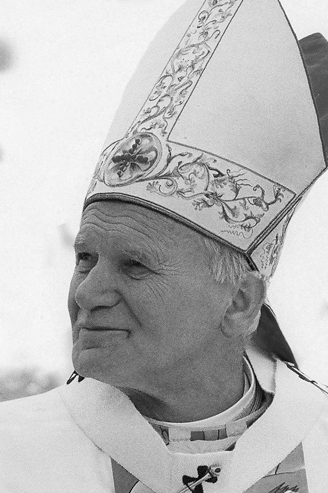
John Paul II at Lourdes
PILGRIMAGE
OF HIS HOLINESS JOHN PAUL II
TO LOURDES ON THE OCCASION OF 150TH ANNIVERSARY
OF THE PROMULGATION OF THE DOGMA
OF THE IMMACULATE CONCEPTION
HOMILY OF THE HOLY FATHER JOHN PAUL II
Prairie de la Ribère
Sunday, 15 August 2004
1. “Que soy era Immaculada Councepciou”. The words which Mary spoke to Bernadette on 25 March 1858 have a particular resonance this year, as the Church celebrates the 150th anniversary of the solemn definition of the dogma of the Immaculate Conception by Blessed Pius IX in the Apostolic Constitution Ineffabilis Deus.
I have greatly wished to make this pilgrimage to Lourdes in order to celebrate an event which continues to give glory to the Triune God. Mary’s Immaculate Conception is the sign of the gracious love of the Father, the perfect expression of the redemption accomplished by the Son and the beginning of a life completely open to the working of the Spirit.
2. Beneath the maternal gaze of the Blessed Virgin I offer a heartfelt greeting to all of you, dear brothers and sisters, as we gather before the Grotto of Massabielle to sing the praises of her whom all generations call blessed (cf. Lk 1:48).
In particular I greet the French pilgrims and their Bishops, especially the President of the Episcopal Conference [name?] and Monsignor Jacques Perrier, the Bishop of Tarbes and Lourdes, whom I thank for his kind words at the start of this celebration.
I also greet the Minister of the Interior, who represents the French Government at today’s celebration, and the other civil and military authorities present.
My thoughts and prayers go also to the pilgrims assembled here from different parts of Europe and from throughout the world, and to all those spiritually united with us by radio and television. With special affection I greet the sick and all who have come to this holy place to seek consolation and hope. May the Blessed Virgin enable you to sense her presence and give comfort to your hearts!
3. “In those days Mary arose and went with haste into the hill country…” (Lk 1:39). The words of the Gospel story have once more brought before the eyes of our hearts the young maiden of Nazareth as she makes her way to that “city of Judah” where her kinswoman Elizabeth lived, in order to be of help to her.
What strikes us about Mary is above all her loving concern for her elderly relative. Hers is a practical love, one which is not limited to words of understanding but is deeply and personally involved in giving help. The Blessed Virgin does not merely give her cousin something of herself; she gives her whole self, asking nothing in return. Mary understood perfectly that the gift she received from God is more than a privilege; it is a duty which obliges her to serve others with the selflessness proper to love.
4. “My soul magnifies the Lord…” (Lk 1:46). Mary’s sentiments in her meeting with Elizabeth are forcefully expressed in the canticle of the Magnificat. Her words convey the hope-filled expectation of the “poor of the Lord” and at the same time an awareness that God has fulfilled his promises, for he “has remembered his mercy” (cf. Lk 1:54).
This same awareness is the source of that joy of the Virgin Mary which pervades the whole canticle: joy in knowing that she has been “looked upon” by God despite her own “lowliness” (cf. Lk 1:48); joy in the “service” she is able to offer because of the “great things” to which the Almighty has called her (cf. Lk 1:49); joy in her foretaste of the eschatological blessedness promised to “those of low degree” and “the hungry” (cf. Lk 1:52-53).
The Magnificat is followed by silence: nothing is said to us about the three months that Mary stayed with her kinswoman Elizabeth. Yet perhaps we are told the most important thing: that goodness works quietly, the power of love is expressed in the unassuming quietness of daily service.
5. By her words and her silence the Virgin Mary stands before us as a model for our pilgrim way. It is not an easy way: as a result of the fall of our first parents, humanity is marked by the wounds of sin, whose consequences continue to be felt also among the redeemed. But evil and death will not have the last word! Mary confirms this by her whole life, for she is a living witness of the victory of Christ, our Passover.
The faithful have understood this. That is why they throng to this grotto in order to hear the maternal counsels of the Blessed Virgin. In her they acknowledge “the woman clothed in the sun” (Rev 12:1), the Queen resplendent before the throne of God (cf. Responsorial Psalm), ever interceding on their behalf.
6. Today the Church celebrates Mary’s glorious Assumption body and soul into Heaven. The two dogmas of the Immaculate Conception and the Assumption are closely related. Both proclaim the glory of Christ the Redeemer and the holiness of Mary, whose human destiny is even now perfectly and definitively realized in God.
“When I go and prepare a place for you, I will come again and will take you to myself, that where I am, there you may be also” (Jn 14: 3). Mary is the pledge of the fulfilment of Christ’s promise. Her Assumption thus becomes for us “a sign of sure hope and consolation” (cf. Lumen Gentium, 68).
7. Dear brothers and sisters! From this grotto of Massabielle the Blessed Virgin speaks to us too, the Christians of the third millennium. Let us listen to her!
Listen to her, young people who seek an answer capable of giving meaning to your lives. Here you can find that answer. It is a demanding one, yet it is the only answer which is genuinely satisfying. For it contains the secret of true joy and peace.
From this grotto I issue a special call to women. Appearing here, Mary entrusted her message to a young girl, as if to emphasize the special mission of women in our own time, tempted as it is by materialism and secularism: to be in today’s society a witness of those essential values which are seen only with the eyes of the heart. To you, women, falls the task of being sentinels of the Invisible! I appeal urgently to all of you, dear brother and sisters, to do everything in your power to ensure that life, each and every life, will be respected from conception to its natural end. Life is a sacred gift, and no one can presume to be its master.
Finally, Our Lady of Lourdes has a message for everyone. Be men and women of freedom! But remember: human freedom is a freedom wounded by sin. It is a freedom which itself needs to be set free. Christ is its liberator; he is the one who “for freedom has set us free” (cf. Gal 5:1). Defend that freedom!
Dear friends, in this we know we can count on Mary, who, since she never yielded to sin, is the only creature who is perfectly free. I entrust you to her. Walk beside Mary as you journey towards the complete fulfilment of your humanity!
© Copyright – Libreria Editrice Vaticana

Saint Kateri , Canada’s Protectress
This was the title given to Saint Kateri Tekakwitha, by Pope Benedict XVI, when he canonized her on October 28th, 2012, along with six others, in Saint Peter’ Square (she had been beatified by Pope John Paul II back in 1980). With Saint Joseph as our protector, along with the Canadian martyrs, we seem to[…]Continue reading→

Remembering Father Alphonse de Valk
(Today marks the sixth anniversary of the death of Father Alphonse de Valk, C.S.B., a faithful, courageous and indefatigable Basilian priest, pro-life-and-family apostle, and the founder of Catholic Insight magazine. Here is what we wrote those on his entering into eternity five years ago, as we continue to remember him in our prayers and thoughts)[…]Continue reading→

My Name is Bernadette
April 16th is a propitious day, for besides the anniversary of Father de Valk’s death, who founded Catholic Insight in its print form decades ago, and the commemoration of the ‘two Benedicts’, mentioned in accompanying posts, today we also recall Saint Bernadette Soubirous, the young visionary to whom the Virgin Mary appeared numerous times at[…]Continue reading→

Canonizing Sister Faustina and Divine Mercy
HOMILY OF THE HOLY FATHER MASS IN ST PETER’S SQUARE FOR THE CANONIZATION OF SR MARY FAUSTINA KOWALSKA Sunday, 30 April 2000 1. “Confitemini Domino quoniam bonus, quoniam in saeculum misericordia eius”; “Give thanks to the Lord for he is good; his steadfast love endures for ever” (Ps 118: 1). So the Church sings on the Octave of[…]Continue reading→

Divine Mercy Sunday – An Echo of Every Mass
Reach out your hand and put it in my side. Do not doubt but believe’… ‘My Lord and my God!’ (Jn. 20:18)). Today is Divine Mercy Sunday, and as we celebrate the end of the Easter Octave, we contemplate the wounded side of our Saviour, the Church’s source of life. On Good Friday in the[…]Continue reading→

Saint Stanislaus of Szczepanów
We celebrate Saint Stanislaus today (+ April 11, 1079), in light of this Easter Octave, a bishop and martyr who accepted the episcopacy only at the direct order of Pope Alexander II. He proved a wise and courageous leader of his flock, put to death by his own king, Boleslaus, for rebuking the monarch’s ‘immoral[…]Continue reading→
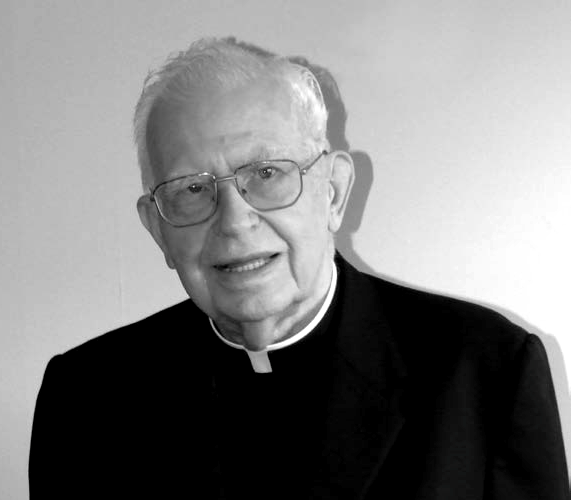
First Holy Communion: Sermon from May 16, 1943
Here is a sermon from the good old days by +Rev. Msgr. Vincent Nicholas Foy (August 14, 1915 – March 13, 2017), from 1943. Readers may recall that Pope Saint Pius X, by the decree Quam Singulari in 1910, lowered the customary age of reception of Holy Communion – after the rigours of the plague[…]Continue reading→
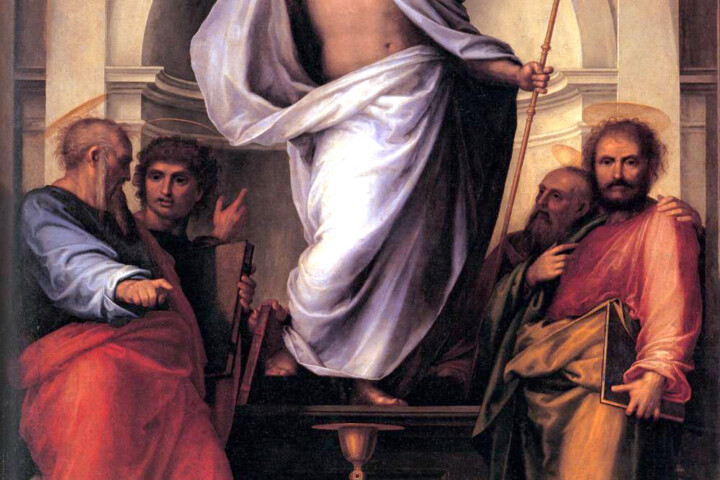
In the Glorious Light of Easter, Alleluia!
Set your minds on things that are above, not on things that are on earth, for you have died, and your life is hidden with Christ in God. When Christ who is your life is revealed, then you also will be revealed with him in glory (Col. 3:3-4). The Resurrection of Our Lord and Saviour[…]Continue reading→
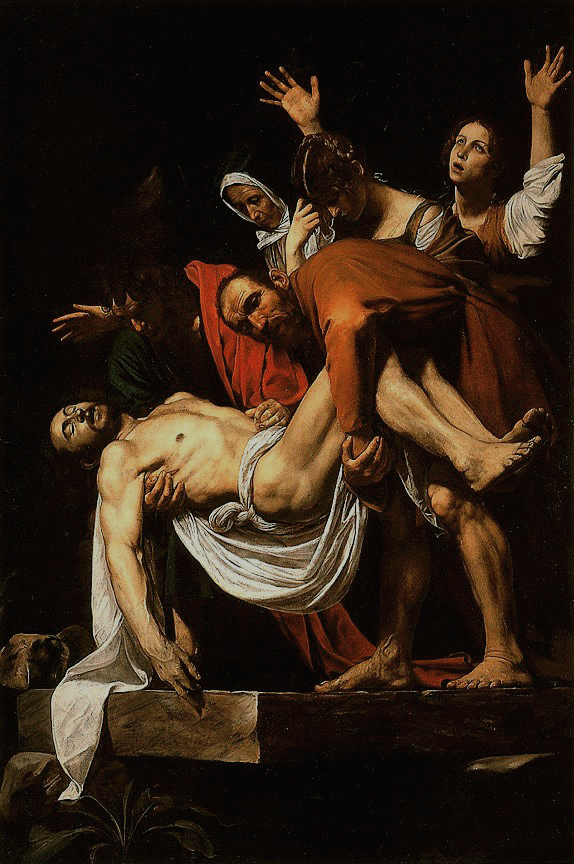
An Ancient Homily for Holy Saturday
The time between Good Friday and Easter Sunday is one of waiting, in silence, as the world wonders – anticipates – what will happen, after the death of Christ. We re-live this time each year in the anamnesis of our liturgy, and in turn look forward to the glorious re-creation of all things at the[…]Continue reading→
Europe’s Long Descent
(As we meditate on this day on Christ’s burial, and His descent into hell, it is fitting to ponder here with contributor Peter Marcus how the world seems to be heading there as well. The difference is that, although God cannot ‘redeem’ hell, nor those therein, He can and did redeem the world. There is[…]Continue reading→