
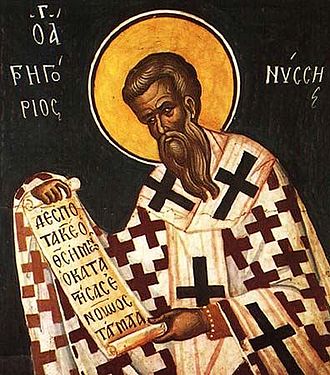
The Mysticism of Gregory of Nyssa
The memorial of Saint Gregory of Nyssa, even if not in the universal calendar, is on this January 10th. Gregory is one of the ‘Cappadocian Fathers’, along with his elder brother, Saint Basil the Great, and their companion, Saint Gregory of Nazianzen – the latter two we celebrate on, January 2nd. Gregory is a highly mystical theologian, with some controversy surrounding his theories, influenced by the earlier Origen, and the tendency towards apokatastasis, or universal salvation. This may be a misreading of the saint, who has much to offer in his profound teaching on the soul’s ascent towards holiness, without which there is no salvation.
Pope Benedict XVI, in his series of addresses on the Church Fathers, devoted two to Gregory of Nyssa, and here they be:
BENEDICT XVI
GENERAL AUDIENCE
Saint Peter’s Square
Wednesday, 29 August 2007
Saint Gregory of Nyssa (1)
Dear Brothers and Sisters,
In the last Catecheses, I spoke of two great fourth-century Doctors of the Church, Basil and Gregory Nazianzus, a Bishop in Cappadocia, in present-day Turkey. Today, we are adding a third, St Gregory of Nyssa, Basil’s brother, who showed himself to be a man disposed to meditation with a great capacity for reflection and a lively intelligence open to the culture of his time. He has thus proved to be an original and profound thinker in the history of Christianity.
He was born in about 335 A.D. His Christian education was supervised with special care by his brother Basil – whom he called “father and teacher” (Ep. 13, 4: SC 363, 198) – and by his sister Macrina. He completed his studies, appreciating in particular philosophy and rhetoric.
Initially, he devoted himself to teaching and was married. Later, like his brother and sister, he too dedicated himself entirely to the ascetic life.
He was subsequently elected Bishop of Nyssa and showed himself to be a zealous Pastor, thereby earning the community’s esteem.
When he was accused of embezzlement by heretical adversaries, he was obliged for a brief period to abandon his episcopal see but later returned to it triumphant (cf. Ep. 6: SC 363, 164-170) and continued to be involved in the fight to defend the true faith.
Especially after Basil’s death, by more or less gathering his spiritual legacy, Gregory cooperated in the triumph of orthodoxy. He took part in various Synods; he attempted to settle disputes between Churches; he had an active part in the reorganization of the Church and, as a “pillar of orthodoxy”, played a leading role at the Council of Constantinople in 381, which defined the divinity of the Holy Spirit.
Various difficult official tasks were entrusted to him by the Emperor Theodosius, he delivered important homilies and funeral discourses, and he devoted himself to writing various theological works. In addition, in 394, he took part in another Synod, held in Constantinople. The date of his death is unknown.
Gregory expressed clearly the purpose of his studies, the supreme goal to which all his work as a theologian was directed: not to engage his life in vain things but to find the light that would enable him to discern what is truly worthwhile (cf. In Ecclesiasten hom. 1: SC 416, 106-146).
He found this supreme good in Christianity, thanks to which “the imitation of the divine nature” is possible (De Professione Christiana: PG 46, 244c).
With his acute intelligence and vast philosophical and theological knowledge, he defended the Christian faith against heretics who denied the divinity of the Son and of the Holy Spirit (such as Eunomius and the Macedonians) or compromised the perfect humanity of Christ (such as Apollinaris).
He commented on Sacred Scripture, reflecting on the creation of man. This was one of his central topics: creation. He saw in the creature the reflection of the Creator and found here the way that leads to God.
But he also wrote an important book on the life of Moses, whom he presents as a man journeying towards God: this climb to Mount Sinai became for him an image of our ascent in human life towards true life, towards the encounter with God.
(To continue reading part 1, please see here).
BENEDICT XVI
GENERAL AUDIENCE
Saint Peter’s Square
Wednesday, 5 September 2007
Saint Gregory of Nyssa (2)
Dear Brothers and Sisters,
I present to you certain aspects of the teaching of St Gregory of Nyssa, of whom we spoke last Wednesday. First of all, Gregory of Nyssa had a very lofty concept of human dignity. Man’s goal, the holy Bishop said, is to liken himself to God, and he reaches this goal first of all through the love, knowledge and practice of the virtues, “bright beams that shine from the divine nature” (De Beatitudinibus 6: PG 44, 1272c), in a perpetual movement of adherence to the good like a corridor outstretched before oneself. In this regard, Gregory uses an effective image already present in Paul’s Letter to the Philippians: épekteinómenos (3: 13), that is, “I press on” towards what is greater, towards truth and love. This vivid expression portrays a profound reality: the perfection we desire to attain is not acquired once and for all; perfection means journeying on, it is continuous readiness to move ahead because we never attain a perfect likeness to God; we are always on our way (cf. Homilia in Canticum 12: PG 44, 1025d). The history of every soul is that of a love which fills every time and at the same time is open to new horizons, for God continually stretches the soul’s possibilities to make it capable of ever greater goods. God himself, who has sown the seeds of good in us and from whom every initiative of holiness stems, “models the block…, and polishing and cleansing our spirit, forms Christ within us” (In Psalmos 2, 11: PG 44, 544b).
Gregory was anxious to explain: “In fact, this likeness to the Divine is not our work at all; it is not the achievement of any faculty of man; it is the great gift of God bestowed upon our nature at the very moment of our birth” (De Virginitate 12, 2: SC 119, 408-410). For the soul, therefore, “it is not a question of knowing something about God but of having God within” (De Beatitudinibus 6: PG 44, 1269c). Moreover, as Gregory perceptively observes, “Divinity is purity, it is liberation from the passions and the removal of every evil: if all these things are in you, God is truly in you” (De Beatitudinibus 6: PG 44, 1272c).
When we have God in us, when man loves God, through that reciprocity which belongs to the law of love he wants what God himself wants (cf. Homilia in Canticum 9: PG 44, 956ac); hence, he cooperates with God in fashioning the divine image in himself, so that “our spiritual birth is the result of a free choice, and we are in a certain way our own parents, creating ourselves as we ourselves wish to be, and through our will forming ourselves in accordance with the model that we choose” (Vita Moysis 2, 3: SC 1ff., 108). To ascend to God, man must be purified: “The way that leads human nature to Heaven is none other than detachment from the evils of this world…. Becoming like God means becoming righteous, holy and good…. If, therefore, according to Ecclesiastes (5: 1), “God is in Heaven’, and if, as the Prophet says, “You have made God your refuge’ (Ps 73[72]: 28), it necessarily follows that you must be where God is found, since you are united with him. “Since he commanded you to call God “Father’ when you pray, he tells you definitely to be likened to your Heavenly Father and to lead a life worthy of God, as the Lord orders us more clearly elsewhere, saying, “Be perfect as your Heavenly Father is perfect’ (Mt 5: 48)” (De Oratione Dominica 2: PG 44, 1145ac).
In this journey of spiritual ascesis Christ is the Model and Teacher, he shows us the beautiful image of God (cf. De Perfectione Christiana: PG 46, 272a). Each of us, looking at him, finds ourselves “the painter of our own life”, who has the will to compose the work and the virtues as his colours (ibid.: PG 46, 272b). So, if man is deemed worthy of Christ’s Name how should he behave? This is Gregory’s answer: “[He must] always examine his own thoughts, his own words and his own actions in his innermost depths to see whether they are oriented to Christ or are drifting away from him” (ibid.: PG 46, 284c). And this point is important because of the value it gives to the word “Christian”. A Christian is someone who bears Christ’s Name, who must therefore also liken his life to Christ. We Christians assume a great responsibility with Baptism.
(To continue reading part 2, please see here).

Saint Kateri , Canada’s Protectress
This was the title given to Saint Kateri Tekakwitha, by Pope Benedict XVI, when he canonized her on October 28th, 2012, along with six others, in Saint Peter’ Square (she had been beatified by Pope John Paul II back in 1980). With Saint Joseph as our protector, along with the Canadian martyrs, we seem to[…]Continue reading→

Remembering Father Alphonse de Valk
(Today marks the sixth anniversary of the death of Father Alphonse de Valk, C.S.B., a faithful, courageous and indefatigable Basilian priest, pro-life-and-family apostle, and the founder of Catholic Insight magazine. Here is what we wrote those on his entering into eternity five years ago, as we continue to remember him in our prayers and thoughts)[…]Continue reading→

A Tale of Two Benedicts
A grace-filled Holy Week to all our readers! As we await and prepare for the Resurrection about to dawn upon us, we might keep in mind two Benedicts: Pope Emeritus Benedict XVI, requiescat in pace, elected on this day in 2005; and today’s commemoration of the mystic pilgrim, Benedict Joseph Labre, who died on this[…]Continue reading→

My Name is Bernadette
April 16th is a propitious day, for besides the anniversary of Father de Valk’s death, who founded Catholic Insight in its print form decades ago, and the commemoration of the ‘two Benedicts’, mentioned in accompanying posts, today we also recall Saint Bernadette Soubirous, the young visionary to whom the Virgin Mary appeared numerous times at[…]Continue reading→

Saint Lydwina of Schiedam and Suffering Joyfully
Saint Lydwina of Schiedam (1380 – 1433) was one of the countless and glorious ‘victim souls’ in the history of the Church, those whose lives are filled with suffering, often of an unimaginable intensity, but who suffer joyfully. She was a fifteen-year old Dutch girl, out skating one day, when she fell and broke one[…]Continue reading→

The Glorious Martyrdoms of Martin and Maximus
As we enter into Eastertide, we recall on this 13th of April Pope Saint Martin I (+655), one of the noblest, if most tragic, of the successors of Saint Peter. Born in Umbria, Italy, he was of noble lineage, with great intelligence combined with charity and love of the poor and the Church. While still[…]Continue reading→

Canonizing Sister Faustina and Divine Mercy
HOMILY OF THE HOLY FATHER MASS IN ST PETER’S SQUARE FOR THE CANONIZATION OF SR MARY FAUSTINA KOWALSKA Sunday, 30 April 2000 1. “Confitemini Domino quoniam bonus, quoniam in saeculum misericordia eius”; “Give thanks to the Lord for he is good; his steadfast love endures for ever” (Ps 118: 1). So the Church sings on the Octave of[…]Continue reading→

Divine Mercy Sunday – An Echo of Every Mass
Reach out your hand and put it in my side. Do not doubt but believe’… ‘My Lord and my God!’ (Jn. 20:18)). Today is Divine Mercy Sunday, and as we celebrate the end of the Easter Octave, we contemplate the wounded side of our Saviour, the Church’s source of life. On Good Friday in the[…]Continue reading→
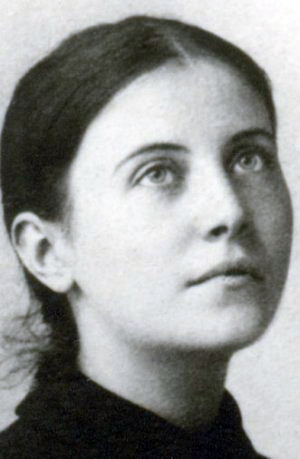
Saint Gemma Galgani
On this April 11th, in 1903 – the same year that the Italian Guiseppe Sarto was elected Pope later that summer as Pius X – a lovely, young Italian woman died, by the name of Gemma Galgani. She lived a brief life of 24 years, as did a number of other young saints, including Pier[…]Continue reading→
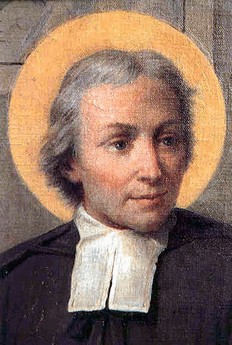
Saint Jean-Baptiste de la Salle: A Teacher for Teachers
Jean-Baptiste de la Salle (1651 – 1719), a French nobleman, ordained a priest, founded the first order in the Church’s history entirely without priests, and this came about almost by accident. I say ‘almost’, for, of course, there are no accidents with God. Destined for ordination from an early age, Jean-Baptiste never looked back, even[…]Continue reading→