
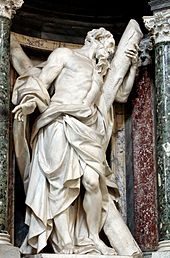
Andrew, An Apostle for All Ages
A blessed feast of Saint Andrew to all our readers! Today, the last day of November, were it not the first Sunday of Advent, we would be celebrating the first Apostle called, along with his brother, the first Pope. It is quite close to my own heart, as Andrew’s patronage includes not only my native land of Scotland, but also Russia, Ukraine and Greece, for reasons that are somewhat historically tenuous. As Belloc says, behind every legend, there is always some truth. So we may pray for peace between at least two of the aforementioned.
What we know of Andrew – whose name is Greek for ‘man’ – and we could use a few more of those – we take from the Gospels. There are similar accounts in Matthew, chapter 4 and Mark 1, where he and his brother leave their nets ‘immediately’ (eutheos) upon being called by Christ. There is, or should not be, a delay when Christ calls.
As Saint John Chrysostom put it:
He brought his brother to the very source of light, and Peter was so joyful and eager that he would not delay even for a moment.
Andrew is not named in Luke’s account of this initial calling, but his presence is implied, and made clear later on; and in the longer account of John, Andrew is a disciple of John the Baptist, and, again, ‘immediately’ recognizes Jesus as the Messiah, running off at once to tell his brother.
There is a legend that the ship upon which Andrew was sailing in his missionary endeavours veered off course in an unruly wind, and landed on the east coast of Scotland, on the site of the town that now bears his name (it must have been quite the gale). At the very least, we do know his relics were brought there, for more likely he preached and was crucified in the city of Patras in Achaea (now Greece) – on a crux decussata, an X-shaped cross, the ‘saltire’ that is now the flag of Scotland – since, like his brother Peter who was crucified upside down, he considered himself unworthy to die in the same manner as his Saviour. It has been handed down that the Apostle survived two days on the cross, preaching to the crowds, converting who knows how many.
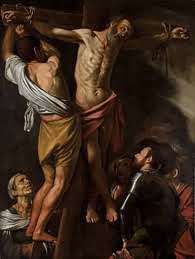
(wikipedia.org)
 The town of Saint Andrew’s was once the centre of Catholicism in Scotland, with its famous university, founded under the aegis of the Church in 1413; it was turned Presbyterian in the ‘Reformation’, but is now secularized like most universities, but where a Catholic friend of mine now teaches at their Institute for Theology, Imagination and the Arts… imagine!).
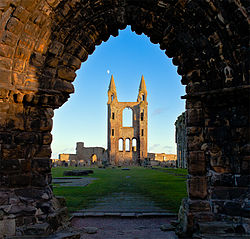
And what are we to say of the once-glorious cathedral named after the saint, completed three centuries before that, in 1148? Alas, the town, and its cathedral, were ransacked by fanatical Presbyterian Protestant mobs in the revolts of 1559, whipped into a frenzy by the quasi-demonic preaching of the fiery apostate priest John Knox, soon after the Holy Mass was proscribed under the same Knox – the hatred of the sacrifice of the Mass is one of the binding threads of the Protestant arch-heretics, and was something to behold. The cathedral’s prized religious and liturgical treasures were dispossessed and scattered – all that ‘Popish frippery’ – the glorious stonework left to rack and ruin in the wind and rain coming off the nearby sea. The hauntingly beautiful relic that remains, showing it to be the largest church ever built in Scotland (390 feet long), still stands is a testament to the state of faith in the once faithful land.
 The Faith itself was ruined spiritually by the ravages of this austere and bitter anti-Catholic Calvinism, with Scotland’s subsequent inevitable descent into secularism, hedonism and the vapid religion of soccer or, if you will, football. Ironically, this is also the anniversary of what is considered the first international ‘football’ game, between Scotland and England in 1872, before a crowd of 4000, resulting in a 0-0 draw, even if the dribbling and playing were quite good on the soggy, rain-drenched field.
Nothing wrong, and much that is good, with football or sports in general, but in contrast with (pre-Covid) packed stadiums, it was reported in a BBC article from a few years ago that only 7.2% of Scots attend any sort of church service regularly – whatever ‘regularly’ means, with half of these over the age of 65, and that includes all so-called ‘denominations’ (even though the drop in practice is least amongst the Catholics).
However those numbers are interpreted, we’re a long, long way from the manly zeal of Saint Andrew. Then again, I was glad to discover that the cathedral ruins are longer than a football pitch, a sign at least of something, a faint glimmer of hope.
For what was might be again, for the Faith never dies; there are always embers and pockets that may be fanned into flame, and signs here and there of such a resurgence in Scotland, even if much is troubling. God always has a plan, and can act in a way we may not expect, like with Andrew quietly fishing on a morning in Galilee, when the Incarnate God walked into his life.
For a window into the great soul of Andrew, we may hearken again to the words of Saint John Chrysostom in today’s Office, meditating on Andrew’s exclamation to his brother Peter: We have found the Messiah, that is to say, the Christ
Notice how his words reveal what he has learned in so short a time. They show the power of the master who has convinced them of this truth. They reveal the zeal and concern of men preoccupied with this question from the very beginning. Andrew’s words reveal a soul waiting with the utmost longing for the coming of the Messiah, looking forward to his appearing from heaven, rejoicing when he does appear, and hastening to announce so great an event to others. To support one another in the things of the spirit is the true sign of good will between brothers, of loving kinship and sincere affection.
Sancte Andreas, ora pro nobis, and for bonnie Scotland!

Carney’s Amoral Majority
After five defections – euphemistically described as ‘crossing the floor’ – and three by-elections, Mark Carney and his Liberals how have their coveted majority. One wonders what bowls of pottage were offered in back-room deals. In the archaic monarchical system that is the Dominion of Canada, this majority allows the newly-minted Prime Minister to rule[…]Continue reading→

Saint Kateri , Canada’s Protectress
This was the title given to Saint Kateri Tekakwitha, by Pope Benedict XVI, when he canonized her on October 28th, 2012, along with six others, in Saint Peter’ Square (she had been beatified by Pope John Paul II back in 1980). With Saint Joseph as our protector, along with the Canadian martyrs, we seem to[…]Continue reading→
A Closed, Unsustainable, Descending Loop
As a follow-up to my thoughts on Payette’s payout, here be a stark image of where are here in Canada. As the graph shows in, well, graphic terms, since 2025, the public sector has contributed to 95.5% of economic growth. The private sector – which funds the public sector, or is supposed to – has[…]Continue reading→

A Tale of Two Benedicts
A grace-filled Holy Week to all our readers! As we await and prepare for the Resurrection about to dawn upon us, we might keep in mind two Benedicts: Pope Emeritus Benedict XVI, requiescat in pace, elected on this day in 2005; and today’s commemoration of the mystic pilgrim, Benedict Joseph Labre, who died on this[…]Continue reading→

My Name is Bernadette
April 16th is a propitious day, for besides the anniversary of Father de Valk’s death, who founded Catholic Insight in its print form decades ago, and the commemoration of the ‘two Benedicts’, mentioned in accompanying posts, today we also recall Saint Bernadette Soubirous, the young visionary to whom the Virgin Mary appeared numerous times at[…]Continue reading→
Presidential Pardon of Weronika Krawczyk
As a good news, follow-up to our story from Poland, of the persecution of Weronika Krawczyk for her pro-life views, we heard that she has been granted a presidential pardon. One might still wonder why one needs a presidential pardon for simply holding the long-held belief that the child within the womb is a child,[…]Continue reading→

Saint Lydwina of Schiedam and Suffering Joyfully
Saint Lydwina of Schiedam (1380 – 1433) was one of the countless and glorious ‘victim souls’ in the history of the Church, those whose lives are filled with suffering, often of an unimaginable intensity, but who suffer joyfully. She was a fifteen-year old Dutch girl, out skating one day, when she fell and broke one[…]Continue reading→

The Glorious Martyrdoms of Martin and Maximus
As we enter into Eastertide, we recall on this 13th of April Pope Saint Martin I (+655), one of the noblest, if most tragic, of the successors of Saint Peter. Born in Umbria, Italy, he was of noble lineage, with great intelligence combined with charity and love of the poor and the Church. While still[…]Continue reading→

Canonizing Sister Faustina and Divine Mercy
HOMILY OF THE HOLY FATHER MASS IN ST PETER’S SQUARE FOR THE CANONIZATION OF SR MARY FAUSTINA KOWALSKA Sunday, 30 April 2000 1. “Confitemini Domino quoniam bonus, quoniam in saeculum misericordia eius”; “Give thanks to the Lord for he is good; his steadfast love endures for ever” (Ps 118: 1). So the Church sings on the Octave of[…]Continue reading→
Pope Leo and a Rosary for Peace
Pope Leo XIV has asked Catholics across the world to join him in a Rosary for peace today, at 18:00 Rome time (6 pm), which would be noon from where I write (EST). If you are able, whether at that time or another, and in whatever way you pray, to join in intercession with the[…]Continue reading→