
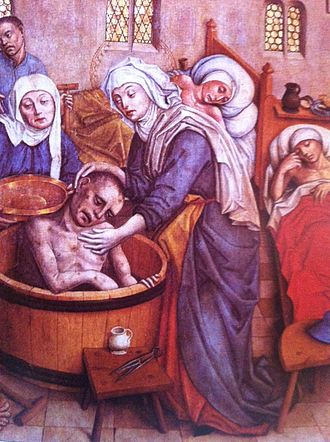
Saint Elizabeth of Hungary
The saint today is one of the patrons of Hungary, Elizabeth (+1320), the niece of Saint Hedwig of Silesia, (+1243) whom we celebrated in October. Elizabeth belongs to the ’24’ club – saints who died at that youthful age, or thereabouts – Saint Therese, Pier Giorgio, Gemma Galgani – all having fulfilled much in a short time. And Elizabeth certainly did. In 1221, at the age of 14 (still the minimum in canon law), she was married to Ludwig IV, Landgrave of Thuringia, and they lived a happy conjugal life until her husband’s untimely death six years later, while she was pregnant with their third child. He himself had been quite content with his wife’s devotional life: Her strict regime of prayer, her generous almsgiving and feeding of the poor, although it is told that he drew the line at coming home and hearing his wife had placed a leper in their marriage bed – and we might sympathize with the man. But when he drew back the covers in indignation, there instead was Christ crucified on the Cross. Strange things happened in that age of Faith, and who are we to gainsay?
There is also the story of her husband – or perhaps her uncle, who was not so well-disposed towards her – meeting Elizabeth as she was bringing food to the poor. To ensure in the presence of his nobles that she was not stealing riches from the treasury, he asked to see what was in her apron, and when she opened it, beautiful and miraculous red and white roses fell to the ground, reminiscent of the future miracle of Juan Diego.
Hearing of her husband’s demise on September 11, 1227, she lamented: He is dead. He is dead. It is to me as if the whole world died today. After that, Elizabeth threw herself fully into religion and a preparation for eternity.
She made a vow of obedience to her spiritual director, Konrad von Marburg, who seems to have been inordinately strict with her – but one wonders who was the stricter, he with her, or Elizabeth with herself. Like the little seers of Fatima, she seems to have ‘seen’ eternity close-up, with the vanity of this passing world, with all its pleasures and fancies, so ethereal and unreal. She made a promise of celibacy – hindering her family’s dynastic ambitions – and moved out (or was kicked out, depending on which version) of her castle, moving to Marburg, where she built a hospital, in those days well before public medicine. There she herself tended to the sick, the suffering and the poor, amongst whose number she soon counted herself, going peacefully to her eternal reward a few years later, on this November 17 in 1231 after a full life, at the age when most young women – and, yes, young men – in the Western world are still wandering and wondering what to do with themselves.
Such was Elizabeth’s reputation for holiness, along with the abundance of miracles through her intercession, that she was canonized just shy of five years later, by Gregory IX on May 27, 1235. Her tomb was a very popular place of pilgrimage for many years, and a grand church built in her honour by the Teutonic Knights. Alas, devotion has faded of late, but I was at an Irish celidh last year at a church dedicated to Saint Elizabeth in Toronto. She is still popular in her native Hungary, a nation maintaining some level of sanity in this increasingly mad world. The magnificent Elizabethekirche still stands as a wonderful testament of her life. Elizabeth is amongst the heavenly host in heaven, waiting for our prayers and requests. Would that more knew her story.
So pray to the great saint today – you never know what miracles might be sent your way.

Carney’s Amoral Majority
After five defections – euphemistically described as ‘crossing the floor’ – and three by-elections, Mark Carney and his Liberals how have their coveted majority. One wonders what bowls of pottage were offered in back-room deals. In the archaic monarchical system that is the Dominion of Canada, this majority allows the newly-minted Prime Minister to rule[…]Continue reading→

Saint Kateri , Canada’s Protectress
This was the title given to Saint Kateri Tekakwitha, by Pope Benedict XVI, when he canonized her on October 28th, 2012, along with six others, in Saint Peter’ Square (she had been beatified by Pope John Paul II back in 1980). With Saint Joseph as our protector, along with the Canadian martyrs, we seem to[…]Continue reading→

A Tale of Two Benedicts
A grace-filled Holy Week to all our readers! As we await and prepare for the Resurrection about to dawn upon us, we might keep in mind two Benedicts: Pope Emeritus Benedict XVI, requiescat in pace, elected on this day in 2005; and today’s commemoration of the mystic pilgrim, Benedict Joseph Labre, who died on this[…]Continue reading→

My Name is Bernadette
April 16th is a propitious day, for besides the anniversary of Father de Valk’s death, who founded Catholic Insight in its print form decades ago, and the commemoration of the ‘two Benedicts’, mentioned in accompanying posts, today we also recall Saint Bernadette Soubirous, the young visionary to whom the Virgin Mary appeared numerous times at[…]Continue reading→

Saint Lydwina of Schiedam and Suffering Joyfully
Saint Lydwina of Schiedam (1380 – 1433) was one of the countless and glorious ‘victim souls’ in the history of the Church, those whose lives are filled with suffering, often of an unimaginable intensity, but who suffer joyfully. She was a fifteen-year old Dutch girl, out skating one day, when she fell and broke one[…]Continue reading→

The Glorious Martyrdoms of Martin and Maximus
As we enter into Eastertide, we recall on this 13th of April Pope Saint Martin I (+655), one of the noblest, if most tragic, of the successors of Saint Peter. Born in Umbria, Italy, he was of noble lineage, with great intelligence combined with charity and love of the poor and the Church. While still[…]Continue reading→

Canonizing Sister Faustina and Divine Mercy
HOMILY OF THE HOLY FATHER MASS IN ST PETER’S SQUARE FOR THE CANONIZATION OF SR MARY FAUSTINA KOWALSKA Sunday, 30 April 2000 1. “Confitemini Domino quoniam bonus, quoniam in saeculum misericordia eius”; “Give thanks to the Lord for he is good; his steadfast love endures for ever” (Ps 118: 1). So the Church sings on the Octave of[…]Continue reading→

Saint Stanislaus of Szczepanów
We celebrate Saint Stanislaus today (+ April 11, 1079), in light of this Easter Octave, a bishop and martyr who accepted the episcopacy only at the direct order of Pope Alexander II. He proved a wise and courageous leader of his flock, put to death by his own king, Boleslaus, for rebuking the monarch’s ‘immoral[…]Continue reading→
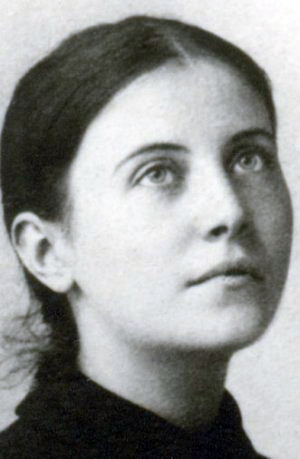
Saint Gemma Galgani
On this April 11th, in 1903 – the same year that the Italian Guiseppe Sarto was elected Pope later that summer as Pius X – a lovely, young Italian woman died, by the name of Gemma Galgani. She lived a brief life of 24 years, as did a number of other young saints, including Pier[…]Continue reading→
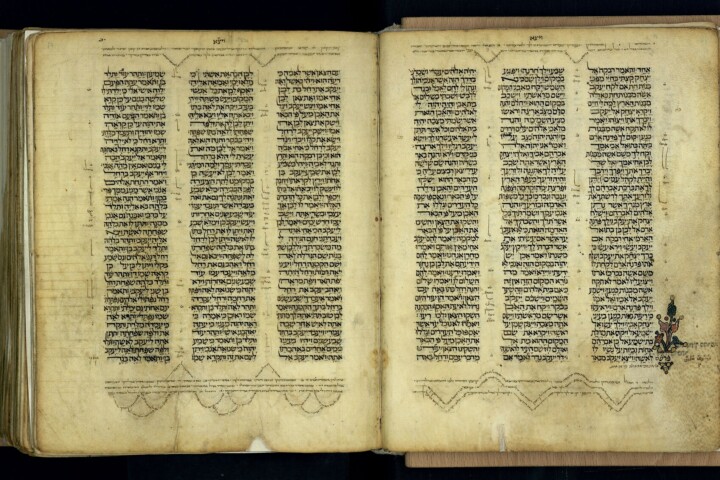
An Ideological and Improper Translation
I noticed something odd with the psalm reading at Mass the other day. Our bishops’ conference here in Canada has decreed that the Mass in English – Novus Ordo – use the ‘NRSV’, the ‘New Revised Standard Version’, an ‘updated’ translation of the original RSV, first published in 1952. This ‘new translation’ has the tendency[…]Continue reading→