
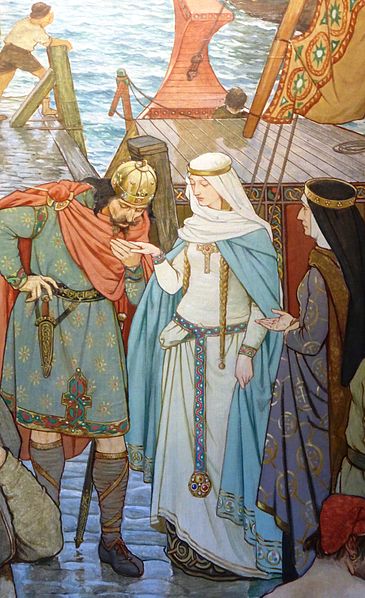
Saints Margaret of Scotland and Gertrude of Germany
Beautiful bonnie Margaret of Scotland (+1093) was the devoted wife of Malcom III, king of the nation to which she fled as a fetching young royal English lass. Her family had been exiled from England, and Margaret was born and raised in a very pious Catholic environment in Hungary, of all places, a nation now returning to its Christian roots after decades of stagnant, atheistic Communism.
The family was recalled to England in 1057, with Margaret’s father, fittingly called Edward the Exile, considered a possible successor to the childless Edward the Confessor. However, said Edward died mysteriously, and Harold Godwinson was chosen instead, not long after which the new king Harold perished by an arrow through the eye in the maelstrom of the Battle of Hastings (1066 and all that). Margaret’s brother Edgar the Aethling was briefly proclaimed king, but soon deposed by the recent conqueror, William of Normandy (whence Calvin and Jean de Brebeuf both hailed). Hence, he was technically a Frenchman, whom Belloc describes by his nickname ‘Mamzer’, or ‘the Bastard’. Belloc was not bashful of his opinions, even if the term simply meant illegitimate, which William was.
Margaret’s widowed mother Agatha intended to take the family back to the continent, but a storm providentially blew their ship off course, and they landed on the shores of the Firth of Forth in Scotland, being met, as a romantic tradition has it, by King Malcolm himself, a rough, unlettered widower with two sons, who was immediately smitten by young Margaret – is there not such a thing as love at first sight? – and, as an added bonus, thought an alliance between the two British kingdoms a fine idea.
Which motivation was foremost, and however they met, they had by all accounts a happy and fruitful union, producing six sons and two daughters: Amongst the lads we find four kings – one of them, David, himself a canonized saint – and one abbot; and the lasses themselves went on to make happy, royal marriages. Even if paterfamilias Malcolm seems to have had little tendency to the formal practice of religion, he rejoiced in the piety of his wife and children, and supported her good works generously, feeding the poor – whose feet she would wash daily – and her generous royal almsgiving. The good queen set up a ferry system to transport pilgrims across the Firth to the shrine and cathedral at Saint Andrew’s. The landing spot is still called Queensferry in her memory.
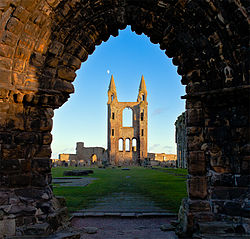
When Malcolm and one of their sons perished in the Battle of Alnwick against the English on November 13, 1093, it was said that Margaret, hearing the sad news, took to her bed with a broken heart, dying a few days later. She was canonized in 1250 by Pope Innocent IV, and is now one of the patron saints of her adopted nation. Sadly, her remains were dispersed in the insane and tragic iconoclasm of the Scottish ‘reformation’ under the fiery apostate priest John Knox, with the famed cathedral of Saint Andrew’s left to fall into rack and ruin.
Margaret’s head was preserved, given centuries later to Mary Queen of Scots as a relic to help in her childbirth – yes, we are rather incarnational, we Catholics. The precious relic then made its way to the exiled Jesuits at Douay after poor Queen Mary lost her own head by order of her cousin (once removed), the Tudor Queen Elizabeth. Saint Margaret’s was then lost, was was so many other treasures, in the chaotic iconoclasm of the French Revolution. They say that what few relics were left of Margaret and Malcolm were brought by King Philip to the Escorial in Spain, but they have yet to be found. Her memory, however, lives forever in the hearts of the Scots and people throughout the world.
We also celebrate a consecrated virgin on this day, Gertrude of Helfta, (+1302) or just the ‘Great’, an appellation given her by Pope Benedict XIV to distinguish her from a number of other saintly Gertrudes.
Gertrude was offered to the Benedictines as an oblate as a child of five years – just as her near contemporary Thomas Aquinas was – and was raised by them. As she wrote in her numerous letters to Christ her Saviour: “Yet you had chosen me to be specially trained to serve you. I was a child of five when I began to live in a convent surrounded by your most devoted friends”.
From early on – and contrary to those who claim the false canard that the Church limited the learning of women – Gertrude absorbed the education of her time like a sponge, following the quadrivium and the trivium of the liberal arts. She became fluent in Latin, adept in music and grammar, and conversant with the Fathers and doctors of the Church, from Augustine to Bernard of Clairvaux. It was at the Cistercian convent of St. Mary at Helfta that Gertrude spent the entirety of her relatively short life, going peacefully to her Saviour – to whom she considered herself ‘married’ in a spiritual way – at around the age of 46 in the year 1301 or 1302, worldly events swirling around her, alone with Christ in her monastery at Fulda.
Besides her saintly example, Gertrude is known for her profound mystical writings which have so influenced the Church’s own theology, as well as future saints and writers, from Philip Neri, Francis de Sales and Teresa of Avila, to Dom Gueranger, whose monks at Solesmes did much to compile her literary spiritual corpus; it was Gertrude who was one of the first to spread devotion to the Sacred Heart and the humanity of Christ, as well as prayers for the holy souls in Purgatory, fitting in this month of November.
Two saintly examples of two very different walks of life, both of whom did so much to lead so many to heaven.
Orate pro nobis, Margarita et Gertrudis. +
Carney’s Amoral Majority
After five defections – euphemistically described as ‘crossing the floor’ – and three by-elections, Mark Carney and his Liberals how have their coveted majority. One wonders what bowls of pottage were offered in back-room deals. In the archaic monarchical system that is the Dominion of Canada, this majority allows the newly-minted Prime Minister to rule[…]Continue reading→

Saint Kateri , Canada’s Protectress
This was the title given to Saint Kateri Tekakwitha, by Pope Benedict XVI, when he canonized her on October 28th, 2012, along with six others, in Saint Peter’ Square (she had been beatified by Pope John Paul II back in 1980). With Saint Joseph as our protector, along with the Canadian martyrs, we seem to[…]Continue reading→
A Closed, Unsustainable, Descending Loop
As a follow-up to my thoughts on Payette’s payout, here be a stark image of where are here in Canada. As the graph shows in, well, graphic terms, since 2025, the public sector has contributed to 95.5% of economic growth. The private sector – which funds the public sector, or is supposed to – has[…]Continue reading→

A Tale of Two Benedicts
A grace-filled Holy Week to all our readers! As we await and prepare for the Resurrection about to dawn upon us, we might keep in mind two Benedicts: Pope Emeritus Benedict XVI, requiescat in pace, elected on this day in 2005; and today’s commemoration of the mystic pilgrim, Benedict Joseph Labre, who died on this[…]Continue reading→

My Name is Bernadette
April 16th is a propitious day, for besides the anniversary of Father de Valk’s death, who founded Catholic Insight in its print form decades ago, and the commemoration of the ‘two Benedicts’, mentioned in accompanying posts, today we also recall Saint Bernadette Soubirous, the young visionary to whom the Virgin Mary appeared numerous times at[…]Continue reading→
Presidential Pardon of Weronika Krawczyk
As a good news, follow-up to our story from Poland, of the persecution of Weronika Krawczyk for her pro-life views, we heard that she has been granted a presidential pardon. One might still wonder why one needs a presidential pardon for simply holding the long-held belief that the child within the womb is a child,[…]Continue reading→

Saint Lydwina of Schiedam and Suffering Joyfully
Saint Lydwina of Schiedam (1380 – 1433) was one of the countless and glorious ‘victim souls’ in the history of the Church, those whose lives are filled with suffering, often of an unimaginable intensity, but who suffer joyfully. She was a fifteen-year old Dutch girl, out skating one day, when she fell and broke one[…]Continue reading→

The Glorious Martyrdoms of Martin and Maximus
As we enter into Eastertide, we recall on this 13th of April Pope Saint Martin I (+655), one of the noblest, if most tragic, of the successors of Saint Peter. Born in Umbria, Italy, he was of noble lineage, with great intelligence combined with charity and love of the poor and the Church. While still[…]Continue reading→

Canonizing Sister Faustina and Divine Mercy
HOMILY OF THE HOLY FATHER MASS IN ST PETER’S SQUARE FOR THE CANONIZATION OF SR MARY FAUSTINA KOWALSKA Sunday, 30 April 2000 1. “Confitemini Domino quoniam bonus, quoniam in saeculum misericordia eius”; “Give thanks to the Lord for he is good; his steadfast love endures for ever” (Ps 118: 1). So the Church sings on the Octave of[…]Continue reading→
Pope Leo and a Rosary for Peace
Pope Leo XIV has asked Catholics across the world to join him in a Rosary for peace today, at 18:00 Rome time (6 pm), which would be noon from where I write (EST). If you are able, whether at that time or another, and in whatever way you pray, to join in intercession with the[…]Continue reading→