
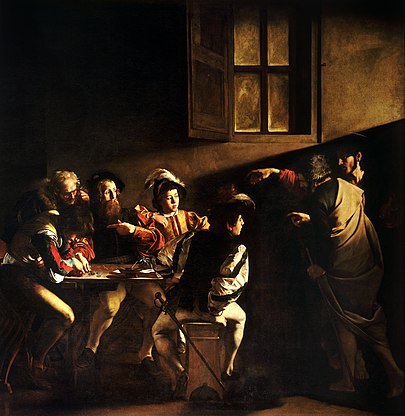
Pope Benedict and Saint Matthew
BENEDICT XVI
GENERAL AUDIENCE
Paul VI Audience Hall
Wednesday, 30 August 2006
Matthew
Dear Brothers and Sisters,
Continuing the series of portraits of the Twelve Apostles that we began a few weeks ago, let us reflect today on Matthew. To tell the truth, it is almost impossible to paint a complete picture of him because the information we have of him is scarce and fragmentary. What we can do, however, is to outline not so much his biography as, rather, the profile of him that the Gospel conveys.
In the meantime, he always appears in the lists of the Twelve chosen by Jesus (cf. Mt 10: 3; Mk 3: 18; Lk 6: 15; Acts 1: 13).
His name in Hebrew means “gift of God”. The first canonical Gospel, which goes under his name, presents him to us in the list of the Twelve, labelled very precisely: “the tax collector” (Mt 10: 3).
Thus, Matthew is identified with the man sitting at the tax office whom Jesus calls to follow him: “As Jesus passed on from there, he saw a man called Matthew sitting at the tax office; and he said to him, “Follow me’. And he rose and followed him” (Mt 9: 9). Mark (cf. 2: 13-17) and Luke (cf. 5: 27-30), also tell of the calling of the man sitting at the tax office, but they call him “Levi”.
To imagine the scene described in Mt 9: 9, it suffices to recall Caravaggio’s magnificent canvas, kept here in Rome at the Church of St Louis of the French.
A further biographical detail emerges from the Gospels: in the passage that immediately precedes the account of the call, a miracle that Jesus worked at Capernaum is mentioned (cf. Mt 9: 1-8; Mk 2: 1-12) and the proximity to the Sea of Galilee, that is, the Lake of Tiberias (cf. Mk 2: 13-14).
It is possible to deduce from this that Matthew exercised the function of tax collector at Capernaum, which was exactly located “by the sea” (Mt 4: 13), where Jesus was a permanent guest at Peter’s house.
On the basis of these simple observations that result from the Gospel, we can advance a pair of thoughts.
The first is that Jesus welcomes into the group of his close friends a man who, according to the concepts in vogue in Israel at that time, was regarded as a public sinner.
Matthew, in fact, not only handled money deemed impure because of its provenance from people foreign to the People of God, but he also collaborated with an alien and despicably greedy authority whose tributes moreover, could be arbitrarily determined.
This is why the Gospels several times link “tax collectors and sinners” (Mt 9: 10; Lk 15: 1), as well as “tax collectors and prostitutes” (Mt 21: 31).
Furthermore, they see publicans as an example of miserliness (cf. Mt 5: 46: they only like those who like them), and mention one of them, Zacchaeus, as “a chief tax collector, and rich” (Lk 19: 2), whereas popular opinion associated them with “extortioners, the unjust, adulterers” (Lk 18: 11).
A first fact strikes one based on these references: Jesus does not exclude anyone from his friendship. Indeed, precisely while he is at table in the home of Matthew-Levi, in response to those who expressed shock at the fact that he associated with people who had so little to recommend them, he made the important statement: “Those who are well have no need of a physician, but those who are sick; I came not to call the righteous, but sinners” (Mk 2: 17).
The good news of the Gospel consists precisely in this: offering God’s grace to the sinner!
(To continue reading, please see the Vatican webpage here)

Saint Kateri , Canada’s Protectress
This was the title given to Saint Kateri Tekakwitha, by Pope Benedict XVI, when he canonized her on October 28th, 2012, along with six others, in Saint Peter’ Square (she had been beatified by Pope John Paul II back in 1980). With Saint Joseph as our protector, along with the Canadian martyrs, we seem to[…]Continue reading→

Remembering Father Alphonse de Valk
(Today marks the sixth anniversary of the death of Father Alphonse de Valk, C.S.B., a faithful, courageous and indefatigable Basilian priest, pro-life-and-family apostle, and the founder of Catholic Insight magazine. Here is what we wrote those on his entering into eternity five years ago, as we continue to remember him in our prayers and thoughts)[…]Continue reading→
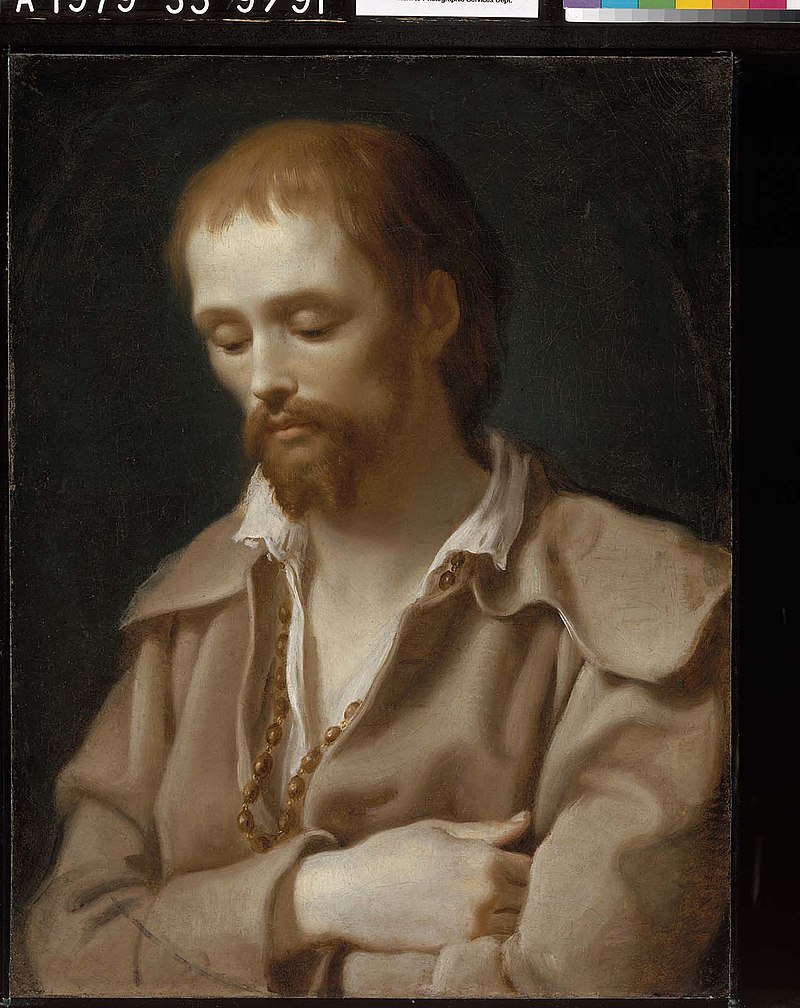
A Tale of Two Benedicts
A grace-filled Holy Week to all our readers! As we await and prepare for the Resurrection about to dawn upon us, we might keep in mind two Benedicts: Pope Emeritus Benedict XVI, requiescat in pace, elected on this day in 2005; and today’s commemoration of the mystic pilgrim, Benedict Joseph Labre, who died on this[…]Continue reading→

My Name is Bernadette
April 16th is a propitious day, for besides the anniversary of Father de Valk’s death, who founded Catholic Insight in its print form decades ago, and the commemoration of the ‘two Benedicts’, mentioned in accompanying posts, today we also recall Saint Bernadette Soubirous, the young visionary to whom the Virgin Mary appeared numerous times at[…]Continue reading→
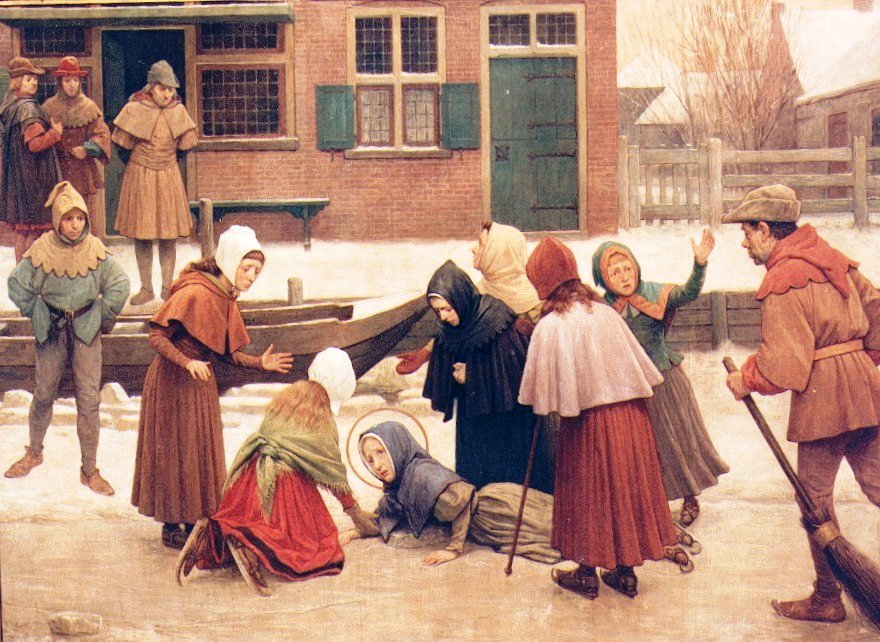
Saint Lydwina of Schiedam and Suffering Joyfully
Saint Lydwina of Schiedam (1380 – 1433) was one of the countless and glorious ‘victim souls’ in the history of the Church, those whose lives are filled with suffering, often of an unimaginable intensity, but who suffer joyfully. She was a fifteen-year old Dutch girl, out skating one day, when she fell and broke one[…]Continue reading→
The Glorious Martyrdoms of Martin and Maximus
As we enter into Eastertide, we recall on this 13th of April Pope Saint Martin I (+655), one of the noblest, if most tragic, of the successors of Saint Peter. Born in Umbria, Italy, he was of noble lineage, with great intelligence combined with charity and love of the poor and the Church. While still[…]Continue reading→
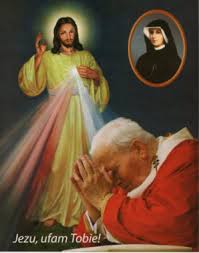
Canonizing Sister Faustina and Divine Mercy
HOMILY OF THE HOLY FATHER MASS IN ST PETER’S SQUARE FOR THE CANONIZATION OF SR MARY FAUSTINA KOWALSKA Sunday, 30 April 2000 1. “Confitemini Domino quoniam bonus, quoniam in saeculum misericordia eius”; “Give thanks to the Lord for he is good; his steadfast love endures for ever” (Ps 118: 1). So the Church sings on the Octave of[…]Continue reading→

Divine Mercy Sunday – An Echo of Every Mass
Reach out your hand and put it in my side. Do not doubt but believe’… ‘My Lord and my God!’ (Jn. 20:18)). Today is Divine Mercy Sunday, and as we celebrate the end of the Easter Octave, we contemplate the wounded side of our Saviour, the Church’s source of life. On Good Friday in the[…]Continue reading→
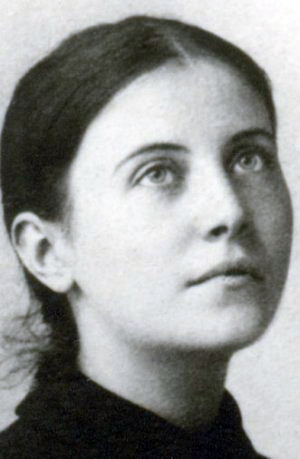
Saint Gemma Galgani
On this April 11th, in 1903 – the same year that the Italian Guiseppe Sarto was elected Pope later that summer as Pius X – a lovely, young Italian woman died, by the name of Gemma Galgani. She lived a brief life of 24 years, as did a number of other young saints, including Pier[…]Continue reading→
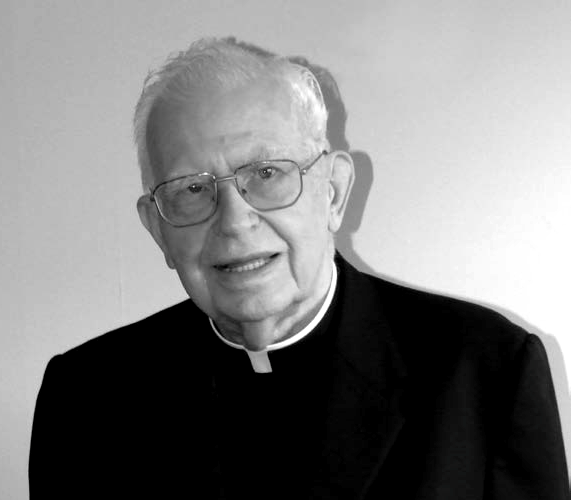
First Holy Communion: Sermon from May 16, 1943
Here is a sermon from the good old days by +Rev. Msgr. Vincent Nicholas Foy (August 14, 1915 – March 13, 2017), from 1943. Readers may recall that Pope Saint Pius X, by the decree Quam Singulari in 1910, lowered the customary age of reception of Holy Communion – after the rigours of the plague[…]Continue reading→