
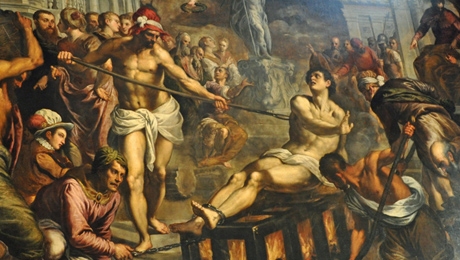
The Divine Comedy of Saint Lawrence
Today’s Saint Lawrence (+258) lives on in the legend of his own divine comedy, a Spaniard from Valencia, chosen in the very bloom of his early maturity by the intelligent and saintly Pope Sixtus II to be Archdeacon of Rome, in charge of distributing the wealth of the Church. It is said that Lawrence’s parents were martyrs – how soon after his birth we know not, but they must have had a good hand in raising the lad before their final witness and entrance into eternity.
Lawrence’s own sanctity shines through the ages and the stories told of him. In the persecution in the reign of Emperor Valerian in 258 – in which Pope Sixtus himself and some companions were killed a few days before our Lawrence – all Christians were commanded to apostatize, worship the pagan deities, or in all likelihood face a swift and sure death. They came for the Pope on August 6th, and then for Lawrence, from whom they demanded all the Church’s riches, to be put into the Emperor’s coffers. Lawrence asked for a few days to get things organized.
He took the time to distribute as much of the wealth to the poor as he could, to keep it off the hands of greedy and wasteful Roman officials. He then gathered together all the same poor, the lame, the sick and other ‘deplorables’, and presented them before the magistrate, licking his chops in anticipation of buckets of gold coins: ‘Behold, here are the Church’s riches’ declared the Deacon, ‘The Church is rich, far richer than your emperor!’
The Magistrate, furious at his avarice being so publicly mocked, ordered Lawrence to be slowly roasted over a gridiron, rather than the relatively merciful decapitation. When he had been suffering for quite some time, Lawrence cheerfully retorted to his tormentors: ‘You can turn me over…I’m quite done on this side’. He was not yet 33 years old, and, is, not surprisingly, the patron saint of chefs, cooks and comedians.
The Perseid meteor shower, which usually occurs around this time in mid-August, are often called the ‘Tears of Saint Lawrence’, although, if tears they be, they are those of laughter. After all, a ‘comedy’ in literature – as in Dante’s Divina Commedia – is a potential tragedy that ends well, even if the characters traverse much suffering along the way. Hence, the saints are all comedians, as should be all Catholics.
The gridiron on which he was roasted alive is on display at San Lorenzo fuori la Mura, his principal church in Rome, one of the Church’s seven major basilicas, and Lawrence’s charred head is displayed on his feast day in Saint Peter’s basilica. I have prayed at length before the gridiron, but have yet to see his head. The Church indeed revels in our incarnate natures.
We need more cheerful saints, who look upon the world and their own lives as a path and a means to a much more real life, and so are enabled to see things in perspective, with an air of healthy detachment. As Pope Leo XIII put it, it is only in heaven will we truly begin to live.
Saint Lawrence is the only non-biblical saint – that is, not an Apostle, Saint Joseph or the Blessed Virgin – whose celebration is a full feast, testifying to the devotion in which he was held in the early Church.
So on the feast of this saint of the virtue of hilarity – delighting in that in which we should delight – laugh a little, grow strong, and be not anxious for the morrow. Let the evil of the day be sufficient thereof. The form of this world – and the form of our bodies – is passing away, to be transformed in a blink of an eye into something far, far more glorious.
A postscript on the grim, cheerless persecutor Valerian: A few years later, in 260, he had the ignominy of being the first Roman Emperor captured in battle, by the Persians, sending a shock of dismay and despair through the Empire. He was made a slave, and it is said that the once-mighty Caesar was used by Shapur, king of Persia, as a footstool to mount his horse, and then his body stuffed after death as a monument, of sorts, of Persian triumph. The rulers of this world, filled with hubris, will have their day, and God will in His own time laugh them to scorn. We can only hope that his own sufferings and humiliation, and the prayers of Lawrence, saved Valerian, and they’re together in heaven. After all, one never knows the ways of salvation of each soul – God writes with what to our perspective seem crooked lines – and, to paraphrase the much-later Saint Jean Vianney, some are meant to bring many in their own holy and glorious wake.
San Lorenzo, ora pro nobis.

Carney’s Amoral Majority
After five defections – euphemistically described as ‘crossing the floor’ – and three by-elections, Mark Carney and his Liberals how have their coveted majority. One wonders what bowls of pottage were offered in back-room deals. In the archaic monarchical system that is the Dominion of Canada, this majority allows the newly-minted Prime Minister to rule[…]Continue reading→

Saint Kateri , Canada’s Protectress
This was the title given to Saint Kateri Tekakwitha, by Pope Benedict XVI, when he canonized her on October 28th, 2012, along with six others, in Saint Peter’ Square (she had been beatified by Pope John Paul II back in 1980). With Saint Joseph as our protector, along with the Canadian martyrs, we seem to[…]Continue reading→
A Closed, Unsustainable, Descending Loop
As a follow-up to my thoughts on Payette’s payout, here be a stark image of where are here in Canada. As the graph shows in, well, graphic terms, since 2025, the public sector has contributed to 95.5% of economic growth. The private sector – which funds the public sector, or is supposed to – has[…]Continue reading→

A Tale of Two Benedicts
A grace-filled Holy Week to all our readers! As we await and prepare for the Resurrection about to dawn upon us, we might keep in mind two Benedicts: Pope Emeritus Benedict XVI, requiescat in pace, elected on this day in 2005; and today’s commemoration of the mystic pilgrim, Benedict Joseph Labre, who died on this[…]Continue reading→

My Name is Bernadette
April 16th is a propitious day, for besides the anniversary of Father de Valk’s death, who founded Catholic Insight in its print form decades ago, and the commemoration of the ‘two Benedicts’, mentioned in accompanying posts, today we also recall Saint Bernadette Soubirous, the young visionary to whom the Virgin Mary appeared numerous times at[…]Continue reading→
Presidential Pardon of Weronika Krawczyk
As a good news, follow-up to our story from Poland, of the persecution of Weronika Krawczyk for her pro-life views, we heard that she has been granted a presidential pardon. One might still wonder why one needs a presidential pardon for simply holding the long-held belief that the child within the womb is a child,[…]Continue reading→

Saint Lydwina of Schiedam and Suffering Joyfully
Saint Lydwina of Schiedam (1380 – 1433) was one of the countless and glorious ‘victim souls’ in the history of the Church, those whose lives are filled with suffering, often of an unimaginable intensity, but who suffer joyfully. She was a fifteen-year old Dutch girl, out skating one day, when she fell and broke one[…]Continue reading→

The Glorious Martyrdoms of Martin and Maximus
As we enter into Eastertide, we recall on this 13th of April Pope Saint Martin I (+655), one of the noblest, if most tragic, of the successors of Saint Peter. Born in Umbria, Italy, he was of noble lineage, with great intelligence combined with charity and love of the poor and the Church. While still[…]Continue reading→

Canonizing Sister Faustina and Divine Mercy
HOMILY OF THE HOLY FATHER MASS IN ST PETER’S SQUARE FOR THE CANONIZATION OF SR MARY FAUSTINA KOWALSKA Sunday, 30 April 2000 1. “Confitemini Domino quoniam bonus, quoniam in saeculum misericordia eius”; “Give thanks to the Lord for he is good; his steadfast love endures for ever” (Ps 118: 1). So the Church sings on the Octave of[…]Continue reading→
Pope Leo and a Rosary for Peace
Pope Leo XIV has asked Catholics across the world to join him in a Rosary for peace today, at 18:00 Rome time (6 pm), which would be noon from where I write (EST). If you are able, whether at that time or another, and in whatever way you pray, to join in intercession with the[…]Continue reading→