
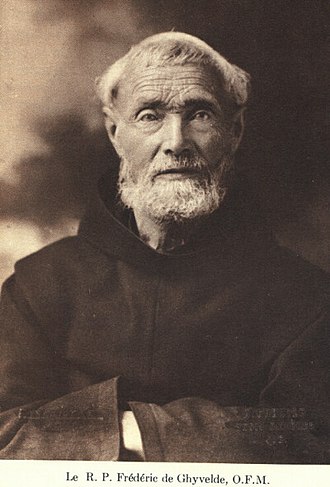
Blessed Frederick Jansoone: The Guardian of Notre Dame du Cap
Blessed Frédéric Janssoone, O.F.M. (1838 – 1916) hailed from France, from the town of Ghyvelde, in the northwest most corner, where the language was Flemish, and not French. After a difficult and impoverished, but holy and pious, upbringing, he joined the Friars Minor, spending his years of priestly ministry as custos of the sacred sites of the Holy Land, a spiritual ministry given to the Franciscans since the Middle Ages.
In 1881, he came to Canada, to the shores of the Saint Lawrence in Quebec, but got into a bit of hot water when in a sermon he commented on liberalism, and church-state relations, a hot topic in Quebec at the time, and now. Besides that, he was a popular preacher, even if he went back to Palestine in 1882.
Canada still beckoned, and Father Janssoone returned in 1888, spending the last three decades of his life here, preaching, converting, raising funds, writing. His home base was the shrine of Notre-Dame-du-Cap, outside Trois-Rivières. He was asked to use his many gifts to revivify the shrine. It was also he who brought the Friars Minor, the reformed Franciscans, back to this country, after the early Recollets had been forbidden to take new novices.
It was at this shrine in 1879 that the miracle of the ‘ice bridge’ occurred. The people had been given permission to build a new church at the shrine, but they had to transport the materials across the Saint Lawrence, a mile-and-a-half wide. That year, however, the river didn’t freeze, part of that phenomenon of pre-industrial global warming, one might suppose. The people prayed the Rosary and sought Our Lady’s help for the river to freeze. Lo and behold, on the very solemnity of Saint Joseph, March 19th, a bridge of ice formed across the river, wide and solid enough to transport all the materials, with open water on either side, evocative of the parting of the Red Sea. I always thought it would take some courage to walk through with those Israelites, with walls on water on either side. I think the same thing about taking a full-loaded horse and wagon across that ice bridge. But those habitants, they were brave men. The miraculous bridge lasted until the Annunciation, March 25th, just long enough to get everything across. The church was duly built, and still stands.
Soon enough, miracles abounded, including the statue of Our Lady of the Cape – a copy of how the Mother of God was said to have appeared to Catherine Labouré in Paris in 1830 – when, on June 22, 1888, soon after Father Janssoone’s second arrival here, on the inauguration day of the shrine, he was in the chapel with two others, a fellow Franciscan and a parishioner. To their surprise, the statue’s face became life-like, and Our Lady opened her eyes for five to ten minutes and looking around. They wandered to and fro, to see if they were seeing an optical illusion of some sort. But, as far as they could tell, it was real.
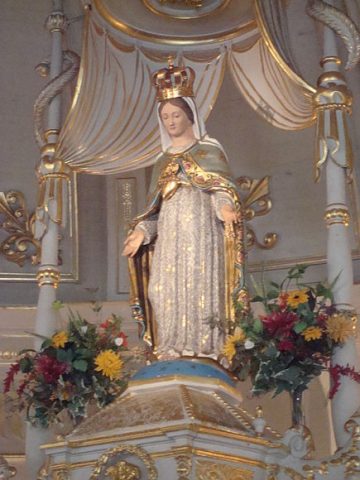
It seems a fitting miracle, for from what few photographs we have of Father Janssoone, he has quite intense eyes, which seem almost to see ‘through’ you, as do most pictures of saints in the modern era, for whom we have such images. I’d imagine Our Lady’s eyes were the same, along with every saint would have that effect, as they see beyond this passing world, far more than we ordinary folk, and the transcendent, heavenly realm is mirrored to us back through them.
The long and fruitful apostolic life of Father Janssoone ended on the 4th of August, 1916, after a pain-stricken battle with stomach cancer. He was beatified by Pope John Paul II on October 25th, 1988, and this great and noble Franciscan now intercedes for this, his adopted, and now beleaguered, dominion. We sure could use his prayers, and why not add our own, with a pilgrimage to Notre Dame, as a few of us did just recently, praying at the statue of the Lady who also seems to be watching over us.

Carney’s Amoral Majority
After five defections – euphemistically described as ‘crossing the floor’ – and three by-elections, Mark Carney and his Liberals how have their coveted majority. One wonders what bowls of pottage were offered in back-room deals. In the archaic monarchical system that is the Dominion of Canada, this majority allows the newly-minted Prime Minister to rule[…]Continue reading→

Saint Kateri , Canada’s Protectress
This was the title given to Saint Kateri Tekakwitha, by Pope Benedict XVI, when he canonized her on October 28th, 2012, along with six others, in Saint Peter’ Square (she had been beatified by Pope John Paul II back in 1980). With Saint Joseph as our protector, along with the Canadian martyrs, we seem to[…]Continue reading→

A Tale of Two Benedicts
A grace-filled Holy Week to all our readers! As we await and prepare for the Resurrection about to dawn upon us, we might keep in mind two Benedicts: Pope Emeritus Benedict XVI, requiescat in pace, elected on this day in 2005; and today’s commemoration of the mystic pilgrim, Benedict Joseph Labre, who died on this[…]Continue reading→

My Name is Bernadette
April 16th is a propitious day, for besides the anniversary of Father de Valk’s death, who founded Catholic Insight in its print form decades ago, and the commemoration of the ‘two Benedicts’, mentioned in accompanying posts, today we also recall Saint Bernadette Soubirous, the young visionary to whom the Virgin Mary appeared numerous times at[…]Continue reading→

Saint Lydwina of Schiedam and Suffering Joyfully
Saint Lydwina of Schiedam (1380 – 1433) was one of the countless and glorious ‘victim souls’ in the history of the Church, those whose lives are filled with suffering, often of an unimaginable intensity, but who suffer joyfully. She was a fifteen-year old Dutch girl, out skating one day, when she fell and broke one[…]Continue reading→

The Glorious Martyrdoms of Martin and Maximus
As we enter into Eastertide, we recall on this 13th of April Pope Saint Martin I (+655), one of the noblest, if most tragic, of the successors of Saint Peter. Born in Umbria, Italy, he was of noble lineage, with great intelligence combined with charity and love of the poor and the Church. While still[…]Continue reading→

Canonizing Sister Faustina and Divine Mercy
HOMILY OF THE HOLY FATHER MASS IN ST PETER’S SQUARE FOR THE CANONIZATION OF SR MARY FAUSTINA KOWALSKA Sunday, 30 April 2000 1. “Confitemini Domino quoniam bonus, quoniam in saeculum misericordia eius”; “Give thanks to the Lord for he is good; his steadfast love endures for ever” (Ps 118: 1). So the Church sings on the Octave of[…]Continue reading→

Saint Stanislaus of Szczepanów
We celebrate Saint Stanislaus today (+ April 11, 1079), in light of this Easter Octave, a bishop and martyr who accepted the episcopacy only at the direct order of Pope Alexander II. He proved a wise and courageous leader of his flock, put to death by his own king, Boleslaus, for rebuking the monarch’s ‘immoral[…]Continue reading→

Saint Gemma Galgani
On this April 11th, in 1903 – the same year that the Italian Guiseppe Sarto was elected Pope later that summer as Pius X – a lovely, young Italian woman died, by the name of Gemma Galgani. She lived a brief life of 24 years, as did a number of other young saints, including Pier[…]Continue reading→
An Ideological and Improper Translation
I noticed something odd with the psalm reading at Mass the other day. Our bishops’ conference here in Canada has decreed that the Mass in English – Novus Ordo – use the ‘NRSV’, the ‘New Revised Standard Version’, an ‘updated’ translation of the original RSV, first published in 1952. This ‘new translation’ has the tendency[…]Continue reading→