
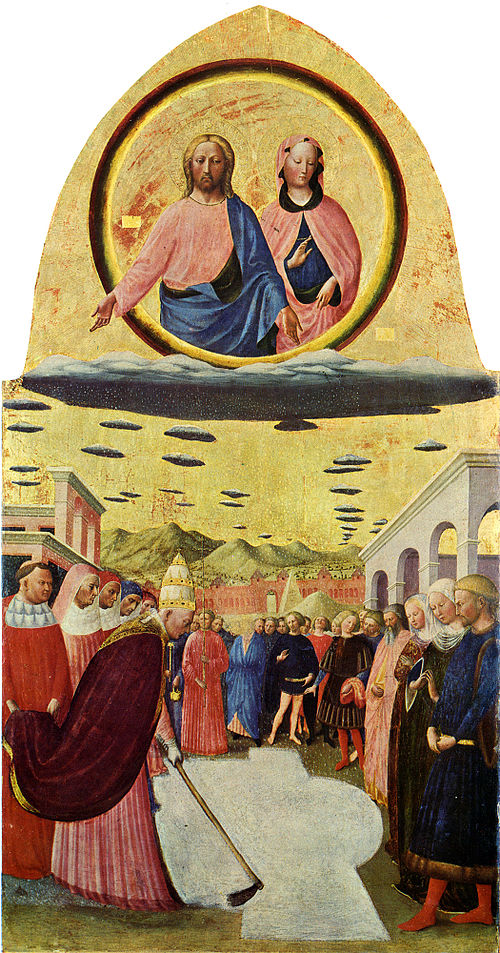
Dedication of Santa Maria Maggiore and Our Lady of the Snows
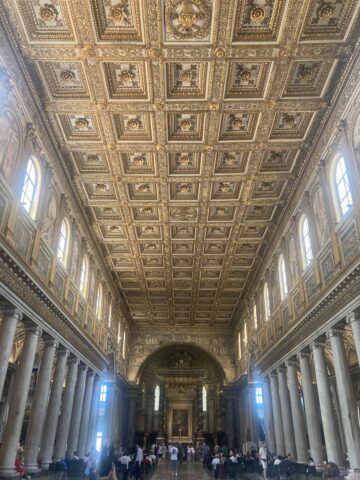
On August 5th, we celebrate the dedication of the Basilica of Santa Maria Maggiore, the highest church in the hierarchy of churches dedicated to Our Lady in all of Christendom. The glorious edifice sits atop the Esquiline Hill, beside the palace of Victor Emmanuel II, just outside the Vatican City State, itself established on February 11th, 1929, providentially the feast of Our Lady of Lourdes, under Benito Mussolini. Even so, the church and its land are owned by the Church, and under her authority.
This memorial is also called Dedicatio Sanctae Mariae ad Nives ‘the Dedication of Our Lady of the Snows’, since legend goes as follows, from the Catholic Encyclopedia:
During the pontificate of Liberius, the Roman patrician John and his wife, who were without heirs, made a vow to donate their possessions to the Virgin Mary. They prayed that she might make known to them how they were to dispose of their property in her honour. On 5 August, at the height of the Roman summer, snow fell during the night on the summit of the Esquiline Hill. In obedience to a vision of the Virgin Mary that they had the same night, the couple built a basilica in honour of Mary on the very spot that was covered with snow.
Like most legends, there may be some truth to this, even if the first reference to the purported miracle was only centuries post hoc. If anyone knows anything about August in Rome, it is brutally hot, and a snowfall would be like hell freezing over (even if Dante does make his inferno cold as ice). Then again, years ago, at WYD 2008, I was wandering through Sydney, Australia, and discovered, on an elevated spot in the middle of the city, a plaque commemorating the one and only snowfall in the city’s history. So far, no church has been built on the spot, but one never knows what the future holds.
Whatever the historical veracity, what is true is that the basilica was completed under Pope Sixtus III just after the Council of Ephesus in 431, and consecrated August 5th, 434. This was to commemorate the Council’s declaration of Our Lady as truly Theotokos, the ‘Mother of God’, against the heresy of Nestorius, who denied this truth, calling Mary only Christotokos – mother of the ‘human person’ of Christ. The Church taught clearly and definitively that Christ is one divine Person, existing in two natures, and it is to that divine Person, the Second of the Trinity, that Our Lady gave birth, in the human nature He had assumed. The world, and our own human nature, would never be the same.
The glorious basilica, an architectural and liturgical marvel, still has its original structure, and within, one may immerse oneself in the beauty of the mosaics, architecture and artwork, along with any number of relics, including most of the original ‘manger’ where the Saviour was born.
Santa Maria Maggiore stands as a testament to Our Lady’s holiness and her unique place is salvation. To conclude with stirring words from Saint Cyril of Alexandria, one of the great champions of Mary’s divine motherhood:
Carney’s Amoral Majority
After five defections – euphemistically described as ‘crossing the floor’ – and three by-elections, Mark Carney and his Liberals how have their coveted majority. One wonders what bowls of pottage were offered in back-room deals. In the archaic monarchical system that is the Dominion of Canada, this majority allows the newly-minted Prime Minister to rule[…]Continue reading→

Saint Kateri , Canada’s Protectress
This was the title given to Saint Kateri Tekakwitha, by Pope Benedict XVI, when he canonized her on October 28th, 2012, along with six others, in Saint Peter’ Square (she had been beatified by Pope John Paul II back in 1980). With Saint Joseph as our protector, along with the Canadian martyrs, we seem to[…]Continue reading→

A Tale of Two Benedicts
A grace-filled Holy Week to all our readers! As we await and prepare for the Resurrection about to dawn upon us, we might keep in mind two Benedicts: Pope Emeritus Benedict XVI, requiescat in pace, elected on this day in 2005; and today’s commemoration of the mystic pilgrim, Benedict Joseph Labre, who died on this[…]Continue reading→

My Name is Bernadette
April 16th is a propitious day, for besides the anniversary of Father de Valk’s death, who founded Catholic Insight in its print form decades ago, and the commemoration of the ‘two Benedicts’, mentioned in accompanying posts, today we also recall Saint Bernadette Soubirous, the young visionary to whom the Virgin Mary appeared numerous times at[…]Continue reading→

Saint Lydwina of Schiedam and Suffering Joyfully
Saint Lydwina of Schiedam (1380 – 1433) was one of the countless and glorious ‘victim souls’ in the history of the Church, those whose lives are filled with suffering, often of an unimaginable intensity, but who suffer joyfully. She was a fifteen-year old Dutch girl, out skating one day, when she fell and broke one[…]Continue reading→

The Glorious Martyrdoms of Martin and Maximus
As we enter into Eastertide, we recall on this 13th of April Pope Saint Martin I (+655), one of the noblest, if most tragic, of the successors of Saint Peter. Born in Umbria, Italy, he was of noble lineage, with great intelligence combined with charity and love of the poor and the Church. While still[…]Continue reading→

Canonizing Sister Faustina and Divine Mercy
HOMILY OF THE HOLY FATHER MASS IN ST PETER’S SQUARE FOR THE CANONIZATION OF SR MARY FAUSTINA KOWALSKA Sunday, 30 April 2000 1. “Confitemini Domino quoniam bonus, quoniam in saeculum misericordia eius”; “Give thanks to the Lord for he is good; his steadfast love endures for ever” (Ps 118: 1). So the Church sings on the Octave of[…]Continue reading→

Saint Stanislaus of Szczepanów
We celebrate Saint Stanislaus today (+ April 11, 1079), in light of this Easter Octave, a bishop and martyr who accepted the episcopacy only at the direct order of Pope Alexander II. He proved a wise and courageous leader of his flock, put to death by his own king, Boleslaus, for rebuking the monarch’s ‘immoral[…]Continue reading→
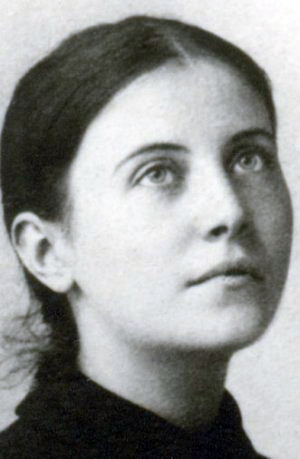
Saint Gemma Galgani
On this April 11th, in 1903 – the same year that the Italian Guiseppe Sarto was elected Pope later that summer as Pius X – a lovely, young Italian woman died, by the name of Gemma Galgani. She lived a brief life of 24 years, as did a number of other young saints, including Pier[…]Continue reading→
An Ideological and Improper Translation
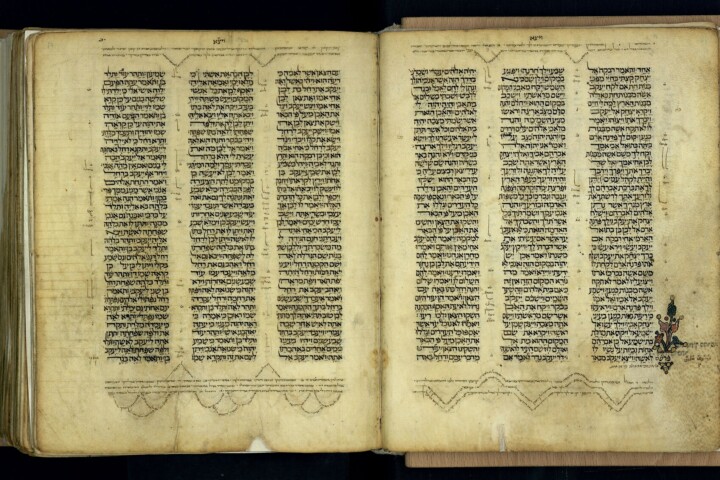
I noticed something odd with the psalm reading at Mass the other day. Our bishops’ conference here in Canada has decreed that the Mass in English – Novus Ordo – use the ‘NRSV’, the ‘New Revised Standard Version’, an ‘updated’ translation of the original RSV, first published in 1952. This ‘new translation’ has the tendency[…]Continue reading→