
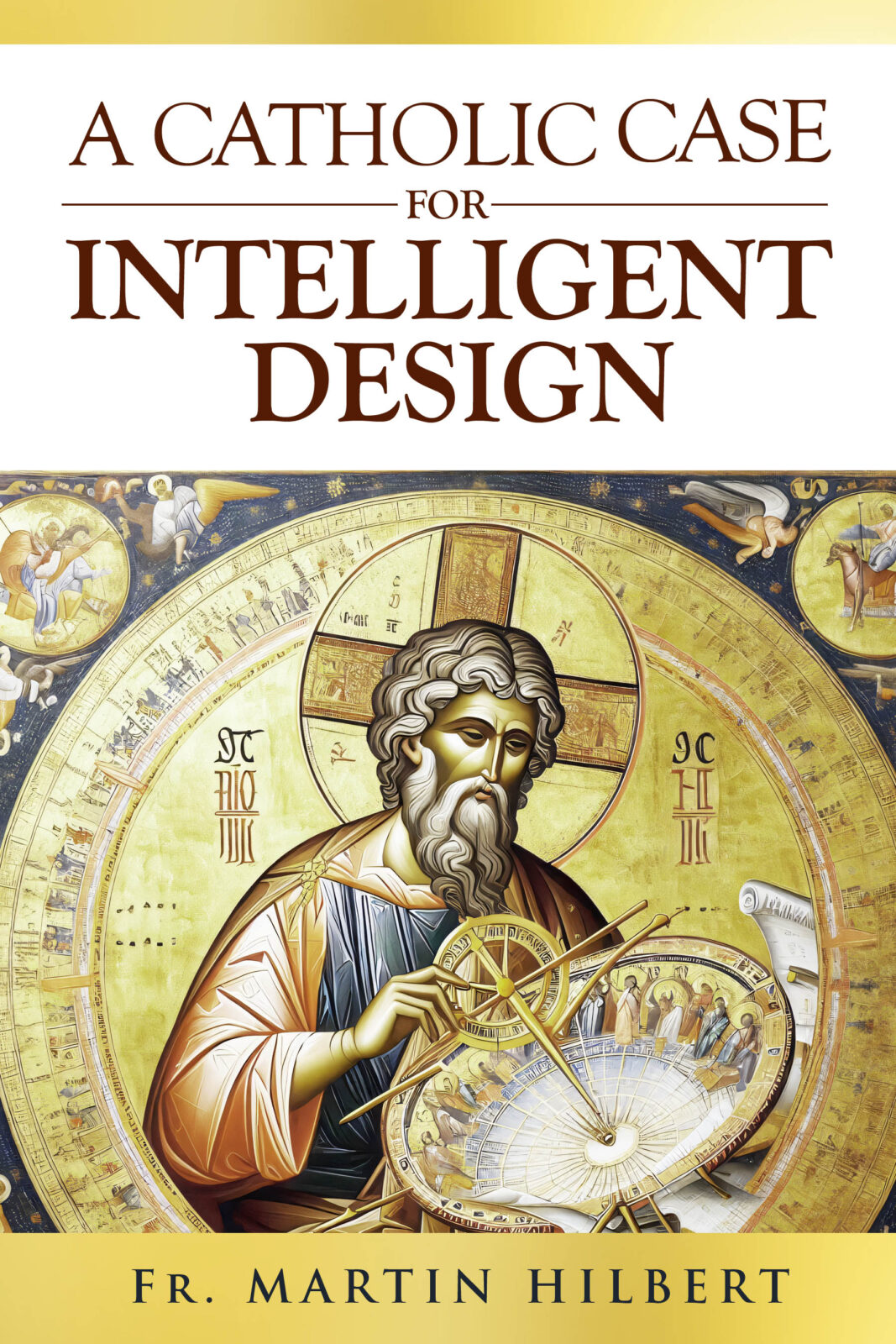
The Catholic Case for Intelligent Design
Father Martin Hilbert, C.O. has written a remarkable book. His ‘The Catholic Case for Intelligent Design’, an argument for seeing God’s handiwork and providence in the order and beauty of creation, covers a lot of ground: evolution, genetics, anthropology, and, of course, philosophy and theology.
The overarching purpose of the book is to ally faith with reason, which is to say, to align what the Church has definitively taught, with what science has demonstrated, or at least claimed to do so. By ‘science’ here, we mean empirical science, an investigation of the world by the testing of hypotheses.
Of all the many books I have read on this theme, Father Hilbert’s is the boldest in confronting head-on some of the more controverted and controversial doctrines of our Faith, and their implications. There is Man’s unique place in creation, with a soul made in God’s image. There is also the doctrine of monogenesis – that we are all descended one from one Adam and one Eve, some of the implications of which have been muted in recent papal teaching. As well, Father Hilbert faces the evidence for (alleged) millions of years of human existence, and our – again alleged – evolution from more primitive hominids, who may, or may not, have been ‘human’. He makes a strong case against materialistic and atheistic Darwinism, and for the literal truth of creation.
But Father Hilbert also warns against too mystical and spiritual an interpretation, in the line of the Jesuit anthropologist Pierre Teilhard de Chardin, whose work is critiqued with precision.
As the Catechism says, God created everything for man, and Father Hilbert’s purpose is to remind us of that. Some Catholics demur from the notion of ‘intelligent design’, seeing therein a return to the ‘God of the gaps’, invoking some Deus ex machina to explain natural phenomena, a Malebranchian occasionalism which, as Father Stanley Jaki warned would mean the death of science as we know it.
Father Hilbert confronts this objection, that ‘the universe is permeated by gaps…by God’s design’, including the creation of human souls, free will, miracles. As Father puts it, science cannot ‘account for every aspect of reality’. On the contrary, the very revelation that God ‘has arranged all things by measure and number and weight’ has given us the very motive of scientific inquiry into those laws God has inscribed in creation. The Book of Wisdom goes on to say, ‘from the greatness and beauty of created things, comes a corresponding perception of their Creator’.
To deny the Creator leads to many blind alleys. As one cosmologist phrased it back in a 1985 interview, ‘it may be a very long time, if ever, before we can answer the question that everyone would like to know – the question of what caused creation’.
Hmm. What ‘caused creation’ is not a scientific question, but a metaphysical and religious one. True enough, science seeks cause and effect, and that there is a consistency to such in science is itself a quasi-miracle,. As Einstein put it, ‘the most incomprehensible thing about the universe is the fact that it is comprehensible’. And in his own pursuit of understanding the cosmos, he said I want to know God’s thoughts – the rest are mere details.
All of this points to evidence of some sort of ‘intelligent design’, God writing His laws into the very structure of His creation. Science brings us to the very limit of what may be understood by our limited minds, all that which is ‘comprehensible’. A worthy endeavour indeed, and one will learn much from a perusal of Father Hilbert’s magnum opus.
Father Hilbert shows himself a very competent scientist, with graduate degrees in engineering and in the history and philosophy of science. His book – the fruit of a lifetime of study and prayer and pondering – offers a very worthy and valuable resource on the harmony of science and revelation. As Pope John Paul II said in the opening lines of his encyclical on this theme, that faith and reason are like two wings on which the human spirit rises to the contemplation of truth. They are never contradictory, only complementary, each fulfilling the other, as we journey towards the fullness of truth, to which God calls us all.
- Publisher: Discovery Institute Press
- Published: November 25, 2024
- ISBN: 978-1637120712
- Pages: 346
Born in Prague, Czechoslovakia, Martin Hilbert migrated to Canada as a child, after the Soviet invasion. He has an MASc in electrical engineering and a PhD in the history and philosophy of science from the University of Toronto. Hilbert studied for the priesthood at St. Philip’s Seminary, where he now teaches a course in the philosophy of science. He is a priest of the Oratory of St. Philip Neri in Toronto.

Carney’s Amoral Majority
After five defections – euphemistically described as ‘crossing the floor’ – and three by-elections, Mark Carney and his Liberals how have their coveted majority. One wonders what bowls of pottage were offered in back-room deals. In the archaic monarchical system that is the Dominion of Canada, this majority allows the newly-minted Prime Minister to rule[…]Continue reading→

Saint Kateri , Canada’s Protectress
This was the title given to Saint Kateri Tekakwitha, by Pope Benedict XVI, when he canonized her on October 28th, 2012, along with six others, in Saint Peter’ Square (she had been beatified by Pope John Paul II back in 1980). With Saint Joseph as our protector, along with the Canadian martyrs, we seem to[…]Continue reading→

A Tale of Two Benedicts
A grace-filled Holy Week to all our readers! As we await and prepare for the Resurrection about to dawn upon us, we might keep in mind two Benedicts: Pope Emeritus Benedict XVI, requiescat in pace, elected on this day in 2005; and today’s commemoration of the mystic pilgrim, Benedict Joseph Labre, who died on this[…]Continue reading→

My Name is Bernadette
April 16th is a propitious day, for besides the anniversary of Father de Valk’s death, who founded Catholic Insight in its print form decades ago, and the commemoration of the ‘two Benedicts’, mentioned in accompanying posts, today we also recall Saint Bernadette Soubirous, the young visionary to whom the Virgin Mary appeared numerous times at[…]Continue reading→

Saint Lydwina of Schiedam and Suffering Joyfully
Saint Lydwina of Schiedam (1380 – 1433) was one of the countless and glorious ‘victim souls’ in the history of the Church, those whose lives are filled with suffering, often of an unimaginable intensity, but who suffer joyfully. She was a fifteen-year old Dutch girl, out skating one day, when she fell and broke one[…]Continue reading→

The Glorious Martyrdoms of Martin and Maximus
As we enter into Eastertide, we recall on this 13th of April Pope Saint Martin I (+655), one of the noblest, if most tragic, of the successors of Saint Peter. Born in Umbria, Italy, he was of noble lineage, with great intelligence combined with charity and love of the poor and the Church. While still[…]Continue reading→

Saint Stanislaus of Szczepanów
We celebrate Saint Stanislaus today (+ April 11, 1079), in light of this Easter Octave, a bishop and martyr who accepted the episcopacy only at the direct order of Pope Alexander II. He proved a wise and courageous leader of his flock, put to death by his own king, Boleslaus, for rebuking the monarch’s ‘immoral[…]Continue reading→

Saint Gemma Galgani
On this April 11th, in 1903 – the same year that the Italian Guiseppe Sarto was elected Pope later that summer as Pius X – a lovely, young Italian woman died, by the name of Gemma Galgani. She lived a brief life of 24 years, as did a number of other young saints, including Pier[…]Continue reading→

An Ideological and Improper Translation
I noticed something odd with the psalm reading at Mass the other day. Our bishops’ conference here in Canada has decreed that the Mass in English – Novus Ordo – use the ‘NRSV’, the ‘New Revised Standard Version’, an ‘updated’ translation of the original RSV, first published in 1952. This ‘new translation’ has the tendency[…]Continue reading→
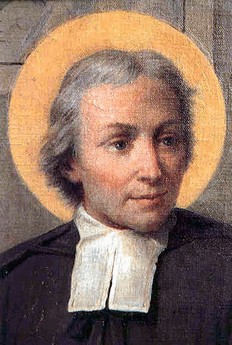
Saint Jean-Baptiste de la Salle: A Teacher for Teachers
Jean-Baptiste de la Salle (1651 – 1719), a French nobleman, ordained a priest, founded the first order in the Church’s history entirely without priests, and this came about almost by accident. I say ‘almost’, for, of course, there are no accidents with God. Destined for ordination from an early age, Jean-Baptiste never looked back, even[…]Continue reading→