
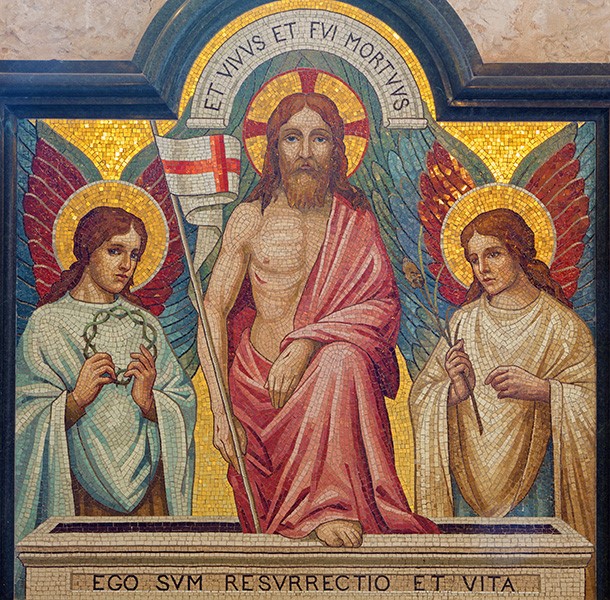
Is the Resurrection Believable?
(As a pre-Lenten meditation on this Eighth Sunday, here is an apologia from Carl Sundell on the truth of the Resurrection of Our Lord and Saviour, Jesus Christ. After all, as Saint Paul himself alludes, the purpose of all our striving – all our prayers, works, joys and sacrifices, all of what we do and give up during this pilgrimage of penance – are so that we may prepare ourselves t participate in Christ’s own Rising in Easter glory. And before the word of praise becomes proscribed during the next forty days, we can say ‘alleluia’ to that). Editor
The superlative sign of an authentic biography of a man is that it rings both true and believable. But if we are looking at the biography of a God-Man, it should ring hugely true and hugely believable.
First, how true could it be? The first thing to settle is whether you can believe the people who reported the Resurrection of Jesus. That is the single event in the life and death of Jesus Christ that is likely to put off people who have been first introduced to him not as a God-Man, but only as a historical figure. If this litmus test of the truthfulness of Christ as God can prevail, all the other Gospel difficulties of truthfulness pale by comparison. Did the Resurrection happen, or was it the boldest of lies? How is it that so many who saw Jesus die and saw him risen from the dead could have been believed if it was a widespread conspiracy of the boldest liars in the world?
The argument rests upon several eyewitness accounts of the Resurrection. These witnesses were commonly talked about in the epistles of Paul and others long before the Gospels were written. Why should these eyewitnesses lie? What did they stand to gain by lying? Most of them stood to gain persecution or martyrdom, first by the Jews immediately after the resurrection; but more especially by the Romans, since the Gospels, having been written after Peter and Paul were martyred in Rome, did present a real threat to the ancient gods of the Empire.
Did those who discovered the empty tomb stand to gain money, the only possible motive to lie? There is no proof anywhere that a great deal of money was made off the so-called hoax of a godlike man being resurrected from the dead. Again, the preachers of the Good News suffered many hardships of hunger, torture, and imprisonment. So the story of the Resurrection that spread rapidly throughout Israel should not be confused with miracle-feats done 2,000 years later by, for example, money-grabbing miracle hucksters in the deep south of the U.S.A.
Naturally, anyone who does not believe in God is not going to believe that miracles can be true. So the Resurrection story is not intended to persuade atheists. Anybody with an open mind to the existence of God has to open that mind wide enough to allow the possibility of miracles. So now we ask whether the Resurrection is credible.
If we believe in God, and if we are looking for a God that we think would care enough about us to come and live among us, and die among us, and rise from the dead and show himself to us so that we could be fortified with hope in our own resurrection, this seems to be the only God in human history who has managed to be so credible a God. It is easy to question whether any of the imagined gods in history who had never done any such wonderful things deserves to be ranked as so credible a God.
This question of credibility does not end with the Resurrection account. Other aspects of the life of Jesus make him increasingly believable as a God-Man. The way he taught, for example, was divinely simple, direct, and truthful, so that all mankind could understand him.
He did not have to write learned tomes. He did not put anyone’s head in a spin, as Socrates did. Rather, he chose to put everyone’s heart, if they really have one, in a spin. He condensed the whole of the Torah in one sentence: “Love God and one another.” He summed up all morality in another sentence: “Do unto others as you would have them do unto you.” He prophesied things that came true, from the fall of Jerusalem to the rise of his universal (catholic) and apostolic Church. He hinted that wolves would fall in among his sheep; did he not know that Judas had already fallen in among the apostles? He made himself the most durably lovable God-Man in the history of the world. If anyone could rise from the dead as proof of his divinity, who else would that be other than Jesus Christ?
If this self-proclaimed Son of God was not both truthful and credible, who is?
Long before the gospels were written we have St. Paul’s eloquent testimony (Corinthians: 15) that Jesus was crucified, buried, and rose from the dead; and that if this is not true, then Christianity is false. But Paul, a Jew, had originally believed that it was indeed false, and that the disciples of Jesus had stolen his body from the tomb. We know from his own mouth that he had offered himself as one to help in the destruction of this blasphemous new sect. But God put him through the crucible of conversion by showing him how genuinely serene St. Stephen was as they stoned him to death. One does not gladly die for a lie, Paul must have thought.
Then Paul is struck blind on the way to Damascus in search of Christians to persecute, and it is only by the kindness of Ananais, a Christian, that the spirit of love overcomes in Paul the the spirit of hate. Had the gospels never been written, Paul would have preserved in I Corinthians the Christian belief that the most extraordinary miracle of all, Jesus rising from the dead, had become the bedrock and most believable doctrine of Christianity.
Paul had been a warrior for the heretic-hunting Jews. But God made his soul great when by amazing grace Paul chose to be a champion and martyr for the the risen Messiah.
Deo gratias!

Saint Kateri , Canada’s Protectress
This was the title given to Saint Kateri Tekakwitha, by Pope Benedict XVI, when he canonized her on October 28th, 2012, along with six others, in Saint Peter’ Square (she had been beatified by Pope John Paul II back in 1980). With Saint Joseph as our protector, along with the Canadian martyrs, we seem to[…]Continue reading→

Remembering Father Alphonse de Valk
(Today marks the sixth anniversary of the death of Father Alphonse de Valk, C.S.B., a faithful, courageous and indefatigable Basilian priest, pro-life-and-family apostle, and the founder of Catholic Insight magazine. Here is what we wrote those on his entering into eternity five years ago, as we continue to remember him in our prayers and thoughts)[…]Continue reading→

My Name is Bernadette
April 16th is a propitious day, for besides the anniversary of Father de Valk’s death, who founded Catholic Insight in its print form decades ago, and the commemoration of the ‘two Benedicts’, mentioned in accompanying posts, today we also recall Saint Bernadette Soubirous, the young visionary to whom the Virgin Mary appeared numerous times at[…]Continue reading→

Canonizing Sister Faustina and Divine Mercy
HOMILY OF THE HOLY FATHER MASS IN ST PETER’S SQUARE FOR THE CANONIZATION OF SR MARY FAUSTINA KOWALSKA Sunday, 30 April 2000 1. “Confitemini Domino quoniam bonus, quoniam in saeculum misericordia eius”; “Give thanks to the Lord for he is good; his steadfast love endures for ever” (Ps 118: 1). So the Church sings on the Octave of[…]Continue reading→

Divine Mercy Sunday – An Echo of Every Mass
Reach out your hand and put it in my side. Do not doubt but believe’… ‘My Lord and my God!’ (Jn. 20:18)). Today is Divine Mercy Sunday, and as we celebrate the end of the Easter Octave, we contemplate the wounded side of our Saviour, the Church’s source of life. On Good Friday in the[…]Continue reading→

First Holy Communion: Sermon from May 16, 1943
Here is a sermon from the good old days by +Rev. Msgr. Vincent Nicholas Foy (August 14, 1915 – March 13, 2017), from 1943. Readers may recall that Pope Saint Pius X, by the decree Quam Singulari in 1910, lowered the customary age of reception of Holy Communion – after the rigours of the plague[…]Continue reading→
In the Glorious Light of Easter, Alleluia!
Set your minds on things that are above, not on things that are on earth, for you have died, and your life is hidden with Christ in God. When Christ who is your life is revealed, then you also will be revealed with him in glory (Col. 3:3-4). The Resurrection of Our Lord and Saviour[…]Continue reading→
An Ancient Homily for Holy Saturday
The time between Good Friday and Easter Sunday is one of waiting, in silence, as the world wonders – anticipates – what will happen, after the death of Christ. We re-live this time each year in the anamnesis of our liturgy, and in turn look forward to the glorious re-creation of all things at the[…]Continue reading→
Europe’s Long Descent
(As we meditate on this day on Christ’s burial, and His descent into hell, it is fitting to ponder here with contributor Peter Marcus how the world seems to be heading there as well. The difference is that, although God cannot ‘redeem’ hell, nor those therein, He can and did redeem the world. There is[…]Continue reading→
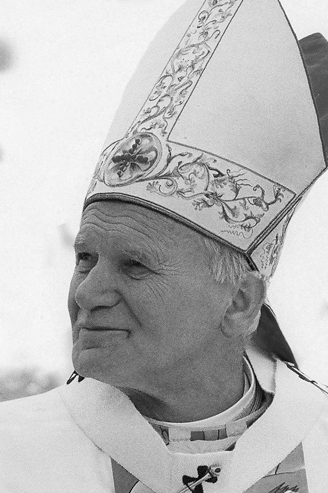
Pope Saint John Paul II’s First Good Friday Homily
ADDRESS OF HIS HOLINESS JOHN PAUL II AT THE CONCLUSION OF THE STATIONS OF THE CROSS AT THE COLOSSEUM Good Friday, 13 April 1979 When we make the Way of the Cross from one station to the next, in spirit we are always at the spot wherethis journey had its “historical” place: where it[…]Continue reading→