
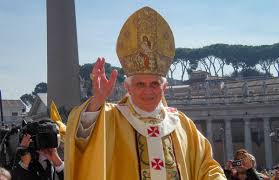
Pope Benedict and Saint Eusebius of Vercelli
This morning I invite you to reflect on St Eusebius of Vercelli, the first Bishop of Northern Italy of whom we have reliable information. Born in Sardinia at the beginning of the fourth century, he moved to Rome with his family at a tender age. Later, he was instituted lector: he thus came to belong to the clergy of the city at a time when the Church was seriously troubled by the Arian heresy. The high esteem that developed around Eusebius explains his election in 345 A.D. to the Episcopal See of Vercelli. The new Bishop immediately began an intense process of evangelization in a region that was still largely pagan, especially in rural areas. Inspired by St Athanasius – who had written the Life of St Anthony, the father of monasticism in the East – he founded a priestly community in Vercelli that resembled a monastic community. This coenobium impressed upon the clergy of Northern Italy a significant hallmark of apostolic holiness and inspired important episcopal figures such as Limenius and Honoratus, successors of Eusebius in Vercelli, Gaudentius in Novara, Exuperantius in Tortona, Eustasius in Aosta, Eulogius in Ivrea and Maximus in Turin, all venerated by the Church as saints.
With his sound formation in the Nicene faith, Eusebius did his utmost to defend the full divinity of Jesus Christ, defined by the Nicene Creed as “of one being with the Father”. To this end, he allied himself with the great Fathers of the fourth century – especially St Athanasius, the standard bearer of Nicene orthodoxy – against the philo-Arian policies of the Emperor. For the Emperor, the simpler Arian faith appeared politically more useful as the ideology of the Empire. For him it was not truth that counted but rather political opportunism: he wanted to exploit religion as the bond of unity for the Empire. But these great Fathers resisted him, defending the truth against political expediency.
(For the rest of Pope Benedict’s address, please see here).

Saint Kateri , Canada’s Protectress
This was the title given to Saint Kateri Tekakwitha, by Pope Benedict XVI, when he canonized her on October 28th, 2012, along with six others, in Saint Peter’ Square (she had been beatified by Pope John Paul II back in 1980). With Saint Joseph as our protector, along with the Canadian martyrs, we seem to[…]Continue reading→

Remembering Father Alphonse de Valk
(Today marks the sixth anniversary of the death of Father Alphonse de Valk, C.S.B., a faithful, courageous and indefatigable Basilian priest, pro-life-and-family apostle, and the founder of Catholic Insight magazine. Here is what we wrote those on his entering into eternity five years ago, as we continue to remember him in our prayers and thoughts)[…]Continue reading→

A Tale of Two Benedicts
A grace-filled Holy Week to all our readers! As we await and prepare for the Resurrection about to dawn upon us, we might keep in mind two Benedicts: Pope Emeritus Benedict XVI, requiescat in pace, elected on this day in 2005; and today’s commemoration of the mystic pilgrim, Benedict Joseph Labre, who died on this[…]Continue reading→

My Name is Bernadette
April 16th is a propitious day, for besides the anniversary of Father de Valk’s death, who founded Catholic Insight in its print form decades ago, and the commemoration of the ‘two Benedicts’, mentioned in accompanying posts, today we also recall Saint Bernadette Soubirous, the young visionary to whom the Virgin Mary appeared numerous times at[…]Continue reading→

Saint Lydwina of Schiedam and Suffering Joyfully
Saint Lydwina of Schiedam (1380 – 1433) was one of the countless and glorious ‘victim souls’ in the history of the Church, those whose lives are filled with suffering, often of an unimaginable intensity, but who suffer joyfully. She was a fifteen-year old Dutch girl, out skating one day, when she fell and broke one[…]Continue reading→

The Glorious Martyrdoms of Martin and Maximus
As we enter into Eastertide, we recall on this 13th of April Pope Saint Martin I (+655), one of the noblest, if most tragic, of the successors of Saint Peter. Born in Umbria, Italy, he was of noble lineage, with great intelligence combined with charity and love of the poor and the Church. While still[…]Continue reading→

Canonizing Sister Faustina and Divine Mercy
HOMILY OF THE HOLY FATHER MASS IN ST PETER’S SQUARE FOR THE CANONIZATION OF SR MARY FAUSTINA KOWALSKA Sunday, 30 April 2000 1. “Confitemini Domino quoniam bonus, quoniam in saeculum misericordia eius”; “Give thanks to the Lord for he is good; his steadfast love endures for ever” (Ps 118: 1). So the Church sings on the Octave of[…]Continue reading→

Divine Mercy Sunday – An Echo of Every Mass
Reach out your hand and put it in my side. Do not doubt but believe’… ‘My Lord and my God!’ (Jn. 20:18)). Today is Divine Mercy Sunday, and as we celebrate the end of the Easter Octave, we contemplate the wounded side of our Saviour, the Church’s source of life. On Good Friday in the[…]Continue reading→

Saint Stanislaus of Szczepanów
We celebrate Saint Stanislaus today (+ April 11, 1079), in light of this Easter Octave, a bishop and martyr who accepted the episcopacy only at the direct order of Pope Alexander II. He proved a wise and courageous leader of his flock, put to death by his own king, Boleslaus, for rebuking the monarch’s ‘immoral[…]Continue reading→
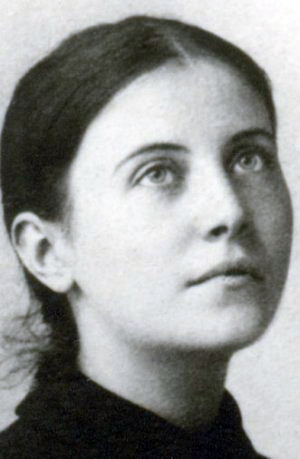
Saint Gemma Galgani
On this April 11th, in 1903 – the same year that the Italian Guiseppe Sarto was elected Pope later that summer as Pius X – a lovely, young Italian woman died, by the name of Gemma Galgani. She lived a brief life of 24 years, as did a number of other young saints, including Pier[…]Continue reading→