
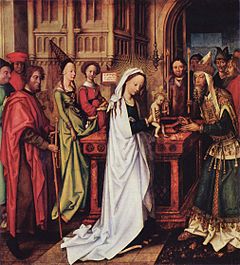
Christ, Consecration and Candlemas
A blessed feast of the Presentation to all our readers, which used to, and still may, be called Candlemas, a celebration of the light that is Christ, now revealed to the world; the Lumen gentium, outside of Whom there is only darkness. In the pre-1969 calendar, this day marks the end of the Christmas season, and the beginning of Christ’s public life, after the forty days ritually required for the Purification of Our Lady – which is another name for this feast.
The Presentation is Christ’s first public appearance, one which would be repeated in a different key twelve years later in the finding in the Temple; then, after eighteen or so years of hidden life in Nazareth, the vivid inauguration of His ministry, after His baptism, followed by the vigorous cleansing of the same Temple.
Pope John Paul II connected this feast particularly with religious vows and consecrated life, by which the soul dedicates itself to God through the three evangelical counsels. We all have some share in these through our Baptismal promises, renewed at Confirmation: We are all called to be witnesses for the Truth, martyrs, in some sense – signs that will be contradicted. As darkness washes over the face of the earth, and the faith retreats like the tide, we must become more intentional in our Faith, as Father Callam reiterates, and cling more closely to Christ, His battered Church, His sacraments, His people, and bring as many as we can through that witness into the fold.
So rejoice that we have such a bulwark of truth against the onslaught of lies; an ark of salvation in the roiling sea of obfuscation and deceit; a light in the darkness. So light some candles today, hopefully blessed, perhaps over dinner, during prayer.
And we cannot neglect music, to bolster our own devotion. I might recommend two cantatas Bach composed for this feast, Mit Fried und Freud ich fahr dahin, ‘With peace and joy I now depart’, originally a hymn by Martin Luther, based on the Nunc Dimittis, the Gospel canticle of Simeon sung at Compline, which Luther would have recited each night in his days as an Augustinian monk. Bach would take such hymns, and harmonize them into complex polyphonies that only his genius could accomplish.
There is also Ich habe genug – I have enough – composed originally by Bach himself, one which seems to have been a favorite of his, and one of the most often performed and recorded of his cantatas in modern times. The opening oboe obbligato is nearly unsurpassed in its melodic expressiveness.
The Lutherans, after their divergence from Catholicism, kept a strong devotion to Our Lady, and Bach himself composed much in honour of the Mother of God (immerse yourself also in his incomparable Magnificat).
Of course, there is much explicitly Catholic music as well – from Palestrina to Vivaldi and Mozart and countless others – but I mention these, perhaps, to show that we, as the ‘universal’ Church, reject nothing that is true, good and beautiful. In light of last week’s week of Christian unity and this feast of Christ’s revelation to all the nations, we should keep in mind that music as one of the most ecumenical of endeavours, a universal language that speaks to the heart.
We might imagine Simeon himself singing his canticle, now made ready to depart in peace to meet his God whom he had served so well. Would that we could all say – or sing – the same when our own final nunc dimmitis draws near.
May the lumen Christi dawn upon the world, and each soul therein. +
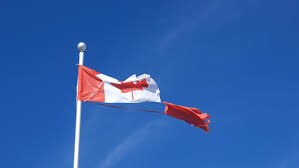
Carney’s Amoral Majority
After five defections – euphemistically described as ‘crossing the floor’ – and three by-elections, Mark Carney and his Liberals how have their coveted majority. One wonders what bowls of pottage were offered in back-room deals. In the archaic monarchical system that is the Dominion of Canada, this majority allows the newly-minted Prime Minister to rule[…]Continue reading→

Saint Kateri , Canada’s Protectress
This was the title given to Saint Kateri Tekakwitha, by Pope Benedict XVI, when he canonized her on October 28th, 2012, along with six others, in Saint Peter’ Square (she had been beatified by Pope John Paul II back in 1980). With Saint Joseph as our protector, along with the Canadian martyrs, we seem to[…]Continue reading→

A Tale of Two Benedicts
A grace-filled Holy Week to all our readers! As we await and prepare for the Resurrection about to dawn upon us, we might keep in mind two Benedicts: Pope Emeritus Benedict XVI, requiescat in pace, elected on this day in 2005; and today’s commemoration of the mystic pilgrim, Benedict Joseph Labre, who died on this[…]Continue reading→

My Name is Bernadette
April 16th is a propitious day, for besides the anniversary of Father de Valk’s death, who founded Catholic Insight in its print form decades ago, and the commemoration of the ‘two Benedicts’, mentioned in accompanying posts, today we also recall Saint Bernadette Soubirous, the young visionary to whom the Virgin Mary appeared numerous times at[…]Continue reading→

Saint Lydwina of Schiedam and Suffering Joyfully
Saint Lydwina of Schiedam (1380 – 1433) was one of the countless and glorious ‘victim souls’ in the history of the Church, those whose lives are filled with suffering, often of an unimaginable intensity, but who suffer joyfully. She was a fifteen-year old Dutch girl, out skating one day, when she fell and broke one[…]Continue reading→

The Glorious Martyrdoms of Martin and Maximus
As we enter into Eastertide, we recall on this 13th of April Pope Saint Martin I (+655), one of the noblest, if most tragic, of the successors of Saint Peter. Born in Umbria, Italy, he was of noble lineage, with great intelligence combined with charity and love of the poor and the Church. While still[…]Continue reading→

Saint Stanislaus of Szczepanów
We celebrate Saint Stanislaus today (+ April 11, 1079), in light of this Easter Octave, a bishop and martyr who accepted the episcopacy only at the direct order of Pope Alexander II. He proved a wise and courageous leader of his flock, put to death by his own king, Boleslaus, for rebuking the monarch’s ‘immoral[…]Continue reading→
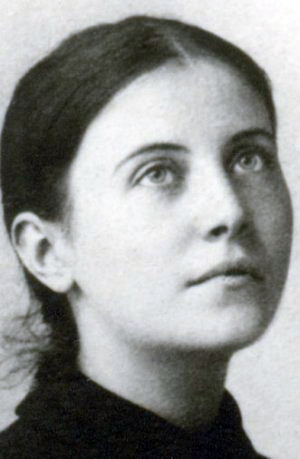
Saint Gemma Galgani
On this April 11th, in 1903 – the same year that the Italian Guiseppe Sarto was elected Pope later that summer as Pius X – a lovely, young Italian woman died, by the name of Gemma Galgani. She lived a brief life of 24 years, as did a number of other young saints, including Pier[…]Continue reading→
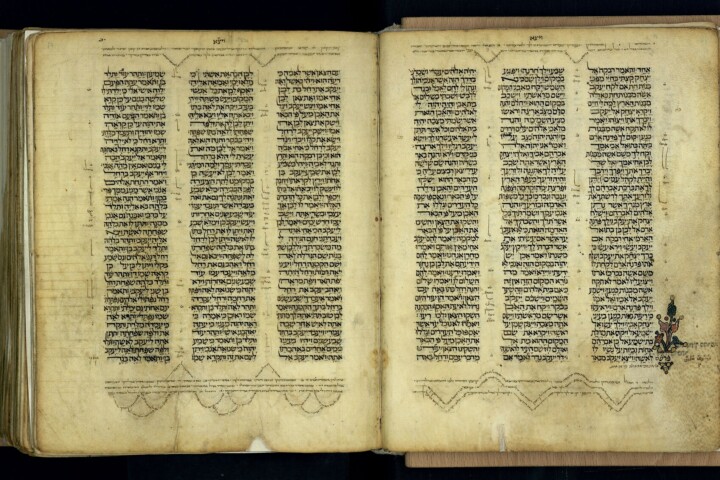
An Ideological and Improper Translation
I noticed something odd with the psalm reading at Mass the other day. Our bishops’ conference here in Canada has decreed that the Mass in English – Novus Ordo – use the ‘NRSV’, the ‘New Revised Standard Version’, an ‘updated’ translation of the original RSV, first published in 1952. This ‘new translation’ has the tendency[…]Continue reading→
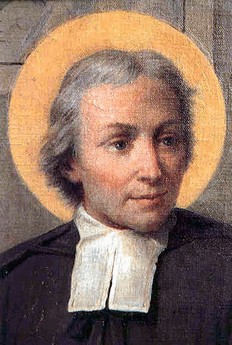
Saint Jean-Baptiste de la Salle: A Teacher for Teachers
Jean-Baptiste de la Salle (1651 – 1719), a French nobleman, ordained a priest, founded the first order in the Church’s history entirely without priests, and this came about almost by accident. I say ‘almost’, for, of course, there are no accidents with God. Destined for ordination from an early age, Jean-Baptiste never looked back, even[…]Continue reading→