
Blackface or Blackheart?
Minstrelsy has a rather long and convoluted history, its origin with a singing group of white men from Virginia – the Virginia Minstrels – who in the innocent days of 1843 decided to darken their faces with cork as they put on a banjo show at New York’s Bowery Amphitheatre, in a fad that in various forms went on well into the twentieth century.
More recently, the tables were turned, as in the Wayans’ brother’s 2004 outing White Chicks, blacks not only played whites – with more advanced technological make-up and latex – but, as the title suggests, white women. The latter premise seems to have fizzled far more quickly, and the film garnered a 15% on Rotten Tomatoes.
Offence and scandal are sensitive things, dependent upon culture, relationship, intention and other mysterious factors. A few years ago at the College where I teach, we put on The Lost Elevator by Percival Wilde, in which the drama takes place in one of those old, crowded elevators – the operator of which was supposed to be in ‘blackface’. We did one performance, and the backlash was swift – from certain members of the wider community who may not have been so strict on other moral values.
The thing is, in the play, besides the attempt at humour, the black-faced character ironically ended up being the wisest member of the group, a resolving deus ex machina, signifying in an ironic way that those formerly discriminated against – people of colour – had gifts that so many failed to realize. The point was lost when the white actor was, well, just white.
There may well be other ways to make such points in our culture than minstrelsy, even of an ironic variety, but we should ponder our priorities.
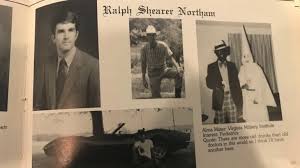
As readers are now all too aware – or is that woke? – Dr. Ralph Northam, current Governor of Virginia, has been vilified a year book photo in which he seems to be dressed as a minstrel; this, he denies, but does has apparently admitted to wearing a bit of blackface – some ‘shoe polish’ rubbed on his cheeks – at some vague point in his life, so that, as he says, he could mimic Michael Jackson doing the moonwalk; I will leave the reader to imagine how much shoe polish was needed for the ever-paler-visaged crooner.
Yet, as readers are also aware, the same Ralph Northam was on record a few days earlier advocating not just late-term abortion, but outright infanticide – all with the macabre and just plain weird air of clinical detachment. Here he is, describing the treatment of babies who survive abortion, or who – we may soon suppose – are deemed just too ‘damaged’ to live:
The infant would be delivered. The infant would be kept comfortable. The infant would be resuscitated if that’s what the mother and the family desired, and then a discussion would ensure between the physician and the mother.
As Father Rutler ominously puts it, Northam prudently did not add what the ‘discussion’ would be about.
The Catechism teaches (par. 1860) that no one is deemed ignorant of the principles of the moral law, to say nothing of the basic tenet of the medical art in which Northam has a degree, to first do no harm. And one might think that harming defenceless children is at a very principled level deeply against the natural law.
Yet things are even worse than I thought, as the academic-media complex ignores the real evil here. Wesley Smythe’s description of the intellectual ‘elite’ justifying the murder of infants is eye-opening even for this inured soul. I had no idea there was such a thing as the Groningen Protocol, listing the requirements – as they euphemistically put it – for ‘euthanasia in newborns’. Read it and weep.
But such clinicians are simply putting into effect the philosophical ethics of tenured Ivy League professors such as Peter Singer, who opines:
When the death of a disabled infant will lead to the birth of another infant with better prospects of a happy life, the total amount of happiness will be greater if the disabled infant is killed. The loss of the happy life for the first infant is outweighed by the gain of a happier life for the second. Therefore, if killing the hemophiliac infant has no adverse effect on others, it would, according to the total view, be right to kill him.
To paraphrase Chesterton, the neo-barbarians will be wearing labcoats and neckties. I know not the guilt of such men as Dr. Northam and his ilk – and we all carry some burden for the culture of death – but whatever one thinks of blackface, it’s nowhere near as bad as a black soul.
Carney’s Amoral Majority
After five defections – euphemistically described as ‘crossing the floor’ – and three by-elections, Mark Carney and his Liberals how have their coveted majority. One wonders what bowls of pottage were offered in back-room deals. In the archaic monarchical system that is the Dominion of Canada, this majority allows the newly-minted Prime Minister to rule[…]Continue reading→

Saint Kateri , Canada’s Protectress
This was the title given to Saint Kateri Tekakwitha, by Pope Benedict XVI, when he canonized her on October 28th, 2012, along with six others, in Saint Peter’ Square (she had been beatified by Pope John Paul II back in 1980). With Saint Joseph as our protector, along with the Canadian martyrs, we seem to[…]Continue reading→

Remembering Father Alphonse de Valk
(Today marks the sixth anniversary of the death of Father Alphonse de Valk, C.S.B., a faithful, courageous and indefatigable Basilian priest, pro-life-and-family apostle, and the founder of Catholic Insight magazine. Here is what we wrote those on his entering into eternity five years ago, as we continue to remember him in our prayers and thoughts)[…]Continue reading→
A Tale of Two Benedicts
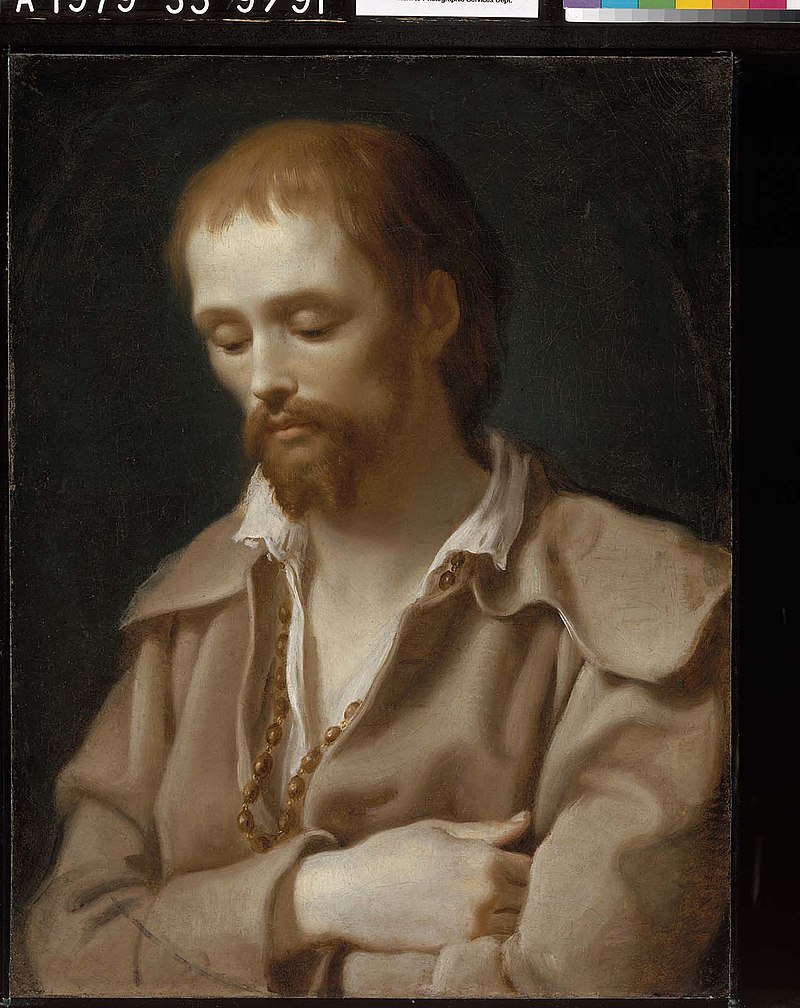
A grace-filled Holy Week to all our readers! As we await and prepare for the Resurrection about to dawn upon us, we might keep in mind two Benedicts: Pope Emeritus Benedict XVI, requiescat in pace, elected on this day in 2005; and today’s commemoration of the mystic pilgrim, Benedict Joseph Labre, who died on this[…]Continue reading→

My Name is Bernadette
April 16th is a propitious day, for besides the anniversary of Father de Valk’s death, who founded Catholic Insight in its print form decades ago, and the commemoration of the ‘two Benedicts’, mentioned in accompanying posts, today we also recall Saint Bernadette Soubirous, the young visionary to whom the Virgin Mary appeared numerous times at[…]Continue reading→
Saint Lydwina of Schiedam and Suffering Joyfully
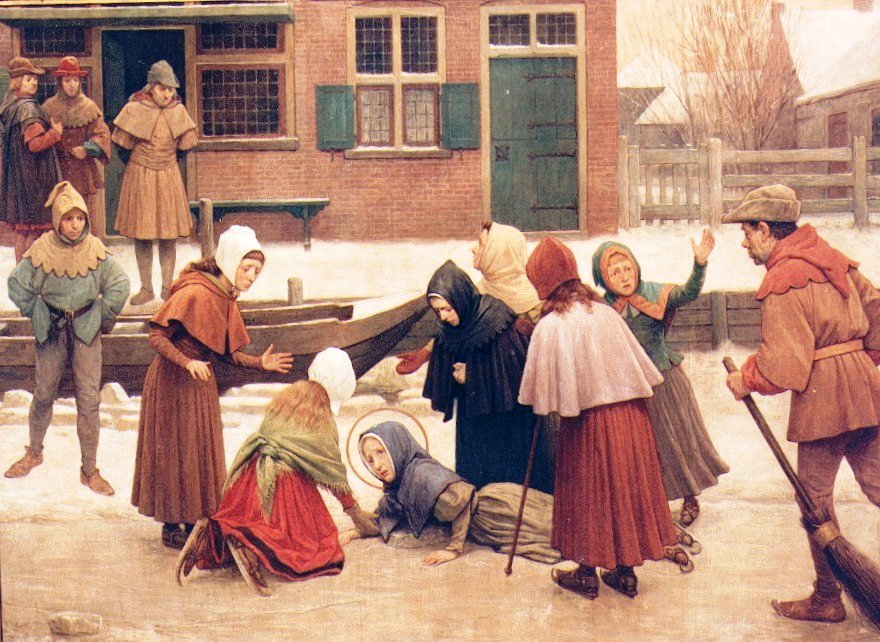
Saint Lydwina of Schiedam (1380 – 1433) was one of the countless and glorious ‘victim souls’ in the history of the Church, those whose lives are filled with suffering, often of an unimaginable intensity, but who suffer joyfully. She was a fifteen-year old Dutch girl, out skating one day, when she fell and broke one[…]Continue reading→
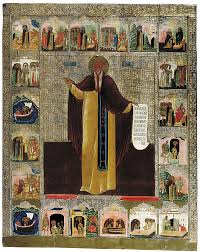
The Glorious Martyrdoms of Martin and Maximus
As we enter into Eastertide, we recall on this 13th of April Pope Saint Martin I (+655), one of the noblest, if most tragic, of the successors of Saint Peter. Born in Umbria, Italy, he was of noble lineage, with great intelligence combined with charity and love of the poor and the Church. While still[…]Continue reading→
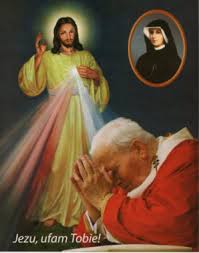
Canonizing Sister Faustina and Divine Mercy
HOMILY OF THE HOLY FATHER MASS IN ST PETER’S SQUARE FOR THE CANONIZATION OF SR MARY FAUSTINA KOWALSKA Sunday, 30 April 2000 1. “Confitemini Domino quoniam bonus, quoniam in saeculum misericordia eius”; “Give thanks to the Lord for he is good; his steadfast love endures for ever” (Ps 118: 1). So the Church sings on the Octave of[…]Continue reading→

Divine Mercy Sunday – An Echo of Every Mass
Reach out your hand and put it in my side. Do not doubt but believe’… ‘My Lord and my God!’ (Jn. 20:18)). Today is Divine Mercy Sunday, and as we celebrate the end of the Easter Octave, we contemplate the wounded side of our Saviour, the Church’s source of life. On Good Friday in the[…]Continue reading→
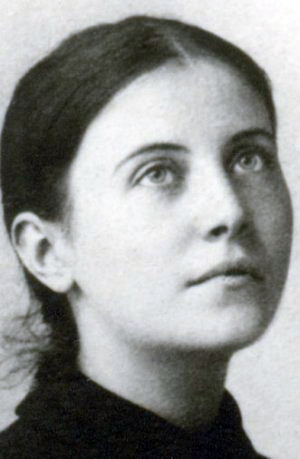
Saint Gemma Galgani
On this April 11th, in 1903 – the same year that the Italian Guiseppe Sarto was elected Pope later that summer as Pius X – a lovely, young Italian woman died, by the name of Gemma Galgani. She lived a brief life of 24 years, as did a number of other young saints, including Pier[…]Continue reading→