
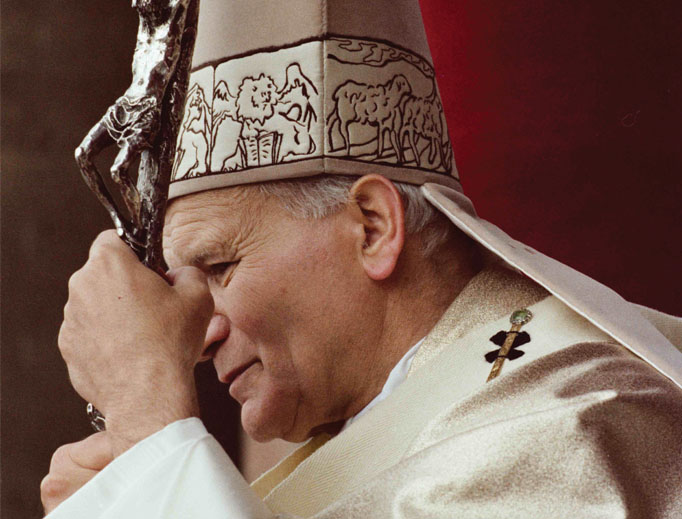
Witnessing to Truth
(In light of today’s feast of the Martyrs of Japan, what follows is a brief excerpt from Pope Saint John Paul II’s masterpiece – and too often neglected – encyclical Veritatis Splendor, the Splendour of Truth, on the principles of the moral life. Here the Holy Father meditates upon, and exalts, martyrdom for the sake of truth. We must all be willing to sacrifice for the truth, especially moral truths, even to the point of shedding our blood, something that may soon – given the direction of things – become all too much a reality. What we get in return is an eternal reward beyond description. As the martyrs exhorted each other, the pain lasts but a moment, but heaven, forever…).
Martyrdom, the exaltation of the inviolable holiness of God’s law
- The relationship between faith and morality shines forth with all its brilliance in the unconditional respect due to the insistent demands of the personal dignity of every man, demands protected by those moral norms which prohibit without exception actions which are intrinsically evil. The universality and the immutability of the moral norm make manifest and at the same time serve to protect the personal dignity and inviolability of man, on whose face is reflected the splendour of God (cf. Gen 9:5-6).
The unacceptability of “teleological”, “consequentialist” and “proportionalist” ethical theories, which deny the existence of negative moral norms regarding specific kinds of behaviour, norms which are valid without exception, is confirmed in a particularly eloquent way by Christian martyrdom, which has always accompanied and continues to accompany the life of the Church even today.
- In the Old Testament we already find admirable witnesses of fidelity to the holy law of God even to the point of a voluntary acceptance of death. A prime example is the story of Susanna: in reply to the two unjust judges who threatened to have her condemned to death if she refused to yield to their sinful passion, she says: “I am hemmed in on every side. For if I do this thing, it is death for me; and if I do not, I shall not escape your hands. I choose not to do it and to fall into your hands, rather than to sin in the sight of the Lord!” (Dan 13:22-23). Susanna, preferring to “fall innocent” into the hands of the judges, bears witness not only to her faith and trust in God but also to her obedience to the truth and to the absoluteness of the moral order. By her readiness to die a martyr, she proclaims that it is not right to do what God’s law qualifies as evil in order to draw some good from it. Susanna chose for herself the “better part”: hers was a perfectly clear witness, without any compromise, to the truth about the good and to the God of Israel. By her acts, she revealed the holiness of God.
At the dawn of the New Testament, John the Baptist, unable to refrain from speaking of the law of the Lord and rejecting any compromise with evil, “gave his life in witness to truth and justice”,[142] and thus also became the forerunner of the Messiah in the way he died (cf. Mk 6:17-29). “The one who came to bear witness to the light and who deserved to be called by that same light, which is Christ, a burning and shining lamp, was cast into the darkness of prison… The one to whom it was granted to baptize the Redeemer of the world was thus baptized in his own blood”.[143]
In the New Testament we find many examples of followers of Christ, beginning with the deacon Stephen (cf. Acts 6:8-7:60) and the Apostle James (cf. Acts 12:1-2), who died as martyrs in order to profess their faith and their love for Christ, unwilling to deny him. In this they followed the Lord Jesus who “made the good confession” (1 Tim 6:13) before Caiaphas and Pilate, confirming the truth of his message at the cost of his life. Countless other martyrs accepted persecution and death rather than perform the idolatrous act of burning incense before the statue of the Emperor (cf. Rev 13:7-10). They even refused to feign such worship, thereby giving an example of the duty to refrain from performing even a single concrete act contrary to God’s love and the witness of faith. Like Christ himself, they obediently trusted and handed over their lives to the Father, the one who could free them from death (cf. Heb 5:7).
The Church proposes the example of numerous Saints who bore witness to and defended moral truth even to the point of enduring martyrdom, or who preferred death to a single mortal sin. In raising them to the honour of the altars, the Church has canonized their witness and declared the truth of their judgment, according to which the love of God entails the obligation to respect his commandments, even in the most dire of circumstances, and the refusal to betray those commandments, even for the sake of saving one’s own life.
- Martyrdom, accepted as an affirmation of the inviolability of the moral order, bears splendid witness both to the holiness of God’s law and to the inviolability of the personal dignity of man, created in God’s image and likeness. This dignity may never be disparaged or called into question, even with good intentions, whatever the difficulties involved. Jesus warns us most sternly: “What does it profit a man, to gain the whole world and forfeit his life?” (Mk 8:36).
Martyrdom rejects as false and illusory whatever “human meaning” one might claim to attribute, even in “exceptional” conditions, to an act morally evil in itself. Indeed, it even more clearly unmasks the true face of such an act: it is a violation of man’s “humanity,” in the one perpetrating it even before the one enduring it.[144] Hence martyrdom is also the exaltation of a person’s perfect “humanity” and of true “life”, as is attested by Saint Ignatius of Antioch, addressing the Christians of Rome, the place of his own martyrdom: “Have mercy on me, brethren: do not hold me back from living; do not wish that I die… Let me arrive at the pure light; once there I will be truly a man. Let me imitate the passion of my God.”[145]
- Finally, martyrdom is an outstanding sign of the holiness of the Church. Fidelity to God’s holy law, witnessed to by death, is a solemn proclamation and missionary commitment usque ad sanguinem, so that the splendour of moral truth may be undimmed in the behaviour and thinking of individuals and society. This witness makes an extraordinarily valuable contribution to warding off, in civil society and within the ecclesial communities themselves, a headlong plunge into the most dangerous crisis which can afflict man: the confusion between good and evil, which makes it impossible to build up and to preserve the moral order of individuals and communities. By their eloquent and attractive example of a life completely transfigured by the splendour of moral truth, the martyrs and, in general, all the Church’s Saints, light up every period of history by reawakening its moral sense. By witnessing fully to the good, they are a living reproof to those who transgress the law (cf. Wis 2:12), and they make the words of the Prophet echo ever afresh: “Woe to those who call evil good and good evil, who put darkness for light and light for darkness, who put bitter for sweet and sweet for bitter!” (Is 5:20).
Although martyrdom represents the high point of the witness to moral truth, and one to which relatively few people are called, there is nonetheless a consistent witness which all Christians must daily be ready to make, even at the cost of suffering and grave sacrifice. Indeed, faced with the many difficulties which fidelity to the moral order can demand, even in the most ordinary circumstances, the Christian is called, with the grace of God invoked in prayer, to a sometimes heroic commitment. In this he or she is sustained by the virtue of fortitude, whereby–as Gregory the Great teaches–one can actually “love the difficulties of this world for the sake of eternal rewards”.[146]
- In this witness to the absoluteness of the moral good Christians are not alone: they are supported by the moral sense present in peoples and by the great religious and sapiential traditions of East and West, from which the interior and mysterious workings of God’s Spirit are not absent. The words of the Latin poet Juvenal apply to all: “Consider it the greatest of crimes to prefer survival to honour and, out of love of physical life, to lose the very reason for living”.[147] The voice of conscience has always clearly recalled that there are truths and moral values for which one must be prepared to give up one’s life. In an individual’s words and above all in the sacrifice of his life for a moral value, the Church sees a single testimony to that truth which, already present in creation, shines forth in its fullness on the face of Christ. As Saint Justin put it, “the Stoics, at least in their teachings on ethics, demonstrated wisdom, thanks to the seed of the Word present in all peoples, and we know that those who followed their doctrines met with hatred and were killed”.[148]

Saint Kateri , Canada’s Protectress
This was the title given to Saint Kateri Tekakwitha, by Pope Benedict XVI, when he canonized her on October 28th, 2012, along with six others, in Saint Peter’ Square (she had been beatified by Pope John Paul II back in 1980). With Saint Joseph as our protector, along with the Canadian martyrs, we seem to[…]Continue reading→
A Closed, Unsustainable, Descending Loop
As a follow-up to my thoughts on Payette’s payout, here be a stark image of where are here in Canada. As the graph shows in, well, graphic terms, since 2025, the public sector has contributed to 95.5% of economic growth. The private sector – which funds the public sector, or is supposed to – has[…]Continue reading→

Remembering Father Alphonse de Valk
(Today marks the sixth anniversary of the death of Father Alphonse de Valk, C.S.B., a faithful, courageous and indefatigable Basilian priest, pro-life-and-family apostle, and the founder of Catholic Insight magazine. Here is what we wrote those on his entering into eternity five years ago, as we continue to remember him in our prayers and thoughts)[…]Continue reading→

My Name is Bernadette
April 16th is a propitious day, for besides the anniversary of Father de Valk’s death, who founded Catholic Insight in its print form decades ago, and the commemoration of the ‘two Benedicts’, mentioned in accompanying posts, today we also recall Saint Bernadette Soubirous, the young visionary to whom the Virgin Mary appeared numerous times at[…]Continue reading→
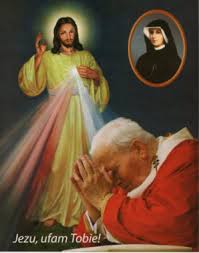
Canonizing Sister Faustina and Divine Mercy
HOMILY OF THE HOLY FATHER MASS IN ST PETER’S SQUARE FOR THE CANONIZATION OF SR MARY FAUSTINA KOWALSKA Sunday, 30 April 2000 1. “Confitemini Domino quoniam bonus, quoniam in saeculum misericordia eius”; “Give thanks to the Lord for he is good; his steadfast love endures for ever” (Ps 118: 1). So the Church sings on the Octave of[…]Continue reading→
Divine Mercy Sunday – An Echo of Every Mass
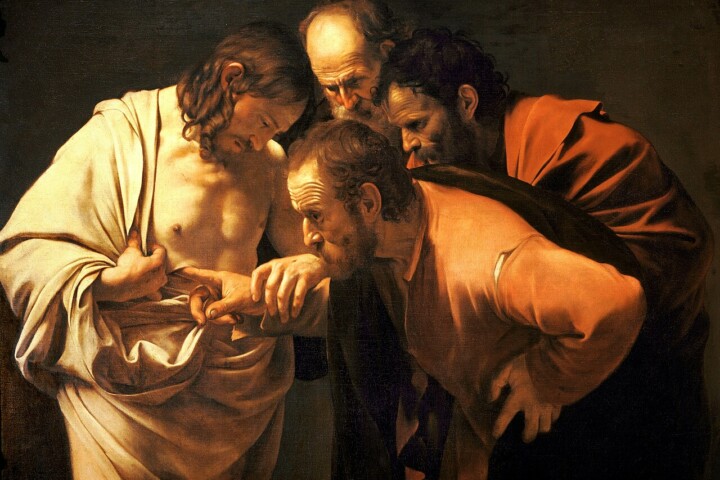
Reach out your hand and put it in my side. Do not doubt but believe’… ‘My Lord and my God!’ (Jn. 20:18)). Today is Divine Mercy Sunday, and as we celebrate the end of the Easter Octave, we contemplate the wounded side of our Saviour, the Church’s source of life. On Good Friday in the[…]Continue reading→
Pope Leo and a Rosary for Peace
Pope Leo XIV has asked Catholics across the world to join him in a Rosary for peace today, at 18:00 Rome time (6 pm), which would be noon from where I write (EST). If you are able, whether at that time or another, and in whatever way you pray, to join in intercession with the[…]Continue reading→
Payette’s Payout
I was glancing through some headlines, and noticed a mention of Julie Payette – engineer and astronaut and sometime the Queen’s representative in Canada – which brought back vague memories. She was appointed Governor-General by Justin Trudeau in 2017. Ms. Payette resigned in 2021, amidst claims that she created a ‘toxic work environment’, with allegations[…]Continue reading→
First Holy Communion: Sermon from May 16, 1943
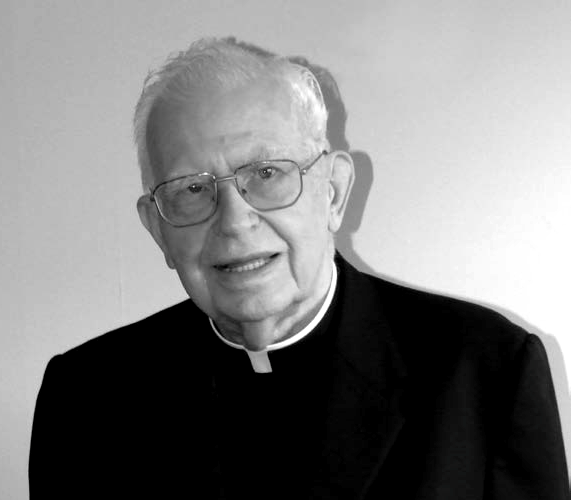
Here is a sermon from the good old days by +Rev. Msgr. Vincent Nicholas Foy (August 14, 1915 – March 13, 2017), from 1943. Readers may recall that Pope Saint Pius X, by the decree Quam Singulari in 1910, lowered the customary age of reception of Holy Communion – after the rigours of the plague[…]Continue reading→
Your Easter Prayer
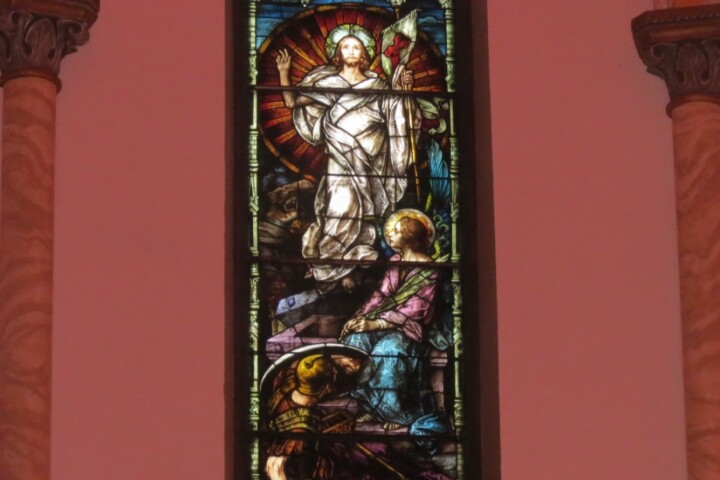
Happy Easter Lord Jesus Christ. It’s Easter day and we smile In the Lord’s in gentle light and His tomb is bare the stone is rolled A story new that must be told And Lord Jesus Christ We love you it’s so true and Lord Jesus Christ has risen From his sleep and the Promises[…]Continue reading→