
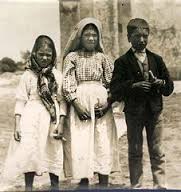
The Revelation of Fatima
The 100th anniversary of Fatima is a significant one in the minds of many, not least due to the effect of the apparitions on the momentous events of the 20th century, but also in connection with the purported prophecy of Pope Leo XIII, who as the century began, said the Devil would have a ‘100 year reign’, wherein God would allow the Evil One greater freedom to wreak havoc in the world, something that prompted him to write the prayer to Saint Michael, and have it said after every Mass (a pious custom well worth continuing). Of course, in the designs of God’s providence, the Almighty would bring, and has brought, greater good out of this evil, in ways that we will only fully understand at the end of time.
Then there are the ‘secrets’ of Fatima, revealed to the three children, and safeguarded by the one survivor, Sister Lucia, after Francesco and Jacinta died soon after the visions, as they themselves predicted, in the Spanish influenza in that fateful year 1918 which killed millions across the globe. (Pope Francis will canonize them in his own pilgrimage to Fatima this Sunday). In particular, the so-called ‘third secret’, a mystical vision made public by Cardinal Ratzinger in June of 2000, has exercised the minds of all too many, with lurid visions of apocalyptic scenarios, disintegration within the Church, and horrors all around.
We as Catholics must always be cautious of private revelation, for they can offer nothing new to the faith, neither adding to nor subtracting from the body of public revelation, given to us by Christ, preserved by the Apostles, and handed on and explicated through their successors in the Magisterium. The whole purpose of private revelation is to support and lead us to live more perfectly what God has already revealed in His Son. As the Catechism states:
Throughout the ages, there have been so-called “private” revelations, some of which have been recognized by the authority of the Church. They do not belong, however, to the deposit of faith. It is not their role to improve or complete Christ’s definitive Revelation, but to help live more fully by it in a certain period of history. Guided by the Magisterium of the Church, the sensus fidelium knows how to discern and welcome in these revelations whatever constitutes an authentic call of Christ or his saints to the Church. (par. 67)
Hence, strictly speaking, we need not believe all that was revealed at Fatima in order to be a ‘good Catholic’. The only elements that bind us in the realm of faith are those things already revealed by Christ, as clarified by His Magisterium: Prayer and penance for the conversion of sinners, and for peace in the world.
Of course, the miracles and prophecies of Fatima, along with all the other private revelations throughout history, are very good helps and supports to our faith. Many were converted by witnessing the miracle of the Sun on that rain-drenched October 13th morning in 1917, and by the fulfillment of the predictions not only of the end of the ‘war to end all wars’, but also the tragic beginning of another war in the late summer of 1939, when, as the children foresaw, a ‘bright light’ throughout the sky would presage an even worse conflict, if men did not amend their ways.
Tradition has called these various miracles, prophecies, even the very holiness of the saints and visionaries, motiva credibilitatis, motives of credibility, all those things which either lead someone into faith, or increase the faith of those who have it already (cf., CCC, #156).
I for one believe that those three young children, on those spring and summer days of 1917, really did see Our Lady, the young virgin chosen by God to be the dwelling for His incarnation, who now exists body and soul glorified in heaven. Through these innocent visionaries we too have some indirect access to that celestial realm, which seems so far from this fractious vale of tears through which we now journey.
If we have ‘eyes to see’, Our Lady of Fatima helps us keep those eyes, along with our minds and hearts, ever ‘upward’, knowing that whatever is in store for us and the world, however we may live and eventually die, old or young or middle-aged, whether in the apocalypse or in some more mundane manner, all things work together for the good for those who love God, that we too are made for heaven, not for earth, and that by following her Son’s commandments and inspirations, we too will one day join her and all the saints in glory.
What in the end could be more hopeful?
Our Lady of Fatima, ora pro nobis!

Carney’s Amoral Majority
After five defections – euphemistically described as ‘crossing the floor’ – and three by-elections, Mark Carney and his Liberals how have their coveted majority. One wonders what bowls of pottage were offered in back-room deals. In the archaic monarchical system that is the Dominion of Canada, this majority allows the newly-minted Prime Minister to rule[…]Continue reading→

Saint Kateri , Canada’s Protectress
This was the title given to Saint Kateri Tekakwitha, by Pope Benedict XVI, when he canonized her on October 28th, 2012, along with six others, in Saint Peter’ Square (she had been beatified by Pope John Paul II back in 1980). With Saint Joseph as our protector, along with the Canadian martyrs, we seem to[…]Continue reading→

Remembering Father Alphonse de Valk
(Today marks the sixth anniversary of the death of Father Alphonse de Valk, C.S.B., a faithful, courageous and indefatigable Basilian priest, pro-life-and-family apostle, and the founder of Catholic Insight magazine. Here is what we wrote those on his entering into eternity five years ago, as we continue to remember him in our prayers and thoughts)[…]Continue reading→

A Tale of Two Benedicts
A grace-filled Holy Week to all our readers! As we await and prepare for the Resurrection about to dawn upon us, we might keep in mind two Benedicts: Pope Emeritus Benedict XVI, requiescat in pace, elected on this day in 2005; and today’s commemoration of the mystic pilgrim, Benedict Joseph Labre, who died on this[…]Continue reading→

My Name is Bernadette
April 16th is a propitious day, for besides the anniversary of Father de Valk’s death, who founded Catholic Insight in its print form decades ago, and the commemoration of the ‘two Benedicts’, mentioned in accompanying posts, today we also recall Saint Bernadette Soubirous, the young visionary to whom the Virgin Mary appeared numerous times at[…]Continue reading→

Saint Lydwina of Schiedam and Suffering Joyfully
Saint Lydwina of Schiedam (1380 – 1433) was one of the countless and glorious ‘victim souls’ in the history of the Church, those whose lives are filled with suffering, often of an unimaginable intensity, but who suffer joyfully. She was a fifteen-year old Dutch girl, out skating one day, when she fell and broke one[…]Continue reading→

The Glorious Martyrdoms of Martin and Maximus
As we enter into Eastertide, we recall on this 13th of April Pope Saint Martin I (+655), one of the noblest, if most tragic, of the successors of Saint Peter. Born in Umbria, Italy, he was of noble lineage, with great intelligence combined with charity and love of the poor and the Church. While still[…]Continue reading→

Canonizing Sister Faustina and Divine Mercy
HOMILY OF THE HOLY FATHER MASS IN ST PETER’S SQUARE FOR THE CANONIZATION OF SR MARY FAUSTINA KOWALSKA Sunday, 30 April 2000 1. “Confitemini Domino quoniam bonus, quoniam in saeculum misericordia eius”; “Give thanks to the Lord for he is good; his steadfast love endures for ever” (Ps 118: 1). So the Church sings on the Octave of[…]Continue reading→

Divine Mercy Sunday – An Echo of Every Mass
Reach out your hand and put it in my side. Do not doubt but believe’… ‘My Lord and my God!’ (Jn. 20:18)). Today is Divine Mercy Sunday, and as we celebrate the end of the Easter Octave, we contemplate the wounded side of our Saviour, the Church’s source of life. On Good Friday in the[…]Continue reading→

Saint Stanislaus of Szczepanów
We celebrate Saint Stanislaus today (+ April 11, 1079), in light of this Easter Octave, a bishop and martyr who accepted the episcopacy only at the direct order of Pope Alexander II. He proved a wise and courageous leader of his flock, put to death by his own king, Boleslaus, for rebuking the monarch’s ‘immoral[…]Continue reading→