
For the Sake of One Iota
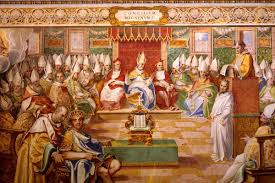
There are times when one word, even one letter, can make all the difference. The scene is June of 325, in the basilica of the imperial city of Nicaea (now in northwestern Turkey) where an ecumenical council has been called by the Emperor Constantine to deal with a number of issues in the Church, not least the ideas of a certain learned and charismatic deacon from Alexandria on the Egyptian coast (then under the control of the empire), Arius, who claimed that Jesus the Christ was not fully and completely ‘God’, at least not in the sense that God the Father was God.
The Second Person, rather, was an emanation from the Father, exalted and ‘divine’ in a sense, but still, technically, a ‘creature’, who came into existence at a certain point. As the followers of Arius would say, ‘there was a time when He was not’.
Many were convinced by the subtle argument of Arius, that Christ and the Father could not be the ‘same’, for are they not somehow different? Otherwise, is not the Trinity something of an illusion, just three ways or modes of God presenting Himself to mankind, as the Roman priest Sabellius had claimed a century or so earlier?
The Council was called to settle the question, and the argument became heated, as the pro-Arian bishops fought, sometimes literally with the anti-Arian faction (there is a rumour that Nicholas of Cusa, the prototype of Santa Claus, descended to the ad baculum argument, pulling the beard of the annoying Arius).
The orthodox position, of course as we now know and believe, is that Christ is the ‘same’ as the Father, fully divine, fully God: ‘I and the Father are one’, and ‘He who has seen Me has seen the Father’.
The term that captured and solidified this position was adopted from ancient and pagan Greek philosophy, ‘homo-ousios’, that Christ was and is the ‘same-being’ or ‘same-substance’ as the Father. And the great champion of the homo-ousios was the saint we celebrate today, the holy and learned Athanasius of Alexandria (296-373), bishop of the very same city as the recalcitrant Arius.
There is too much to tell of the varied and adventurous life of the great Athanasius (I would recommend the reader to peruse the essays of Bd. John Henry Newman, a great devotee of Athanasius). Suffice to say that Athanasius suffered much for the faith, exiles and imprisonments, fleeing often as a fugitive from his own episcopal see, especially under Constantine’s sons and successors, who adopted Arianism with a vengeance.
But to end for now where we began, with the term and the letter: A compromise was attempted, that instead of homo-ousios, could we not all agree on homoi-ousios, that the Son is ‘like’ the Father, but not quite the ‘same’?
Athanasius’ clear mind, sharpened and developed through a life of prayer study, discipline and chastity, knew that this would be the death knell of Catholicism. For are we not all ‘like’ God in some way? Is not the Son unique, in being not only similar to God, but very God Himself, in a way that transcends our limited human minds to fully comprehend?
Thus, for the sake of one ‘iota’, the smallest of Greek letters, our faith was saved, largely due to the efforts of one great and holy bishop, who stood, often alone, against the forces of waffling, ambiguity and ultimate heterodoxy, with the whole might of the imperial army behind them. He was known as Athanasius contra mundum, Athanasius against the world, a term that should in some way apply to us all. After his death in 373, the Cappadocian doctor of the Church Gregory of Naziansus called Athanasius the ‘pillar of the Church’.
The truth always wins out in the end, even if it costs. And what is worth winning, without some sacrifice?
Ponder Athanasius the next time you recite the Creed that was adopted at that Council of Nicaea, meditating on the unambiguous description of Jesus the Christ as:
God from God, Light from Light, true God from true God, begotten not made, consubstantial (homo-ousios) with the Father…

Carney’s Amoral Majority
After five defections – euphemistically described as ‘crossing the floor’ – and three by-elections, Mark Carney and his Liberals how have their coveted majority. One wonders what bowls of pottage were offered in back-room deals. In the archaic monarchical system that is the Dominion of Canada, this majority allows the newly-minted Prime Minister to rule[…]Continue reading→

Saint Kateri , Canada’s Protectress
This was the title given to Saint Kateri Tekakwitha, by Pope Benedict XVI, when he canonized her on October 28th, 2012, along with six others, in Saint Peter’ Square (she had been beatified by Pope John Paul II back in 1980). With Saint Joseph as our protector, along with the Canadian martyrs, we seem to[…]Continue reading→

Remembering Father Alphonse de Valk
(Today marks the sixth anniversary of the death of Father Alphonse de Valk, C.S.B., a faithful, courageous and indefatigable Basilian priest, pro-life-and-family apostle, and the founder of Catholic Insight magazine. Here is what we wrote those on his entering into eternity five years ago, as we continue to remember him in our prayers and thoughts)[…]Continue reading→

A Tale of Two Benedicts
A grace-filled Holy Week to all our readers! As we await and prepare for the Resurrection about to dawn upon us, we might keep in mind two Benedicts: Pope Emeritus Benedict XVI, requiescat in pace, elected on this day in 2005; and today’s commemoration of the mystic pilgrim, Benedict Joseph Labre, who died on this[…]Continue reading→

My Name is Bernadette
April 16th is a propitious day, for besides the anniversary of Father de Valk’s death, who founded Catholic Insight in its print form decades ago, and the commemoration of the ‘two Benedicts’, mentioned in accompanying posts, today we also recall Saint Bernadette Soubirous, the young visionary to whom the Virgin Mary appeared numerous times at[…]Continue reading→

Saint Lydwina of Schiedam and Suffering Joyfully
Saint Lydwina of Schiedam (1380 – 1433) was one of the countless and glorious ‘victim souls’ in the history of the Church, those whose lives are filled with suffering, often of an unimaginable intensity, but who suffer joyfully. She was a fifteen-year old Dutch girl, out skating one day, when she fell and broke one[…]Continue reading→

The Glorious Martyrdoms of Martin and Maximus
As we enter into Eastertide, we recall on this 13th of April Pope Saint Martin I (+655), one of the noblest, if most tragic, of the successors of Saint Peter. Born in Umbria, Italy, he was of noble lineage, with great intelligence combined with charity and love of the poor and the Church. While still[…]Continue reading→

Canonizing Sister Faustina and Divine Mercy
HOMILY OF THE HOLY FATHER MASS IN ST PETER’S SQUARE FOR THE CANONIZATION OF SR MARY FAUSTINA KOWALSKA Sunday, 30 April 2000 1. “Confitemini Domino quoniam bonus, quoniam in saeculum misericordia eius”; “Give thanks to the Lord for he is good; his steadfast love endures for ever” (Ps 118: 1). So the Church sings on the Octave of[…]Continue reading→

Divine Mercy Sunday – An Echo of Every Mass
Reach out your hand and put it in my side. Do not doubt but believe’… ‘My Lord and my God!’ (Jn. 20:18)). Today is Divine Mercy Sunday, and as we celebrate the end of the Easter Octave, we contemplate the wounded side of our Saviour, the Church’s source of life. On Good Friday in the[…]Continue reading→

Saint Stanislaus of Szczepanów
We celebrate Saint Stanislaus today (+ April 11, 1079), in light of this Easter Octave, a bishop and martyr who accepted the episcopacy only at the direct order of Pope Alexander II. He proved a wise and courageous leader of his flock, put to death by his own king, Boleslaus, for rebuking the monarch’s ‘immoral[…]Continue reading→