
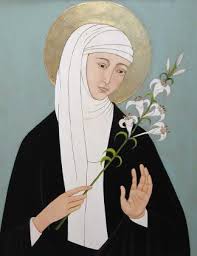
The Real Catherine the Great
Saint Catherine of Siena, born in 1347, and who died on this day in 1380, was in no uncertain terms a remarkable woman. Born into a family of 22 (!!) children (yes, all from the same parents without technological help), half of whom sadly died, Catherine showed signs of her uniqueness at an early age, eschewing the normal activities of young people, not least any interest in romance and marriage. Interiorly, at the tender age of seven by her biographer, Raymond of Capua’s, account, she dedicated herself to Christ as his ‘bride’, and never looked back. As she advised ‘build a castle within your mind, from which you can never flee’.
She became a Dominican tertiary, still a laywoman, but her followers were many, and she influenced the troubled Church of the 14th century more than most of the high-ranking men of her age. If we think the Church troubled now, try the era of what has come to be known as the ‘Great Western Schism’, with the Pope living in the scandalous court in Avignon in southern France (technically, papal territory).
Catherine was an early example of speaking truth to power, sparing no pains nor ‘standing on ceremony’ in urging the Holy Father, Gregory XI, that he must return the papacy to Rome, replete with dire threats she heard from God. Catherine showed that there is nothing intrinsically wrong with ‘criticising’ the Pope, so long as it is done respectfully, with charity and good will, as the current Code of Canon Law states, quoted the Catechism:
In accord with the knowledge, competence, and preeminence which they possess, [lay people] have the right and even at times a duty to manifest to the sacred pastors their opinion on matters which pertain to the good of the Church, and they have a right to make their opinion known to the other Christian faithful, with due regard to the integrity of faith and morals and reverence toward their pastors, and with consideration for the common good and the dignity of persons. (CCC, #907; CIC, 212, #3).
Moved by her urging, the Pope did return to the Eternal City, the centre of Christendom, which began the process of healing the schism, complete at the Council of Constance in 1415.
(As an aside, we modern Catholics may follow Catherine’s example, and ask for clarification of some of the remarks of the current Holy Father. To offer one example amongst others, I, a great fan of clarity and precision, and would not mind knowing what the Pope means by his recent condemnation of ‘proselytism’. In today’s Gospel reading, recounting the ordination of the first deacons in the Church, Stephen and the others, Nicolaus is described as a ‘proselyte from Antioch’, which does not imply anything bad, but rather something good. Clearly, the Pope cannot mean that we should not evangelize).
I could go on, but perhaps we need a few more Catherines of Siena, steeped in prayer, chaste, pure, humble, obedient to Christ and His Church in the deepest sense.
Saint Catherine was one of the greatest of mystics in the history of the Church, and her dictated revelations, the Dialogue on Divine Providence, (from a woman who could neither read nor write), is a masterpiece of spiritual and theological insight, and her letters a model of beauty and intelligence, as well as masterpieces of early Tuscan. She is a powerful example and intercessor for women, as well as men, throughout the ages.
Saint Catherine of Siena, ora pro nobis!

Carney’s Amoral Majority
After five defections – euphemistically described as ‘crossing the floor’ – and three by-elections, Mark Carney and his Liberals how have their coveted majority. One wonders what bowls of pottage were offered in back-room deals. In the archaic monarchical system that is the Dominion of Canada, this majority allows the newly-minted Prime Minister to rule[…]Continue reading→

Saint Kateri , Canada’s Protectress
This was the title given to Saint Kateri Tekakwitha, by Pope Benedict XVI, when he canonized her on October 28th, 2012, along with six others, in Saint Peter’ Square (she had been beatified by Pope John Paul II back in 1980). With Saint Joseph as our protector, along with the Canadian martyrs, we seem to[…]Continue reading→

A Tale of Two Benedicts
A grace-filled Holy Week to all our readers! As we await and prepare for the Resurrection about to dawn upon us, we might keep in mind two Benedicts: Pope Emeritus Benedict XVI, requiescat in pace, elected on this day in 2005; and today’s commemoration of the mystic pilgrim, Benedict Joseph Labre, who died on this[…]Continue reading→

My Name is Bernadette
April 16th is a propitious day, for besides the anniversary of Father de Valk’s death, who founded Catholic Insight in its print form decades ago, and the commemoration of the ‘two Benedicts’, mentioned in accompanying posts, today we also recall Saint Bernadette Soubirous, the young visionary to whom the Virgin Mary appeared numerous times at[…]Continue reading→

Saint Lydwina of Schiedam and Suffering Joyfully
Saint Lydwina of Schiedam (1380 – 1433) was one of the countless and glorious ‘victim souls’ in the history of the Church, those whose lives are filled with suffering, often of an unimaginable intensity, but who suffer joyfully. She was a fifteen-year old Dutch girl, out skating one day, when she fell and broke one[…]Continue reading→

The Glorious Martyrdoms of Martin and Maximus
As we enter into Eastertide, we recall on this 13th of April Pope Saint Martin I (+655), one of the noblest, if most tragic, of the successors of Saint Peter. Born in Umbria, Italy, he was of noble lineage, with great intelligence combined with charity and love of the poor and the Church. While still[…]Continue reading→

Saint Stanislaus of Szczepanów
We celebrate Saint Stanislaus today (+ April 11, 1079), in light of this Easter Octave, a bishop and martyr who accepted the episcopacy only at the direct order of Pope Alexander II. He proved a wise and courageous leader of his flock, put to death by his own king, Boleslaus, for rebuking the monarch’s ‘immoral[…]Continue reading→

Saint Gemma Galgani
On this April 11th, in 1903 – the same year that the Italian Guiseppe Sarto was elected Pope later that summer as Pius X – a lovely, young Italian woman died, by the name of Gemma Galgani. She lived a brief life of 24 years, as did a number of other young saints, including Pier[…]Continue reading→

An Ideological and Improper Translation
I noticed something odd with the psalm reading at Mass the other day. Our bishops’ conference here in Canada has decreed that the Mass in English – Novus Ordo – use the ‘NRSV’, the ‘New Revised Standard Version’, an ‘updated’ translation of the original RSV, first published in 1952. This ‘new translation’ has the tendency[…]Continue reading→
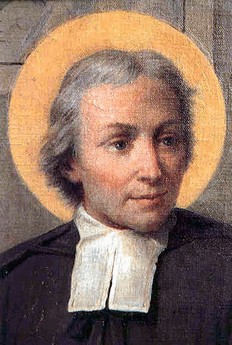
Saint Jean-Baptiste de la Salle: A Teacher for Teachers
Jean-Baptiste de la Salle (1651 – 1719), a French nobleman, ordained a priest, founded the first order in the Church’s history entirely without priests, and this came about almost by accident. I say ‘almost’, for, of course, there are no accidents with God. Destined for ordination from an early age, Jean-Baptiste never looked back, even[…]Continue reading→