
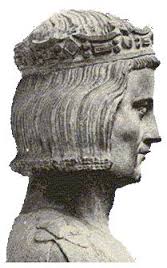
Good King Louis
We celebrate today in the universal Church one of my own favorites (not least since I was baptized on this day in bonnie Scotland many moons ago) King Saint Louis IX, who ruled France during the golden era of the 13th century, and was a personal friend of one my other favorites, Saint Thomas Aquinas.
There is an anecdote that at a royal banquet in the presence of his royal majesty, the good Dominican (who although Italian by birth, spent much of his life in France) was lost in thought, when he suddenly slammed his meaty fist down on the thick, wooden table, declaring “I have got it!”, resolving some abstruse metaphysical quandary in his abstracted mind. Normally, a serious breach of etiquette, even an insult to the King; but Louis just smiled, and asked for his servants to get Thomas some paper and a quill, so he could write down whatever great thought he had.
So were the priorities of one of the most noble and virtuous kings in history. One need only peruse Louis’ letter to one of his sons (he had eleven children with his devoted wife Margaret of Provence), which comprises part of today’s Office of Readings, wherein he declares, following advice he had received from his own mother, Blanche of Castille:
You must be ready to undergo every kind of martyrdom rather than commit one mortal sin.
I wonder how many parents offer their children the same advice today? Do they even know what ‘mortal sin’ is?
The fundamental reason for what is wrong with the world today is we have our priorities all wrong. As I wrote at the end of my piece on the Olympics, we have put first things last, and last things first.
How many of our up and coming millennials would lie, cheat and steal, even in subtle, not-so-serious ways, to get ahead? For that matter, how many of us would? Would we die rather than commit one mortal sin? Thus is the price of martyrdom, which Pope Saint John Paul II advocates in his treatise on morality, Veritatis Splendor:
The Church proposes the example of numerous Saints who bore witness to and defended moral truth even to the point of enduring martyrdom, or who preferred death to a single mortal sin. In raising them to the honour of the altars, the Church has canonized their witness and declared the truth of their judgment, according to which the love of God entails the obligation to respect his commandments, even in the most dire of circumstances, and the refusal to betray those commandments, even for the sake of saving one’s own life. (par. 91)
Louis was not a martyr, per se, but he did die on this day in 1274 while on what we now term the ‘Eighth Crusade’, to defend the Holy Land, and more importantly the Christians who dwelt and the pilgrims who journeyed there, from the predations of the Muslims. Unlike our modern ‘king’, Prime Minister Trudeau, Louis was no multiculturalist, nor was he all that tolerant of manifest ‘grave and mortal sin’ in his subjects, especially those sins that disrupted public order (perhaps Louis had read Thomas’ own treatise on this question in the Summa). He ruled his domain as a Catholic king, with Catholic principles, and Catholic laws, or, as we might now put it, laws derived and based upon Catholic revelation and the Judeo-Christian heritage. The only truly sustainable, life-giving, just ‘culture’ is the Christian culture, which is why we are called, with Saint Louis, to imbue whatever culture within which we dwell with these Christian mores.
Of course, we cannot go back to the Middle Ages, nor to what the author James Walsh called the ‘greatest of centuries‘. But that does not mean that their principles were not sound, even though we may now apply them somewhat differently.
To paraphrase G.K. Chesterton, we cannot have any practical plan unless we keep our ideals firmly in mind: The only way to build a good house, is to have in mind what a ‘perfect’ house might be; and the only way to rule a kingdom well is to keep focused on the most perfect kingdom, God’s. Only an idealist can be a competent practicalist, and it is these ideals that made Louis such a great and noble King, husband and father.

Carney’s Amoral Majority
After five defections – euphemistically described as ‘crossing the floor’ – and three by-elections, Mark Carney and his Liberals how have their coveted majority. One wonders what bowls of pottage were offered in back-room deals. In the archaic monarchical system that is the Dominion of Canada, this majority allows the newly-minted Prime Minister to rule[…]Continue reading→

Saint Kateri , Canada’s Protectress
This was the title given to Saint Kateri Tekakwitha, by Pope Benedict XVI, when he canonized her on October 28th, 2012, along with six others, in Saint Peter’ Square (she had been beatified by Pope John Paul II back in 1980). With Saint Joseph as our protector, along with the Canadian martyrs, we seem to[…]Continue reading→

A Tale of Two Benedicts
A grace-filled Holy Week to all our readers! As we await and prepare for the Resurrection about to dawn upon us, we might keep in mind two Benedicts: Pope Emeritus Benedict XVI, requiescat in pace, elected on this day in 2005; and today’s commemoration of the mystic pilgrim, Benedict Joseph Labre, who died on this[…]Continue reading→

My Name is Bernadette
April 16th is a propitious day, for besides the anniversary of Father de Valk’s death, who founded Catholic Insight in its print form decades ago, and the commemoration of the ‘two Benedicts’, mentioned in accompanying posts, today we also recall Saint Bernadette Soubirous, the young visionary to whom the Virgin Mary appeared numerous times at[…]Continue reading→

Saint Lydwina of Schiedam and Suffering Joyfully
Saint Lydwina of Schiedam (1380 – 1433) was one of the countless and glorious ‘victim souls’ in the history of the Church, those whose lives are filled with suffering, often of an unimaginable intensity, but who suffer joyfully. She was a fifteen-year old Dutch girl, out skating one day, when she fell and broke one[…]Continue reading→

The Glorious Martyrdoms of Martin and Maximus
As we enter into Eastertide, we recall on this 13th of April Pope Saint Martin I (+655), one of the noblest, if most tragic, of the successors of Saint Peter. Born in Umbria, Italy, he was of noble lineage, with great intelligence combined with charity and love of the poor and the Church. While still[…]Continue reading→

Saint Stanislaus of Szczepanów
We celebrate Saint Stanislaus today (+ April 11, 1079), in light of this Easter Octave, a bishop and martyr who accepted the episcopacy only at the direct order of Pope Alexander II. He proved a wise and courageous leader of his flock, put to death by his own king, Boleslaus, for rebuking the monarch’s ‘immoral[…]Continue reading→

Saint Gemma Galgani
On this April 11th, in 1903 – the same year that the Italian Guiseppe Sarto was elected Pope later that summer as Pius X – a lovely, young Italian woman died, by the name of Gemma Galgani. She lived a brief life of 24 years, as did a number of other young saints, including Pier[…]Continue reading→
An Ideological and Improper Translation
I noticed something odd with the psalm reading at Mass the other day. Our bishops’ conference here in Canada has decreed that the Mass in English – Novus Ordo – use the ‘NRSV’, the ‘New Revised Standard Version’, an ‘updated’ translation of the original RSV, first published in 1952. This ‘new translation’ has the tendency[…]Continue reading→
Saint Jean-Baptiste de la Salle: A Teacher for Teachers
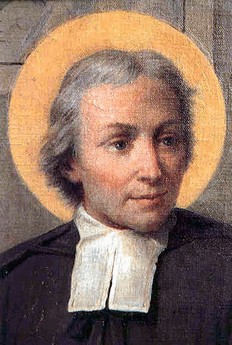
Jean-Baptiste de la Salle (1651 – 1719), a French nobleman, ordained a priest, founded the first order in the Church’s history entirely without priests, and this came about almost by accident. I say ‘almost’, for, of course, there are no accidents with God. Destined for ordination from an early age, Jean-Baptiste never looked back, even[…]Continue reading→