
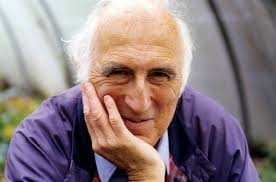
Jean Vanier Clarifies his Remarks, Reiterating his Support for Assisted Suicide Law in CBC Interview
(This article appeared in this revision on LifeSite News, based on a clarification they received from Dr. Vanier)
At the end of May, Jean Vanier was interviewed on the CBC by Carol Off for the evening program As it Happens. As most of you are aware, Vanier is a widely revered figure, a ‘living saint’ some may say, the founder ofL’Arche, which cares for severely handicapped and developmentally challenged people, heroic work that I could scarcely consider doing. I visited the L’Arche in Inverness, Scotland in 2003, when two of my students were working there in the summer, and was duly impressed.
The theme of the interview was medical assistance in dying, and to be fair to Dr. Vanier (he earned a Ph.D. on Aristotle’s Ethics from the Institut Catholique de Parisin the mid-sixties), he spends most of the discussion on the theme of caring for the sick, accompanying, helping and loving each other, developing from an ‘I’ to a ‘we’ model, and palliative care.
Early in the interview, Carol Off asks him directly whether he is in favour of the proposed assisted suicide law, and Vanier avoids answering directly, but later in the interview, he confesses on his own recognizance that he is in favour of a law. You can peruse the whole clip here. The interview with Jean Vanier begins at minute 29, with his own admission at the end of minute 36.
Here is Vanier in his own words, after a nuanced preface:
Shouldn’t we have some legislation to permit this? I say yes, but let’s put in safeguards…
Curiously, this snippet does not show up on the CBC’s own written transcription, for reasons I cannot discern. A few moments later, as they end their discussion, Ms. Off asks Vanier if he would ever consider having his own life ended:
That is certainly a very personal question, and I would say no…But I have never lived intense pain…
Presuming that under the influence of such ‘intense pain’, he might avail himself of this option? Or that others may?
We should be clear what the proposed law (Bill C-14) legalizes: Not suicide (which is already legal), nor the administration of painkillers for the alleviation of pain, even if this hastens death somewhat, a practice that is also already legal, and, in fact, morally justified. As Pope St. John Paul II states in his 1995 encyclical Evangelium Vitae (par. 65):
Among the questions which arise in this context is that of the licitness of using various types of painkillers and sedatives for relieving the patient’s pain when this involves the risk of shortening life. While praise may be due to the person who voluntarily accepts suffering by forgoing treatment with pain-killers in order to remain fully lucid and, if a believer, to share consciously in the Lord’s Passion, such “heroic” behaviour cannot be considered the duty of everyone. Pius XII affirmed that it is licit to relieve pain by narcotics, even when the result is decreased consciousness and a shortening of life, “if no other means exist, and if, in the given circumstances, this does not prevent the carrying out of other religious and moral duties” In such a case, death is not willed or sought, even though for reasonable motives one runs the risk of it: there is simply a desire to ease pain effectively by using the analgesics which medicine provides.
Rather, what the proposed Canadian law legalizes is physician-assisted suicide, which means giving doctors the right (and in some jurisdictions, potentially, the duty) to deliberately and consciously end the lives of their patients, should they (so far) voluntarily request it.
No Catholic, indeed no person of good conscience, can support any ‘euthanasia’ legislation, and there is no ‘compromise’ position on this that is morally acceptable. Again, John Paul II from Evangelium Vitae (par.72-73):
…laws which legitimize the direct killing of innocent human beings through abortion or euthanasia are in complete opposition to the inviolable right to life proper to every individual; they thus deny the equality of everyone before the law. It might be objected that such is not the case in euthanasia, when it is requested with full awareness by the person involved. But any State which made such a request legitimate and authorized it to be carried out would be legalizing a case of suicide-murder, contrary to the fundamental principles of absolute respect for life and of the protection of every innocent life. In this way the State contributes to lessening respect for life and opens the door to ways of acting which are destructive of trust in relations between people…
Abortion and euthanasia are thus crimes which no human law can claim to legitimize. There is no obligation in conscience to obey such laws; instead there is a grave and clear obligation to oppose them by conscientious objection.
LifeSiteNews asked Dr. Vanier for a clarification of his words, highlighting the problematic quote above, and he did offer one, the full text of which is provided at the end of this article, in both the original French, and English translation. He declares:
I stand by everything that I have said. The main thing is in any case to support life and to avoid all situations of suicide that originate in a situation of depression and solitude.
So, we may presume, that Dr. Vanier thinks there are cases, outside of depression and solitude, wherein suicide, assisted or not, should be permissible, even aided by law and physicians under the law? This is what Vanier apparently means when he goes on to clarify:
If the correct sedative or medication has not been found one cannot oblige someone to live through an unrelenting agony.
Presuming, again, that we should put them out of their ‘unrelenting agony’ by offering them assisted ‘suicide’.
Finally, Vanier ends off his clarification by declaring that
Pope Francis continues to tell us that everything cannot be regulated by a law and there are always exceptions.
Vanier seems to be referring to the recent exhortation Amoris Laetitia (and other declarations by the Pope) wherein the Holy Father warns against a strict, casuistic reliance upon the ‘law’, particularly the laws governing marriage. This is not the place to go into the complexities of this discussion, but let it be said for now that although there may be exceptions to human law, there are never exceptions to thenatural moral law, amongst which are suicide and murder, violations of which must be resisted even to the point of martyrdom, as Pope John Paul II declares so forcefully in his 1993 encyclical Veritatis Splendor (cf., par. 76; 90-94).
What is implied in Vanier’s responses is that there is such a thing as suffering which is ‘unbearable’, and that we must take it upon ourselves to end such suffering by legally-sanctioned murder-suicide. He would do well to peruse Pope John Paul II’s 1984 Letter, Salvifici Doloris, a profound meditation on the salvific power of suffering. God always provides the helps and graces necessary to bear such suffering as He sends, whether through natural, medical means, or through supernatural, grace-inspired means.
Either way, we cannot and must not usurp God’s mastery over life and death, and take it upon ourselves to end such suffering by suicide or murder, regardless of our compassionate motives. Not only is this contrary to the law of God and human dignity, but even at a practical level, who is to say what suffering is bearable or not? Pope John Paul makes clear in his letter that much of the ‘world of human suffering’ is subjective and spiritual, largely opaque to empirical, medical analysis. People can live joyfully in the midst of great physical pain, while others in peak bodily health are depressed and suicidal.
And on a more direct, personal level, does not Dr. Vanier realize that amongst the first victims of any non-consensual extension of the euthanasia law (which is more than likely, as history attests) will be people like his very beloved and very vulnerable core members of L’Arche? Does he not realize what will happen to the ‘safeguards’ that he proposes the legislation put in place?
This is truly saddening, and I hesitated even to write about it. I had to listen to the audio more than a few times to be sure of what I was hearing, but Vanier’s statement to LifeSiteNews more or less makes his position clear. My fear is that the CBC had him on as the voice of a rational, compromising, compassionate Catholicism, gently advocating the ‘medical assistance in dying’ bill, in rare instances, with love and all the proper ‘safeguards’, of course.
The CBC chose well, for Jean Vanier is indeed one of the great Catholics of the last and this century, giving his life up, including marriage and family, to work with the weakest and most vulnerable amongst us. I had the honour to hear him speak and to meet him briefly a number of years ago at a talk he gave in Kingston.
But that is why his words are a scandal, and may lead others who are on the fence to support the proposed legislation, or even to consider availing themselves, or their loved ones, of euthanasia. In his clarification, Dr. Vanier warns that one must not “take part of a series of remarks…out of context”, and I hope I have not done so here. In fact, you can read the whole context yourselves. To be clear, I do not think that Dr. Vanier is ‘pro euthanasia’, and his emphasis is on the accompanying of the dying via palliative care. I still hope that his words stemmed from some level of confusion about the law or what it entails.
That said, suicide and murder are never justified even in the most extreme cases, and a whole lot of palliative care cannot make up for even one deliberate killing. We should pray that Jean Vanier retracts his words and reconsiders his position. Or the Church may have to reconsider all the schools named after him (I have never been a fan of naming Catholic buildings after living people anyways, which used to be contrary to Church practice).
It would be sad to see such a great life end on such a sad note.
John Paul Meenan is a professor of Theology and Natural Science at Our Lady Seat of Wisdom in Barry’s Bay, and blogs regularly at johnpaulmeenan.com.
Jean Vanier’s full statement to LifeSiteNews on assisted suicide
English translation
I stand by everything that I have said. The main thing is in any case to support life and to avoid all situations of suicide that originate in a situation of depression and solitude.
My sister Therese, who was a palliative care doctor, has always said that 97 percent of people die fully conscious and without suffering. For the remaining 3 percent, they worked at finding a way to administer medication so that all could die without suffering.
If the correct sedative or medication has not been found one cannot oblige someone to live through an unrelenting agony.
One must not take part of a series of remarks and take them out of context. The most important thing is to accompany people with a competent doctor and above all if possible involved in palliative care.
Pope Francis continues to tell us that everything cannot be regulated by a law and there are always exceptions.
Original French
Je maintiens tout ce que j’ai dit. L’essentiel de toute façon est de soutenir la vie et d’éviter toutes les situations de suicide qui vient d’une situation de dépression et de solitude.
Ma soeur Therese, qui a été médecin dans les soins palliatifs, a toujours dit que 97 % de personnes mourraient en pleine conscience et sans souffrance. Pour les 3 % restants ils travaillaient pour trouver la façon d’administrer les médicaments pour que tous puissent mourir sans souffrance.
Si l’on a pas trouvé les bons calmants ou médicaments on ne peut pas obliger quelqu’un de vivre en agonie sans rémission.
Il ne faut pas prendre une partie du discours en coupant du contexte. Le plus important c’est d’accompagner les personnes avec un médecin compétent et surtout si possible engagé dans les soins palliatifs.
Le pape François continue à nous dire que tout ne peut pas être réglé par une loi et qu’il y a toujours des exceptions.

Carney’s Amoral Majority
After five defections – euphemistically described as ‘crossing the floor’ – and three by-elections, Mark Carney and his Liberals how have their coveted majority. One wonders what bowls of pottage were offered in back-room deals. In the archaic monarchical system that is the Dominion of Canada, this majority allows the newly-minted Prime Minister to rule[…]Continue reading→

Saint Kateri , Canada’s Protectress
This was the title given to Saint Kateri Tekakwitha, by Pope Benedict XVI, when he canonized her on October 28th, 2012, along with six others, in Saint Peter’ Square (she had been beatified by Pope John Paul II back in 1980). With Saint Joseph as our protector, along with the Canadian martyrs, we seem to[…]Continue reading→

Remembering Father Alphonse de Valk
(Today marks the sixth anniversary of the death of Father Alphonse de Valk, C.S.B., a faithful, courageous and indefatigable Basilian priest, pro-life-and-family apostle, and the founder of Catholic Insight magazine. Here is what we wrote those on his entering into eternity five years ago, as we continue to remember him in our prayers and thoughts)[…]Continue reading→

A Tale of Two Benedicts
A grace-filled Holy Week to all our readers! As we await and prepare for the Resurrection about to dawn upon us, we might keep in mind two Benedicts: Pope Emeritus Benedict XVI, requiescat in pace, elected on this day in 2005; and today’s commemoration of the mystic pilgrim, Benedict Joseph Labre, who died on this[…]Continue reading→

My Name is Bernadette
April 16th is a propitious day, for besides the anniversary of Father de Valk’s death, who founded Catholic Insight in its print form decades ago, and the commemoration of the ‘two Benedicts’, mentioned in accompanying posts, today we also recall Saint Bernadette Soubirous, the young visionary to whom the Virgin Mary appeared numerous times at[…]Continue reading→

Saint Lydwina of Schiedam and Suffering Joyfully
Saint Lydwina of Schiedam (1380 – 1433) was one of the countless and glorious ‘victim souls’ in the history of the Church, those whose lives are filled with suffering, often of an unimaginable intensity, but who suffer joyfully. She was a fifteen-year old Dutch girl, out skating one day, when she fell and broke one[…]Continue reading→

The Glorious Martyrdoms of Martin and Maximus
As we enter into Eastertide, we recall on this 13th of April Pope Saint Martin I (+655), one of the noblest, if most tragic, of the successors of Saint Peter. Born in Umbria, Italy, he was of noble lineage, with great intelligence combined with charity and love of the poor and the Church. While still[…]Continue reading→

Canonizing Sister Faustina and Divine Mercy
HOMILY OF THE HOLY FATHER MASS IN ST PETER’S SQUARE FOR THE CANONIZATION OF SR MARY FAUSTINA KOWALSKA Sunday, 30 April 2000 1. “Confitemini Domino quoniam bonus, quoniam in saeculum misericordia eius”; “Give thanks to the Lord for he is good; his steadfast love endures for ever” (Ps 118: 1). So the Church sings on the Octave of[…]Continue reading→

Divine Mercy Sunday – An Echo of Every Mass
Reach out your hand and put it in my side. Do not doubt but believe’… ‘My Lord and my God!’ (Jn. 20:18)). Today is Divine Mercy Sunday, and as we celebrate the end of the Easter Octave, we contemplate the wounded side of our Saviour, the Church’s source of life. On Good Friday in the[…]Continue reading→

Saint Stanislaus of Szczepanów
We celebrate Saint Stanislaus today (+ April 11, 1079), in light of this Easter Octave, a bishop and martyr who accepted the episcopacy only at the direct order of Pope Alexander II. He proved a wise and courageous leader of his flock, put to death by his own king, Boleslaus, for rebuking the monarch’s ‘immoral[…]Continue reading→