
Two Lenten Saint Nicholases: Flüe and Owen
On March 21 and 22, we commemorate two saints by the name of Nicholas. The first is Nicholas of Flüe (1415 – 1487), patron saint of Switzerland. His life was unique, and perhaps not to be imitated: As a husband and father of ten children, he decided to retreat from his busy life as a farmer, member of the assembly, councilor and judge, to become an ascetical hermit. He apparently had the consent of his wife and children, and did not completely separate – his cabin was in the woods not too far from the family home. But one does wonder what his wife thought, and perhaps she should be canonized as well.
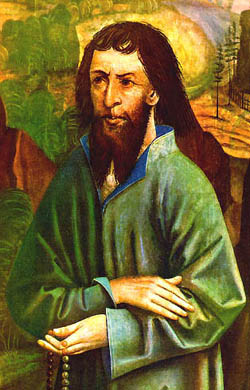
Nicholas began as a proficient soldier, working his way up to captain, fighting with a sword in one hand, and a rosary in the other. But in later middle age he gave everything up to live with and for God alone – while making provision for his family. From his own funds, Nicholas had a priest on hand in a chantry to say Mass daily, which he could attend. He was one of those few saints who lived on the Eucharist alone – for twenty years. Christ did describe our ‘daily bread’ as ‘epiousios’ bread, or super-substantial, and it certainly has the potential power to sustain us. Nicholas did have mystical gifts, and his counsel – which seemed supernaturally inspired – was sought by many. One quotation attributed to him bears pondering:
The Church will be punished because the majority of her members, high and low, will become so perverted. The Church will sink deeper and deeper until she will at last seem to be extinguished, and the succession of Peter and the other Apostles to have expired. But, after this, she will be victoriously exalted in the sight of all doubters.
The key word there is ‘seem’ – for the Church continues, regardless, both spiritually, and in her visible, hierarchical dimension. The Chair of Peter cannot fail, even if it seems to falter. Trust, dear reader, and have patience, as did all the saints.
When Nicholas died on March 21, 1487, surrounded by his family, he was mourned by the whole nation. His hermitage became a famous pilgrimage site on the Santiago de Compostela.
The Catechism cites saint Nichols of Flüe, and a prayer he composed (#226):
My Lord and my God, take from me everything that distances me from you.
My Lord and my God, give me everything that brings me closer to you.
My Lord and my God, detach me from myself to give my all to you.
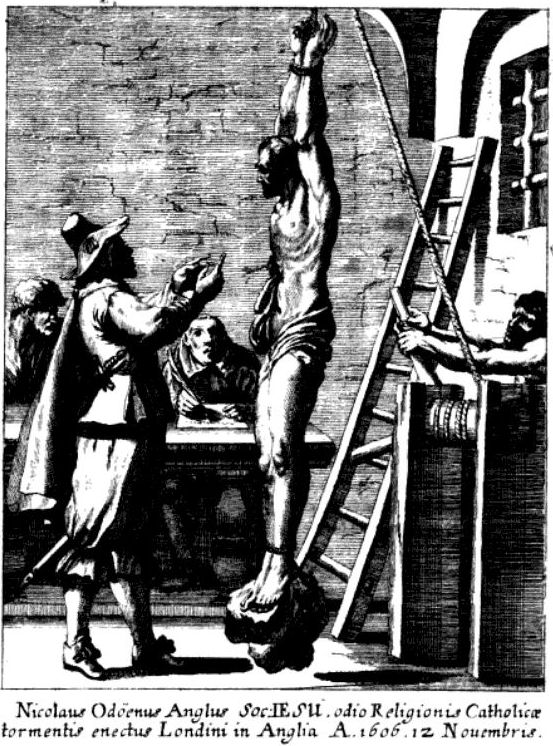
The second Nicholas, Owen, was a Jesuit lay brother during the tumultuous time in England of the Protestant revolt under Elizabeth I. After she was excommunicated by Pope Saint Pius V in 1570 for her anti-Catholic Oath of Supremacy, the Tudor queen – whose legitimacy on the throne was tenuous on different levels – began a persecution of Catholics that almost defies description in its intensity. Perhaps Shakespeare did not have her far from his mind with the words, ‘hell hath no fury...’. like a woman scorned by the Church. The Jesuits, still in the flush of their initial zeal, continued the work of sacramental ministry in England, under constant threat of a gruesome death if captured.
Nicholas Owen was raised in a Catholic family, his two older brothers becoming priest. Nicholas, however, followed his father’s trade as a carpenter. When the persecutions began, he dedicated his ‘off hours’ – often late a night – building priest hiding-holes in recusant manors. These were so well constructed that any number of them have yet to be found. Nicholas joined the Jesuits as a lay-brother to more fully consecrate himself and his work to God, and went about under various aliases. He was a servant of Edmund Campion, and was arrested in 1581 for proclaiming Edmund’s innocence, but let go, spending the next eighteen years doing his work. It was said the good lay-brother saved untold thousands of lives, and who knows how many souls, by helping the priests continue their ministry.
Eventually, he was caught again, giving himself up to save Father Henry Garnet, whom he was serving. Robert Cecil, Elizabeth’s Machiavellian Secretary of State, rejoiced, realizing what a fish they had caught. Nicholas was tortured mercilessly, hung from iron manacles, and racked repeatedly. His hernia – from which he suffered all his life – eventually burst out, and he died on the night of March 1st or 2nd, in 1606. Through it all, the heroic brother never betrayed a word, but suffered in silence, just like the Lord he served so well, and whose own trade he followed.
Nicholas Owen was canonized as one of the ’40 martyrs of England and Wales’ by Pope Saint Paul VI on October 25th, 1970. May he intercede for us all, especially all the countless hidden laborers in the Lord’s vineyard.
Saint Nicholas and Saint Nicholas, orate pro nobis! +
(source: in partibus, wikipedia.org)
Carney’s Amoral Majority
After five defections – euphemistically described as ‘crossing the floor’ – and three by-elections, Mark Carney and his Liberals how have their coveted majority. One wonders what bowls of pottage were offered in back-room deals. In the archaic monarchical system that is the Dominion of Canada, this majority allows the newly-minted Prime Minister to rule[…]Continue reading→

Saint Kateri , Canada’s Protectress
This was the title given to Saint Kateri Tekakwitha, by Pope Benedict XVI, when he canonized her on October 28th, 2012, along with six others, in Saint Peter’ Square (she had been beatified by Pope John Paul II back in 1980). With Saint Joseph as our protector, along with the Canadian martyrs, we seem to[…]Continue reading→

A Tale of Two Benedicts
A grace-filled Holy Week to all our readers! As we await and prepare for the Resurrection about to dawn upon us, we might keep in mind two Benedicts: Pope Emeritus Benedict XVI, requiescat in pace, elected on this day in 2005; and today’s commemoration of the mystic pilgrim, Benedict Joseph Labre, who died on this[…]Continue reading→

My Name is Bernadette
April 16th is a propitious day, for besides the anniversary of Father de Valk’s death, who founded Catholic Insight in its print form decades ago, and the commemoration of the ‘two Benedicts’, mentioned in accompanying posts, today we also recall Saint Bernadette Soubirous, the young visionary to whom the Virgin Mary appeared numerous times at[…]Continue reading→

Saint Lydwina of Schiedam and Suffering Joyfully
Saint Lydwina of Schiedam (1380 – 1433) was one of the countless and glorious ‘victim souls’ in the history of the Church, those whose lives are filled with suffering, often of an unimaginable intensity, but who suffer joyfully. She was a fifteen-year old Dutch girl, out skating one day, when she fell and broke one[…]Continue reading→

The Glorious Martyrdoms of Martin and Maximus
As we enter into Eastertide, we recall on this 13th of April Pope Saint Martin I (+655), one of the noblest, if most tragic, of the successors of Saint Peter. Born in Umbria, Italy, he was of noble lineage, with great intelligence combined with charity and love of the poor and the Church. While still[…]Continue reading→

Canonizing Sister Faustina and Divine Mercy
HOMILY OF THE HOLY FATHER MASS IN ST PETER’S SQUARE FOR THE CANONIZATION OF SR MARY FAUSTINA KOWALSKA Sunday, 30 April 2000 1. “Confitemini Domino quoniam bonus, quoniam in saeculum misericordia eius”; “Give thanks to the Lord for he is good; his steadfast love endures for ever” (Ps 118: 1). So the Church sings on the Octave of[…]Continue reading→

Saint Stanislaus of Szczepanów
We celebrate Saint Stanislaus today (+ April 11, 1079), in light of this Easter Octave, a bishop and martyr who accepted the episcopacy only at the direct order of Pope Alexander II. He proved a wise and courageous leader of his flock, put to death by his own king, Boleslaus, for rebuking the monarch’s ‘immoral[…]Continue reading→
Saint Gemma Galgani
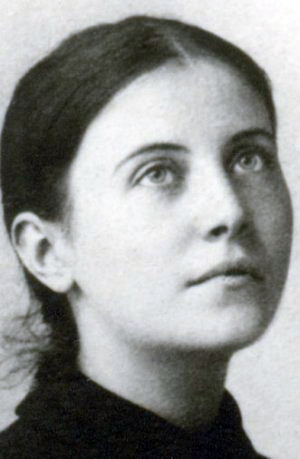
On this April 11th, in 1903 – the same year that the Italian Guiseppe Sarto was elected Pope later that summer as Pius X – a lovely, young Italian woman died, by the name of Gemma Galgani. She lived a brief life of 24 years, as did a number of other young saints, including Pier[…]Continue reading→
An Ideological and Improper Translation
I noticed something odd with the psalm reading at Mass the other day. Our bishops’ conference here in Canada has decreed that the Mass in English – Novus Ordo – use the ‘NRSV’, the ‘New Revised Standard Version’, an ‘updated’ translation of the original RSV, first published in 1952. This ‘new translation’ has the tendency[…]Continue reading→