
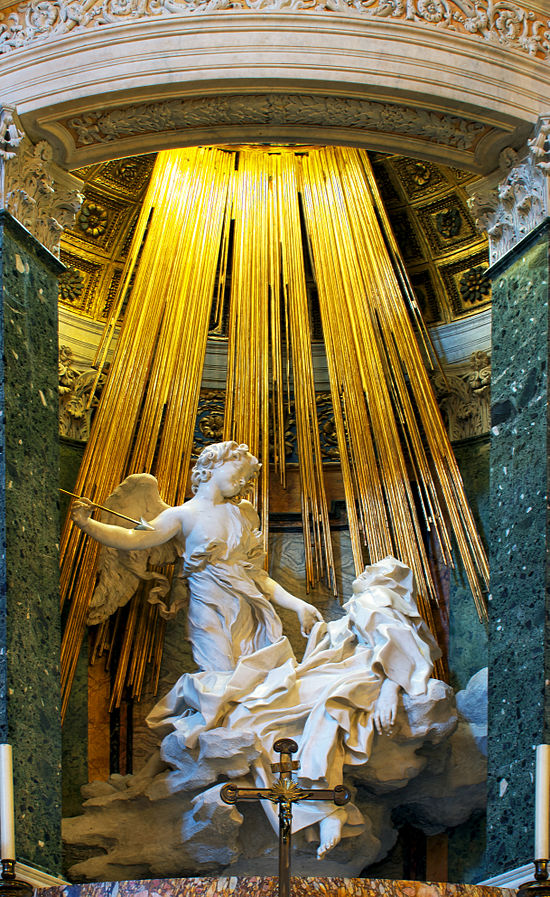
The Ecstasy of Fernandez, Mariette and Teresa
We won’t talk about the resurfaced book by Cardinal Fernandez, like some antedeluvian and postlapsarian creature out of the black lagoon. The current head of what is now known as the Dicastery for the Doctrine of the Faith has already embarrassed himself with his treatise on kissing for teens – bad enough – but the one about erotic delights of prayer, or the prayerful delights of eroticism, or something. The less said about this voyage into voyeuristic prurience, the better, as, from what little I could glean and suffer, it is grossly explicit, and too much even for impious ears.
Rather, we will take a step back from the luridness, and ponder in theory the comparison between sex and prayer. That is, the ‘ecstasy’ of union with God – literally, to ‘stand outside’ oneself with delight – and the conjugal act.
There was a disturbing 1991 novel by Ron Hansen – who did write a fine recounting of the Wreck of the Deutschland in his later 2008 novel Exiles, describing the tragic, noble death of the nuns on board the fated ship, a tale which had previously been put into noble poetry by Gerard Manley Hopkins. Hansen’s earlier novel, however, is about a beautiful, young, French nun – yes, I know – Mariette by name (‘little Mary’) whose intimate prayer life with Christ, is, well, a tad too intimate. The author doesn’t get overly graphic – there is a scene where she is standing disrobed in a trance before a crucifix – but the point is made.
I don’t know about Mr. Hansen, but Cardinal Fernandez should know that the consolation that God gives in prayer, even if intense, is not the same as the sensual delight of sexual union. There is an analogy, to be sure, as Christ Himself often uses marriage as a symbol of the joys of the kingdom, but, as Aristotle rightly pointed out, analogies – pros hen equivocations – are usually more different than alike.
Saint Thomas teaches in fact the contrary, that sexual act, even if good in its nature, is in fact inhibitory to prayer and the spiritual life, which is why the path of celibacy and continence in chastity is, as the Church has always taught, objectively more perfect.
Here are Thomas’ pointed words:
Now the use of sexual union hinders the mind from giving itself wholly to the service of God…on account of its vehement delectation, which by frequent repetition increases concupiscence, as also the Philosopher observes (Ethic. iii, 12): and hence it is that the use of venery withdraws the mind from that perfect intentness on tending to God. (ST, II-II, q.186, a.4)
Not only does continence allow one to focus more intently on spiritual growth, sublimating the sexual energy, but the freedom from its entanglements also allows one more time and space for apostolic, even academic, apostolates. The reader may recall the early temptation of Saint Thomas by a prostitute, whom he chased out of his room with a flaming firebrand, after which he was mystically girded by an angel and give the gift of perpetual chastity. Neither Thomas nor John Paul II would be who they were, nor would they have done all they did, if they were married men.
This is not to be Manichean, or deny the great beauty, nobility and holiness of marriage and the marital act. But we should not over-spiritualize our animal nature, a tragic misinterpretation of the ‘Theology of the Body’, and not what Pope John Paul II meant. We are destined for a far higher life, and in this vale of tears, the effects of original sin, and our own personal sins, are such that it is difficult to control and moderate the all that the conjugal life entails, which gets very complicated and engrossing. One is toggled to one’s own limits and vagaries and bodily and emotional swings, as well as those of another fallen and imperfect person, which is why the sexual acts in marriage must be moderated by temperance. And this assumes that both members of the marital union are striving for holiness, repenting of their sins, going to confession and all the rest of it.
And what is more, we are not ultimately called to the delights of the marital bed – often a cross as well – which are for this life only. As Christ had to explain to the obtuse Pharisees, we are made for heaven, where there will be no marriage, no sex, ecstatic or otherwise, no romance or even exclusive friendships.
Jesus said to them, “Is not this why you are wrong, that you know neither the scriptures nor the power of God? For when they rise from the dead, they neither marry nor are given in marriage, but are like angels in heaven. (Mk 12:24-25)
Like the angels, we will rejoice in the eternal communal bliss of the Triune God, which is a delight beyond any delight imaginable in this life, the very beatitude of God Himself, for all eternity. Again to Thomas, who says that the unbounded joy of the glorified soul will redound upon the body, and not the other way around.
This was the ‘ecstasy’ of Teresa of Avila, who, along with any number of other saints, received a taste of heaven itself in their contemplative life, far from some transient neuronal and physiological stimulation, which almost always leaves one sated and dissatisfied. Contra Freud, it’s not all about sex.
This spiritual end of Man, and the infinite concomitant delights thereof, can only be accepted on Faith, and to reduce it to some animal, bodily pleasure, regardless of how this may be sanctified by marriage, is to do a disservice to the myriad of continent and consecrated saints, and those who on such a path. One need not have sex to know true ecstasy – in fact, the opposite is more true. The ‘happiest’ person who ever lived, and certainly the highest in heaven, is the Virgin who ‘knew not man’. And it’s easier, and more delightful, if we follow her example to reach that beatific end to which God calls us.

Carney’s Amoral Majority
After five defections – euphemistically described as ‘crossing the floor’ – and three by-elections, Mark Carney and his Liberals how have their coveted majority. One wonders what bowls of pottage were offered in back-room deals. In the archaic monarchical system that is the Dominion of Canada, this majority allows the newly-minted Prime Minister to rule[…]Continue reading→

Saint Kateri , Canada’s Protectress
This was the title given to Saint Kateri Tekakwitha, by Pope Benedict XVI, when he canonized her on October 28th, 2012, along with six others, in Saint Peter’ Square (she had been beatified by Pope John Paul II back in 1980). With Saint Joseph as our protector, along with the Canadian martyrs, we seem to[…]Continue reading→

Remembering Father Alphonse de Valk
(Today marks the sixth anniversary of the death of Father Alphonse de Valk, C.S.B., a faithful, courageous and indefatigable Basilian priest, pro-life-and-family apostle, and the founder of Catholic Insight magazine. Here is what we wrote those on his entering into eternity five years ago, as we continue to remember him in our prayers and thoughts)[…]Continue reading→
A Tale of Two Benedicts
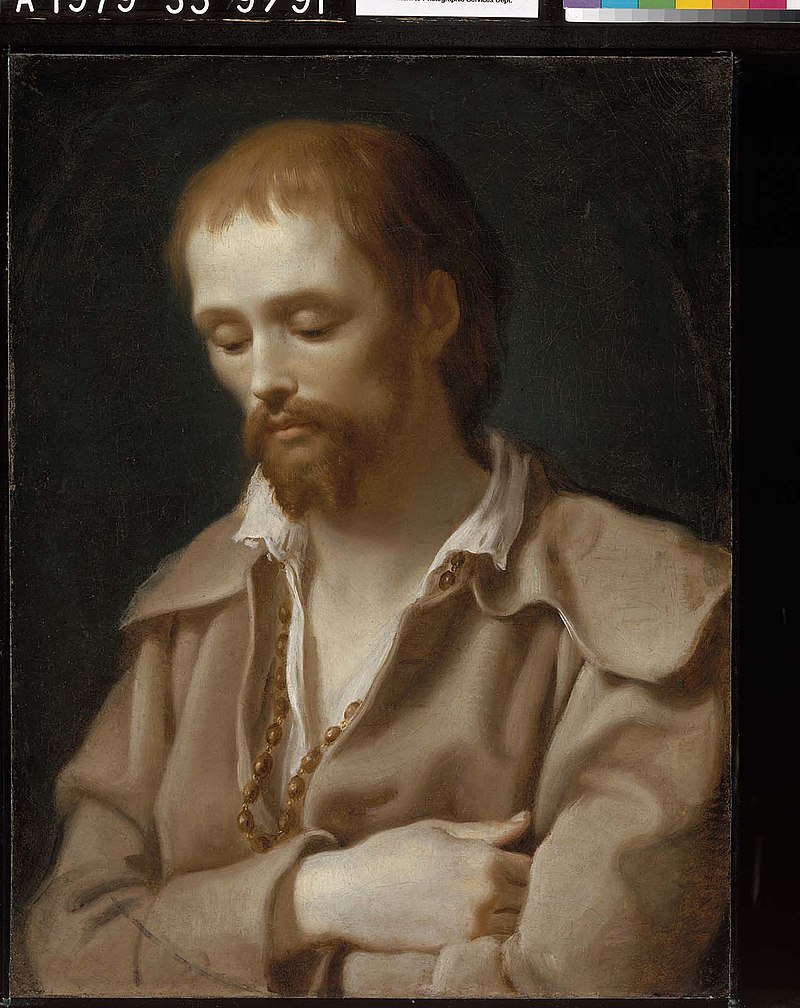
A grace-filled Holy Week to all our readers! As we await and prepare for the Resurrection about to dawn upon us, we might keep in mind two Benedicts: Pope Emeritus Benedict XVI, requiescat in pace, elected on this day in 2005; and today’s commemoration of the mystic pilgrim, Benedict Joseph Labre, who died on this[…]Continue reading→

My Name is Bernadette
April 16th is a propitious day, for besides the anniversary of Father de Valk’s death, who founded Catholic Insight in its print form decades ago, and the commemoration of the ‘two Benedicts’, mentioned in accompanying posts, today we also recall Saint Bernadette Soubirous, the young visionary to whom the Virgin Mary appeared numerous times at[…]Continue reading→
Saint Lydwina of Schiedam and Suffering Joyfully
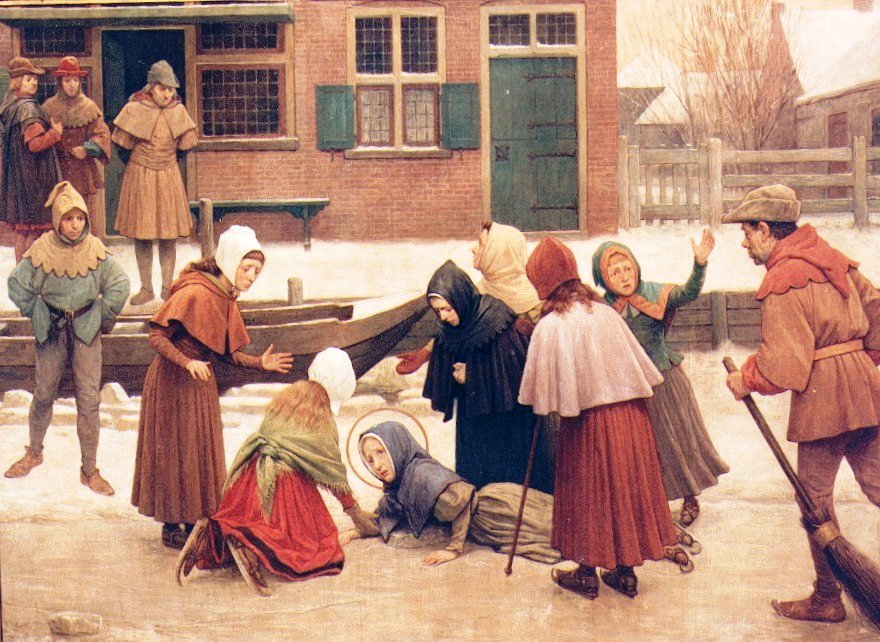
Saint Lydwina of Schiedam (1380 – 1433) was one of the countless and glorious ‘victim souls’ in the history of the Church, those whose lives are filled with suffering, often of an unimaginable intensity, but who suffer joyfully. She was a fifteen-year old Dutch girl, out skating one day, when she fell and broke one[…]Continue reading→
The Glorious Martyrdoms of Martin and Maximus
As we enter into Eastertide, we recall on this 13th of April Pope Saint Martin I (+655), one of the noblest, if most tragic, of the successors of Saint Peter. Born in Umbria, Italy, he was of noble lineage, with great intelligence combined with charity and love of the poor and the Church. While still[…]Continue reading→

Canonizing Sister Faustina and Divine Mercy
HOMILY OF THE HOLY FATHER MASS IN ST PETER’S SQUARE FOR THE CANONIZATION OF SR MARY FAUSTINA KOWALSKA Sunday, 30 April 2000 1. “Confitemini Domino quoniam bonus, quoniam in saeculum misericordia eius”; “Give thanks to the Lord for he is good; his steadfast love endures for ever” (Ps 118: 1). So the Church sings on the Octave of[…]Continue reading→

Divine Mercy Sunday – An Echo of Every Mass
Reach out your hand and put it in my side. Do not doubt but believe’… ‘My Lord and my God!’ (Jn. 20:18)). Today is Divine Mercy Sunday, and as we celebrate the end of the Easter Octave, we contemplate the wounded side of our Saviour, the Church’s source of life. On Good Friday in the[…]Continue reading→

Saint Stanislaus of Szczepanów
We celebrate Saint Stanislaus today (+ April 11, 1079), in light of this Easter Octave, a bishop and martyr who accepted the episcopacy only at the direct order of Pope Alexander II. He proved a wise and courageous leader of his flock, put to death by his own king, Boleslaus, for rebuking the monarch’s ‘immoral[…]Continue reading→