
Saint Paul’s Conversion
BENEDICT XVI
GENERAL AUDIENCE
Paul VI Audience Hall
Wednesday, 3 September 2008
Saint Paul (3)
St Paul’s “Conversion”.
Dear Brothers and Sisters,
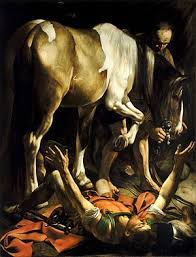
Today’s Catechesis is dedicated to the experience that Paul had on his way to Damascus, and therefore on what is commonly known as his conversion. It was precisely on the road to Damascus, at the beginning of the 30s in the first century and after a period in which he had persecuted the Church that the decisive moment in Paul’s life occurred. Much has been written about it and naturally from different points of view. It is certain that he reached a turning point there, indeed a reversal of perspective. And so he began, unexpectedly, to consider as “loss” and “refuse” all that had earlier constituted his greatest ideal, as it were the raison d’être of his life (cf. Phil 3: 7-8). What had happened?
In this regard we have two types of source. The first kind, the best known, consists of the accounts we owe to the pen of Luke, who tells of the event at least three times in the Acts of the Apostles (cf. 9: 1-19; 22: 3-21; 26: 4-23). The average reader may be tempted to linger too long on certain details, such as the light in the sky, falling to the ground, the voice that called him, his new condition of blindness, his healing like scales falling from his eyes and the fast that he made. But all these details refer to the heart of the event: the Risen Christ appears as a brilliant light and speaks to Saul, transforms his thinking and his entire life. The dazzling radiance of the Risen Christ blinds him; thus what was his inner reality is also outwardly apparent, his blindness to the truth, to the light that is Christ. And then his definitive “yes” to Christ in Baptism restores his sight and makes him really see.
In the ancient Church Baptism was also called “illumination”, because this Sacrament gives light; it truly makes one see. In Paul what is pointed out theologically was also brought about physically: healed of his inner blindness, he sees clearly. Thus St Paul was not transformed by a thought but by an event, by the irresistible presence of the Risen One whom subsequently he would never be able to doubt, so powerful had been the evidence of the event, of this encounter. It radically changed Paul’s life in a fundamental way; in this sense one can and must speak of a conversion. This encounter is the centre St Luke’s account for which it is very probable that he used an account that may well have originated in the community of Damascus. This is suggested by the local colour, provided by Ananias’ presence and by the names, of both the street and the owner of the house in which Paul stayed (Acts 9: 11).
The second type of source concerning the conversion consists in St Paul’s actual Letters. He never spoke of this event in detail, I think because he presumed that everyone knew the essentials of his story: everyone knew that from being a persecutor he had been transformed into a fervent apostle of Christ. And this had not happened after his own reflection, but after a powerful event, an encounter with the Risen One. Even without speaking in detail, he speaks on various occasions of this most important event, that, in other words he too is a witness of the Resurrection of Jesus, the revelation of which he received directly from Jesus, together with his apostolic mission. The clearest text found is in his narrative of what constitutes the centre of salvation history: the death and Resurrection of Jesus and his appearances to witnesses (cf. 1 Cor 15).
(To continue reading, please see here).

Saint Kateri , Canada’s Protectress
This was the title given to Saint Kateri Tekakwitha, by Pope Benedict XVI, when he canonized her on October 28th, 2012, along with six others, in Saint Peter’ Square (she had been beatified by Pope John Paul II back in 1980). With Saint Joseph as our protector, along with the Canadian martyrs, we seem to[…]Continue reading→

Remembering Father Alphonse de Valk
(Today marks the sixth anniversary of the death of Father Alphonse de Valk, C.S.B., a faithful, courageous and indefatigable Basilian priest, pro-life-and-family apostle, and the founder of Catholic Insight magazine. Here is what we wrote those on his entering into eternity five years ago, as we continue to remember him in our prayers and thoughts)[…]Continue reading→

A Tale of Two Benedicts
A grace-filled Holy Week to all our readers! As we await and prepare for the Resurrection about to dawn upon us, we might keep in mind two Benedicts: Pope Emeritus Benedict XVI, requiescat in pace, elected on this day in 2005; and today’s commemoration of the mystic pilgrim, Benedict Joseph Labre, who died on this[…]Continue reading→

My Name is Bernadette
April 16th is a propitious day, for besides the anniversary of Father de Valk’s death, who founded Catholic Insight in its print form decades ago, and the commemoration of the ‘two Benedicts’, mentioned in accompanying posts, today we also recall Saint Bernadette Soubirous, the young visionary to whom the Virgin Mary appeared numerous times at[…]Continue reading→

Saint Lydwina of Schiedam and Suffering Joyfully
Saint Lydwina of Schiedam (1380 – 1433) was one of the countless and glorious ‘victim souls’ in the history of the Church, those whose lives are filled with suffering, often of an unimaginable intensity, but who suffer joyfully. She was a fifteen-year old Dutch girl, out skating one day, when she fell and broke one[…]Continue reading→

The Glorious Martyrdoms of Martin and Maximus
As we enter into Eastertide, we recall on this 13th of April Pope Saint Martin I (+655), one of the noblest, if most tragic, of the successors of Saint Peter. Born in Umbria, Italy, he was of noble lineage, with great intelligence combined with charity and love of the poor and the Church. While still[…]Continue reading→

Canonizing Sister Faustina and Divine Mercy
HOMILY OF THE HOLY FATHER MASS IN ST PETER’S SQUARE FOR THE CANONIZATION OF SR MARY FAUSTINA KOWALSKA Sunday, 30 April 2000 1. “Confitemini Domino quoniam bonus, quoniam in saeculum misericordia eius”; “Give thanks to the Lord for he is good; his steadfast love endures for ever” (Ps 118: 1). So the Church sings on the Octave of[…]Continue reading→

Divine Mercy Sunday – An Echo of Every Mass
Reach out your hand and put it in my side. Do not doubt but believe’… ‘My Lord and my God!’ (Jn. 20:18)). Today is Divine Mercy Sunday, and as we celebrate the end of the Easter Octave, we contemplate the wounded side of our Saviour, the Church’s source of life. On Good Friday in the[…]Continue reading→

Saint Gemma Galgani
On this April 11th, in 1903 – the same year that the Italian Guiseppe Sarto was elected Pope later that summer as Pius X – a lovely, young Italian woman died, by the name of Gemma Galgani. She lived a brief life of 24 years, as did a number of other young saints, including Pier[…]Continue reading→
First Holy Communion: Sermon from May 16, 1943
Here is a sermon from the good old days by +Rev. Msgr. Vincent Nicholas Foy (August 14, 1915 – March 13, 2017), from 1943. Readers may recall that Pope Saint Pius X, by the decree Quam Singulari in 1910, lowered the customary age of reception of Holy Communion – after the rigours of the plague[…]Continue reading→