
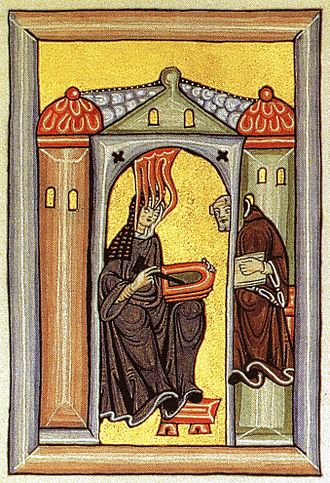
Saint Hildegarde von Bingen, a Woman for All Seasons
Hildegarde von Bingen (+1179) is one of the newest saints in the liturgical calendar, canonized ‘equipollently’ by Pope Benedict XVI on May 12, 2012 (since she had always been regarded as a saint, but never officially canonized). Her feast was extended to the universal Church, now on the same day as Saint Robert Bellarmine (so choose your saint!). The same Pontiff also declared her one of the elite Doctors of the Church that same year (there are only 37 of them in the whole history of the Church). That was on October 7, 2012, fittingly, the feast of the Most Holy Rosary. So we have on this propitious day we celebrate two holy Doctors.
As a young girl, Hildegarde was offered as an oblate to the Benedictines (as would Saint Thomas Aquinas a century and a half hence), making her final vows on All Saints’ Day in 1112. She spent her life following the rule of Saint Benedict, going on to found and govern a number of convents, and leading many to holiness.
Saint Hildegarde was a remarkable woman, cultured, erudite, balanced, deeply prayerful, and gifted with ongoing mystical visions of God. She saw all reality in the light of human creatures, and all the world, to Him, journeying towards the eschaton, all of which she recorded in three treatises. These were approved by Saint Bernard of Clairvaux, a fellow future Doctor of the Church, whom she adopted as her spiritual director, and Pope Eugenius III, who asked that they be published. (The Pope, by the way, had also been a disciple of Saint Bernard, and a Cistercian with him at Clairaux. The Catholic Church is certainly interconnected!)
A renaissance woman three centuries before that historical era, Hildegarde was renowned not only for her spiritual writings, but her compositions in music, her scientific investigations, in medicine and other fields, her journeyings throughout Europe preaching (not at Mass, of course, but her words moved many). She was not afraid to rebuke the powerful, including the Emperor himself, Frederick Barbarossa, warning him that his very soul was at stake with his immoral conduct (we need a new Hildegarde!). As Pope Benedict XVI described her:
This great woman truly stands out crystal clear against the horizon of history for her holiness of life and the originality of her teaching. And, as with every authentic human and theological experience, her authority reaches far beyond the confines of a single epoch or society; despite the distance of time and culture, her thought has proven to be of lasting relevance.
She prayed and lived in the convent she had founded at Bingen, corresponding widely with people across Europe (we still have many of her letters), until her death at the then-very-venerable age of 81.
Pope Benedict gave two addresses on Hildegarde in 2010 that may be found here and here.
Here also is his letter declaring her a Doctor of the Church:
And, finally, for a taste of her music, quite mediaeval, and transcendent:

Carney’s Amoral Majority
After five defections – euphemistically described as ‘crossing the floor’ – and three by-elections, Mark Carney and his Liberals how have their coveted majority. One wonders what bowls of pottage were offered in back-room deals. In the archaic monarchical system that is the Dominion of Canada, this majority allows the newly-minted Prime Minister to rule[…]Continue reading→

Saint Kateri , Canada’s Protectress
This was the title given to Saint Kateri Tekakwitha, by Pope Benedict XVI, when he canonized her on October 28th, 2012, along with six others, in Saint Peter’ Square (she had been beatified by Pope John Paul II back in 1980). With Saint Joseph as our protector, along with the Canadian martyrs, we seem to[…]Continue reading→

A Tale of Two Benedicts
A grace-filled Holy Week to all our readers! As we await and prepare for the Resurrection about to dawn upon us, we might keep in mind two Benedicts: Pope Emeritus Benedict XVI, requiescat in pace, elected on this day in 2005; and today’s commemoration of the mystic pilgrim, Benedict Joseph Labre, who died on this[…]Continue reading→

My Name is Bernadette
April 16th is a propitious day, for besides the anniversary of Father de Valk’s death, who founded Catholic Insight in its print form decades ago, and the commemoration of the ‘two Benedicts’, mentioned in accompanying posts, today we also recall Saint Bernadette Soubirous, the young visionary to whom the Virgin Mary appeared numerous times at[…]Continue reading→

Saint Lydwina of Schiedam and Suffering Joyfully
Saint Lydwina of Schiedam (1380 – 1433) was one of the countless and glorious ‘victim souls’ in the history of the Church, those whose lives are filled with suffering, often of an unimaginable intensity, but who suffer joyfully. She was a fifteen-year old Dutch girl, out skating one day, when she fell and broke one[…]Continue reading→

The Glorious Martyrdoms of Martin and Maximus
As we enter into Eastertide, we recall on this 13th of April Pope Saint Martin I (+655), one of the noblest, if most tragic, of the successors of Saint Peter. Born in Umbria, Italy, he was of noble lineage, with great intelligence combined with charity and love of the poor and the Church. While still[…]Continue reading→

Canonizing Sister Faustina and Divine Mercy
HOMILY OF THE HOLY FATHER MASS IN ST PETER’S SQUARE FOR THE CANONIZATION OF SR MARY FAUSTINA KOWALSKA Sunday, 30 April 2000 1. “Confitemini Domino quoniam bonus, quoniam in saeculum misericordia eius”; “Give thanks to the Lord for he is good; his steadfast love endures for ever” (Ps 118: 1). So the Church sings on the Octave of[…]Continue reading→

Saint Stanislaus of Szczepanów
We celebrate Saint Stanislaus today (+ April 11, 1079), in light of this Easter Octave, a bishop and martyr who accepted the episcopacy only at the direct order of Pope Alexander II. He proved a wise and courageous leader of his flock, put to death by his own king, Boleslaus, for rebuking the monarch’s ‘immoral[…]Continue reading→

Saint Gemma Galgani
On this April 11th, in 1903 – the same year that the Italian Guiseppe Sarto was elected Pope later that summer as Pius X – a lovely, young Italian woman died, by the name of Gemma Galgani. She lived a brief life of 24 years, as did a number of other young saints, including Pier[…]Continue reading→

An Ideological and Improper Translation
I noticed something odd with the psalm reading at Mass the other day. Our bishops’ conference here in Canada has decreed that the Mass in English – Novus Ordo – use the ‘NRSV’, the ‘New Revised Standard Version’, an ‘updated’ translation of the original RSV, first published in 1952. This ‘new translation’ has the tendency[…]Continue reading→