
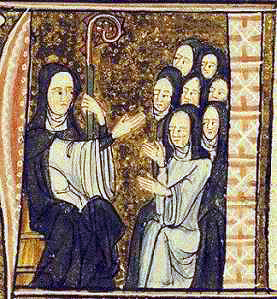
Pope Benedict and Saint Hildegarde of Bingen
BENEDICT XVI
GENERAL AUDIENCE
Papal Summer Residence, Castel Gandolfo
Wednesday, 1st September 2010
Saint Hildegard of Bingen
Dear Brothers and Sisters,
In 1988, on the occasion of the Marian Year, Venerable John Paul II wrote an Apostolic Letter entitled Mulieris Dignitatem on the precious role that women have played and play in the life of the Church. “The Church”, one reads in it, “gives thanks for all the manifestations of the feminine “genius’ which have appeared in the course of history, in the midst of all peoples and nations; she gives thanks for all the charisms that the Holy Spirit distributes to women in the history of the People of God, for all the victories which she owes to their faith, hope and charity: she gives thanks for all the fruits of feminine holiness” (n. 31).
Various female figures stand out for the holiness of their lives and the wealth of their teaching even in those centuries of history that we usually call the Middle Ages. Today I would like to begin to present one of them to you: St Hildegard of Bingen, who lived in Germany in the 12th century. She was born in 1098, probably at Bermersheim, Rhineland, not far from Alzey, and died in 1179 at the age of 81, in spite of having always been in poor health. Hildegard belonged to a large noble family and her parents dedicated her to God from birth for his service. At the age of eight she was offered for the religious state (in accordance with the Rule of St Benedict, chapter 59), and, to ensure that she received an appropriate human and Christian formation, she was entrusted to the care of the consecrated widow Uda of Gölklheim and then to Jutta of Spanheim who had taken the veil at the Benedictine Monastery of St Disibodenberg. A small cloistered women’s monastery was developing there that followed the Rule of St Benedict. Hildegard was clothed by Bishop Otto of Bamberg and in 1136, upon the death of Mother Jutta who had become the community magistra (Prioress), the sisters chose Hildegard to succeed her. She fulfilled this office making the most of her gifts as a woman of culture and of lofty spirituality, capable of dealing competently with the organizational aspects of cloistered life. A few years later, partly because of the increasing number of young women who were knocking at the monastery door, Hildegard broke away from the dominating male monastery of St Disibodenburg with her community, taking it to Bingen, calling it after St Rupert and here she spent the rest of her days. Her manner of exercising the ministry of authority is an example for every religious community: she inspired holy emulation in the practice of good to such an extent that, as time was to tell, both the mother and her daughters competed in mutual esteem and in serving each other.
(To continue reading, please see here)
(For Pope Benedict’s second address, please see here)
(For the Pope’s decree declaring Hildegarde a Doctor of the Church, please see here).

Saint Kateri , Canada’s Protectress
This was the title given to Saint Kateri Tekakwitha, by Pope Benedict XVI, when he canonized her on October 28th, 2012, along with six others, in Saint Peter’ Square (she had been beatified by Pope John Paul II back in 1980). With Saint Joseph as our protector, along with the Canadian martyrs, we seem to[…]Continue reading→

Remembering Father Alphonse de Valk
(Today marks the sixth anniversary of the death of Father Alphonse de Valk, C.S.B., a faithful, courageous and indefatigable Basilian priest, pro-life-and-family apostle, and the founder of Catholic Insight magazine. Here is what we wrote those on his entering into eternity five years ago, as we continue to remember him in our prayers and thoughts)[…]Continue reading→

A Tale of Two Benedicts
A grace-filled Holy Week to all our readers! As we await and prepare for the Resurrection about to dawn upon us, we might keep in mind two Benedicts: Pope Emeritus Benedict XVI, requiescat in pace, elected on this day in 2005; and today’s commemoration of the mystic pilgrim, Benedict Joseph Labre, who died on this[…]Continue reading→

My Name is Bernadette
April 16th is a propitious day, for besides the anniversary of Father de Valk’s death, who founded Catholic Insight in its print form decades ago, and the commemoration of the ‘two Benedicts’, mentioned in accompanying posts, today we also recall Saint Bernadette Soubirous, the young visionary to whom the Virgin Mary appeared numerous times at[…]Continue reading→

Saint Lydwina of Schiedam and Suffering Joyfully
Saint Lydwina of Schiedam (1380 – 1433) was one of the countless and glorious ‘victim souls’ in the history of the Church, those whose lives are filled with suffering, often of an unimaginable intensity, but who suffer joyfully. She was a fifteen-year old Dutch girl, out skating one day, when she fell and broke one[…]Continue reading→

The Glorious Martyrdoms of Martin and Maximus
As we enter into Eastertide, we recall on this 13th of April Pope Saint Martin I (+655), one of the noblest, if most tragic, of the successors of Saint Peter. Born in Umbria, Italy, he was of noble lineage, with great intelligence combined with charity and love of the poor and the Church. While still[…]Continue reading→

Canonizing Sister Faustina and Divine Mercy
HOMILY OF THE HOLY FATHER MASS IN ST PETER’S SQUARE FOR THE CANONIZATION OF SR MARY FAUSTINA KOWALSKA Sunday, 30 April 2000 1. “Confitemini Domino quoniam bonus, quoniam in saeculum misericordia eius”; “Give thanks to the Lord for he is good; his steadfast love endures for ever” (Ps 118: 1). So the Church sings on the Octave of[…]Continue reading→

Divine Mercy Sunday – An Echo of Every Mass
Reach out your hand and put it in my side. Do not doubt but believe’… ‘My Lord and my God!’ (Jn. 20:18)). Today is Divine Mercy Sunday, and as we celebrate the end of the Easter Octave, we contemplate the wounded side of our Saviour, the Church’s source of life. On Good Friday in the[…]Continue reading→

Saint Stanislaus of Szczepanów
We celebrate Saint Stanislaus today (+ April 11, 1079), in light of this Easter Octave, a bishop and martyr who accepted the episcopacy only at the direct order of Pope Alexander II. He proved a wise and courageous leader of his flock, put to death by his own king, Boleslaus, for rebuking the monarch’s ‘immoral[…]Continue reading→
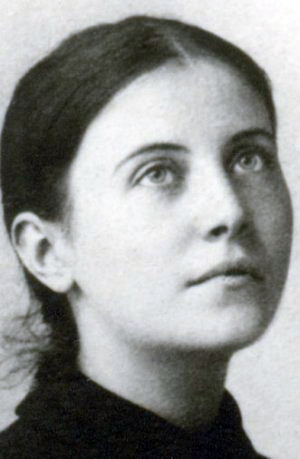
Saint Gemma Galgani
On this April 11th, in 1903 – the same year that the Italian Guiseppe Sarto was elected Pope later that summer as Pius X – a lovely, young Italian woman died, by the name of Gemma Galgani. She lived a brief life of 24 years, as did a number of other young saints, including Pier[…]Continue reading→