
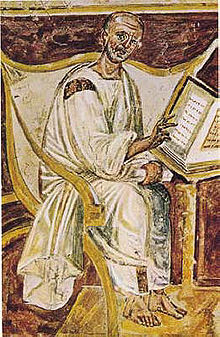
The Late, Great, Saint Augustine
On August 28th, we celebrate with great joy the feast day of St Augustine of Hippo, the great doctor of the Church.
This fourth and fifth century bishop has much to teach us in life. He lived in sin for many years, but the constant prayer accompanied by floods of tears of his mother, St Monica, touched the heart of the proud Augustine. Later on, in his Confessions, St Augustine would humbly admit his folly of living without God when he said: Without you, what am I to myself but a guide to my own self-destruction? Augustine came to realize that the liberty he claimed to have was simply that of escaping from reality. He himself confessed: The liberty I loved was merely that of a runaway.
It was when he hit bottom that he became aware that he had to return to God to find his real peace his restless heart was craving for. In his Confessions Augustine opens our eyes against procrastination. How destructive it is when we keep postponing our conversion! He writes: I myself was exceedingly astonished as I anxiously reflected how long a time had elapsed since the nineteenth year of my life, when I began to burn with a zeal for wisdom, planning that when I had found it I would abandon all the empty hopes and lying follies of hollow ambitions. And here I was already thirty, and still mucking about in the same mire in a state of indecision, avid to enjoy present fugitive delights which were dispersing my concentration, while I was saying: ‘Tomorrow I shall find it…’
Once he took the decision to follow Jesus seriously Augustine started to be healed. In Augustine’s experience, a great source of healing was certainly that coming from the Word of God, precisely the Psalms. He says: How I cried out to you in those Psalms, and how they kindled my love for you! I was fired by an enthusiasm to recite them, were it possible, to the entire world in protest against the pride of the human race. The more he entrusted himself to God’s mercy the more he could see that conversion has nothing to do with earthly education. He admitted this when he confessed: Uneducated people are rising up and capturing heaven, and we with our high culture without any heart–see where we roll in the mud of flesh and blood. Is it because they are ahead of us that we are ashamed to follow?
Hence, the example of this uneducated but humble people brought to attention a very important reality for Augustine: how liberating it is to admit one’s faults sincerely in order to be released and be healed from their disastrous effect. He said: I am more delighted to have declared the truth than to be praised for it. If I were given the choice of being universally admired, though mad or wholly wrong, or of being universally abused, though steadfast and utterly certain in possessing the truth, I see which I should choose.
It is because he was at peace with the truth, God’s presence, in himself, that Augustine could thrive in holiness. If we want that the following teachings make sense and bring about that much-needed healing we all need deep down in our hearts, they are precisely to be seen, reflected and acted upon from this perspective.
As a result of his personal conversion St Augustine teaches us a number of things that can help us in our continual conversion. First, faith has to do with phenomena not visible by the human eye. However, the fruit of faith is the direct experience we have of the things we cannot humanly see. He says: Faith is to believe what you do not see; the reward of this faith is to see what you believe. Second, God loves you and me personally. Augustine explains: God loves each of us as if there were only one of us. Third, humility and the lack of it is the admittance or the exit from God’s saving grace. The Bishop of Hippo teaches: It was pride that changed angels into devils; it is humility that makes men as angels. Fourth, if we want to progress in the spiritual life we just have to keep up trying. This makes sense since, for Augustine, Will is to grace as the horse is to the rider. This lead Augustine to conclude: Men do not fail; they give up trying.
Fifth, Augustine reminds us that if we are to desire God we are to desire to pray to Him. The desire is thy prayers; and if thy desire is without ceasing, thy prayer will also be without ceasing. The continuance of your longing is the continuance of your prayer. Sixth, confession is the starting point of genuine conversion. Since he experienced this first-hand that Augustine could affirm: The confession of evil works is the first beginning of good works. Seventh, forgiveness and the acceptance of it from our part brings the real healing in our injured self as well as it protects us from loosing ourselves once more. Thus says Augustine: Forgiveness is the remission of sins. For it is by this that what has been lost, and was found, is saved from being lost again.
Eighth, our search for God does not end but keeps going on. From his personal experience Augustine could say: God is best known in not knowing him. Ninth, Augustine teaches us of how we can gain friends. Let us appreciate his cute advice: If two friends ask you to judge a dispute, don’t accept, because you will lose one friend; on the other hand, if two strangers come with the same request, accept because you will gain one friend. Tenth, as one of the fruits of the Holy Spirit, kindness is the sign that a person is internally free whereas the evil of arrogance is the result of its very opposite. Augustine declares: He that is kind is free, though he is a slave; he that is evil is a slave, though he be a king.
Let us now pray this prayer with St Augustine, a prayer which he himself wrote:
Lord Jesus, let me know myself and know you,
And desire nothing, save only you.
Let me hate myself and love you.
Let me do everything for the sake of you.
Let me humble myself and exalt you.
Let me think of nothing except you.
Let me die to myself and live in you.
Let me accept whatever happens as from you.
Let me banish self and follow you,
And ever desire to follow you.
Let me fly from myself and take refuge in you,
That I may deserve to be defended by you.
Let me fear for myself, let me fear you,
And let me be among those who are chosen by you.
Let me distrust myself and put my trust in you.
Let me be willing to obey for the sake of you.
Let me cling to nothing, save only to you,
And let me be poor because of you.
Look upon me, that I may love you.
Call me, that I may see you,
And for ever enjoy you. Amen.
Is not St Augustine a faithful companion in our ongoing journey of conversion?

Saint Kateri , Canada’s Protectress
This was the title given to Saint Kateri Tekakwitha, by Pope Benedict XVI, when he canonized her on October 28th, 2012, along with six others, in Saint Peter’ Square (she had been beatified by Pope John Paul II back in 1980). With Saint Joseph as our protector, along with the Canadian martyrs, we seem to[…]Continue reading→

Remembering Father Alphonse de Valk
(Today marks the sixth anniversary of the death of Father Alphonse de Valk, C.S.B., a faithful, courageous and indefatigable Basilian priest, pro-life-and-family apostle, and the founder of Catholic Insight magazine. Here is what we wrote those on his entering into eternity five years ago, as we continue to remember him in our prayers and thoughts)[…]Continue reading→

A Tale of Two Benedicts
A grace-filled Holy Week to all our readers! As we await and prepare for the Resurrection about to dawn upon us, we might keep in mind two Benedicts: Pope Emeritus Benedict XVI, requiescat in pace, elected on this day in 2005; and today’s commemoration of the mystic pilgrim, Benedict Joseph Labre, who died on this[…]Continue reading→

My Name is Bernadette
April 16th is a propitious day, for besides the anniversary of Father de Valk’s death, who founded Catholic Insight in its print form decades ago, and the commemoration of the ‘two Benedicts’, mentioned in accompanying posts, today we also recall Saint Bernadette Soubirous, the young visionary to whom the Virgin Mary appeared numerous times at[…]Continue reading→

Saint Lydwina of Schiedam and Suffering Joyfully
Saint Lydwina of Schiedam (1380 – 1433) was one of the countless and glorious ‘victim souls’ in the history of the Church, those whose lives are filled with suffering, often of an unimaginable intensity, but who suffer joyfully. She was a fifteen-year old Dutch girl, out skating one day, when she fell and broke one[…]Continue reading→

The Glorious Martyrdoms of Martin and Maximus
As we enter into Eastertide, we recall on this 13th of April Pope Saint Martin I (+655), one of the noblest, if most tragic, of the successors of Saint Peter. Born in Umbria, Italy, he was of noble lineage, with great intelligence combined with charity and love of the poor and the Church. While still[…]Continue reading→
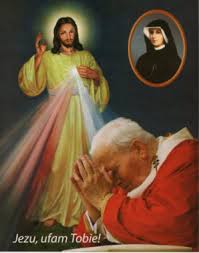
Canonizing Sister Faustina and Divine Mercy
HOMILY OF THE HOLY FATHER MASS IN ST PETER’S SQUARE FOR THE CANONIZATION OF SR MARY FAUSTINA KOWALSKA Sunday, 30 April 2000 1. “Confitemini Domino quoniam bonus, quoniam in saeculum misericordia eius”; “Give thanks to the Lord for he is good; his steadfast love endures for ever” (Ps 118: 1). So the Church sings on the Octave of[…]Continue reading→

Divine Mercy Sunday – An Echo of Every Mass
Reach out your hand and put it in my side. Do not doubt but believe’… ‘My Lord and my God!’ (Jn. 20:18)). Today is Divine Mercy Sunday, and as we celebrate the end of the Easter Octave, we contemplate the wounded side of our Saviour, the Church’s source of life. On Good Friday in the[…]Continue reading→

Saint Stanislaus of Szczepanów
We celebrate Saint Stanislaus today (+ April 11, 1079), in light of this Easter Octave, a bishop and martyr who accepted the episcopacy only at the direct order of Pope Alexander II. He proved a wise and courageous leader of his flock, put to death by his own king, Boleslaus, for rebuking the monarch’s ‘immoral[…]Continue reading→
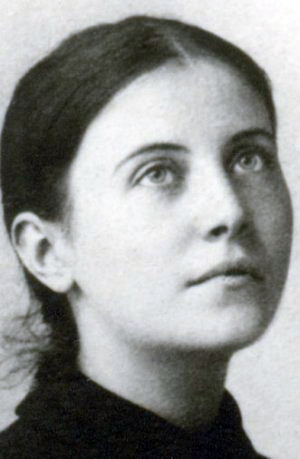
Saint Gemma Galgani
On this April 11th, in 1903 – the same year that the Italian Guiseppe Sarto was elected Pope later that summer as Pius X – a lovely, young Italian woman died, by the name of Gemma Galgani. She lived a brief life of 24 years, as did a number of other young saints, including Pier[…]Continue reading→