
Crecy and the Changing Face of War
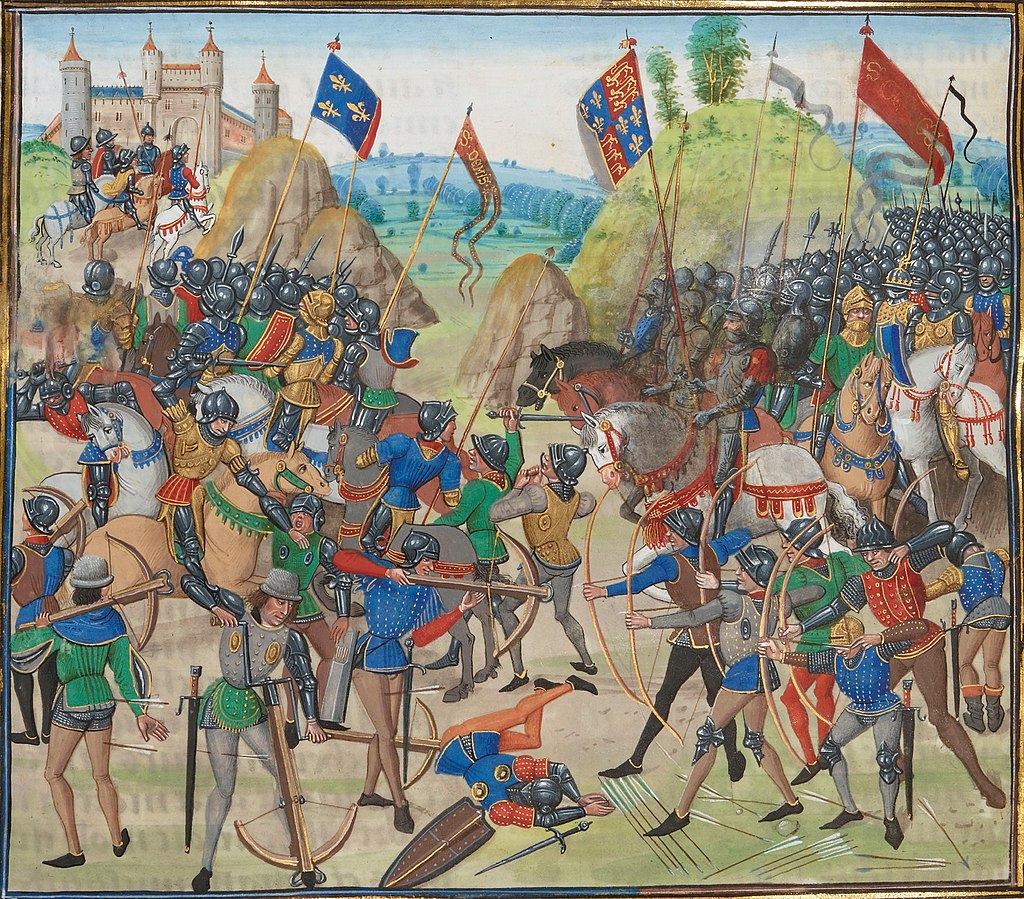
The protracted Hundred Years’ War, (if the term protracted is not redundant) which was more like a series of dynastic wars mainly between French and England, lasted more than a decade longer than its name would imply (1337 – 1453). This day marks the anniversary of one of the most significant of battles, both for the war, and for warfare, on the fields of Crecy, in Normandy. The English, under Edward III, invaded across the Channel with a force of 14,000, with most of these (10,000 being ‘longbowmen), while the French counter-attacked with a roughly equal force of 12,000, armored mounted knights, along with crossbowmen.
The bloody battle was almost entirely one-sided: The French had gone in expecting mediaeval close combat, for which the war horses, knights and crossbows were ideal. But they were slaughtered by the English longbows, who would shoot thousands of arrows high into the air, in a parabolic arch, with much longer range (about 400 yards, three times the length of a soccer pitch) than the crossbows, and these heavy arrows would rain down on the French like hellfire, piercing through their armour, and their bodies.
It was an early form of the now-ubiquitous various forms of indiscriminate death-from-a-distance, the prelude to total war, and annihilating the enemy. The longbow became the musket, the rifle, cannon, the artillery gun, and now the missile, launched from thousands of miles away, whether conventional, or, alas, nuclear.
One could argue there is something gained in this, at least in a technological sense, but there is also something deeply lost, morally speaking. At least in close combat – say, with swords – one knew whom one was attacking, and why. For all war must in the end be defensive war, the protection of kith and kin, of what one holds closest and dearest, that an enemy is intent on destroying. If fighting there must be, let us look our enemy in the face, indeed in the very eye, so he knows what we do, and why we do it. Just so, we might fight like men, and let God decide.
Carney’s Amoral Majority
After five defections – euphemistically described as ‘crossing the floor’ – and three by-elections, Mark Carney and his Liberals how have their coveted majority. One wonders what bowls of pottage were offered in back-room deals. In the archaic monarchical system that is the Dominion of Canada, this majority allows the newly-minted Prime Minister to rule[…]Continue reading→

Saint Kateri , Canada’s Protectress
This was the title given to Saint Kateri Tekakwitha, by Pope Benedict XVI, when he canonized her on October 28th, 2012, along with six others, in Saint Peter’ Square (she had been beatified by Pope John Paul II back in 1980). With Saint Joseph as our protector, along with the Canadian martyrs, we seem to[…]Continue reading→
A Closed, Unsustainable, Descending Loop
As a follow-up to my thoughts on Payette’s payout, here be a stark image of where are here in Canada. As the graph shows in, well, graphic terms, since 2025, the public sector has contributed to 95.5% of economic growth. The private sector – which funds the public sector, or is supposed to – has[…]Continue reading→

A Tale of Two Benedicts
A grace-filled Holy Week to all our readers! As we await and prepare for the Resurrection about to dawn upon us, we might keep in mind two Benedicts: Pope Emeritus Benedict XVI, requiescat in pace, elected on this day in 2005; and today’s commemoration of the mystic pilgrim, Benedict Joseph Labre, who died on this[…]Continue reading→

My Name is Bernadette
April 16th is a propitious day, for besides the anniversary of Father de Valk’s death, who founded Catholic Insight in its print form decades ago, and the commemoration of the ‘two Benedicts’, mentioned in accompanying posts, today we also recall Saint Bernadette Soubirous, the young visionary to whom the Virgin Mary appeared numerous times at[…]Continue reading→
Presidential Pardon of Weronika Krawczyk
As a good news, follow-up to our story from Poland, of the persecution of Weronika Krawczyk for her pro-life views, we heard that she has been granted a presidential pardon. One might still wonder why one needs a presidential pardon for simply holding the long-held belief that the child within the womb is a child,[…]Continue reading→

Saint Lydwina of Schiedam and Suffering Joyfully
Saint Lydwina of Schiedam (1380 – 1433) was one of the countless and glorious ‘victim souls’ in the history of the Church, those whose lives are filled with suffering, often of an unimaginable intensity, but who suffer joyfully. She was a fifteen-year old Dutch girl, out skating one day, when she fell and broke one[…]Continue reading→

The Glorious Martyrdoms of Martin and Maximus
As we enter into Eastertide, we recall on this 13th of April Pope Saint Martin I (+655), one of the noblest, if most tragic, of the successors of Saint Peter. Born in Umbria, Italy, he was of noble lineage, with great intelligence combined with charity and love of the poor and the Church. While still[…]Continue reading→
Pope Leo and a Rosary for Peace
Pope Leo XIV has asked Catholics across the world to join him in a Rosary for peace today, at 18:00 Rome time (6 pm), which would be noon from where I write (EST). If you are able, whether at that time or another, and in whatever way you pray, to join in intercession with the[…]Continue reading→
Payette’s Payout
I was glancing through some headlines, and noticed a mention of Julie Payette – engineer and astronaut and sometime the Queen’s representative in Canada – which brought back vague memories. She was appointed Governor-General by Justin Trudeau in 2017. Ms. Payette resigned in 2021, amidst claims that she created a ‘toxic work environment’, with allegations[…]Continue reading→