

Avoiding Catholic Syncretism
Throughout her history, the Catholic Church has always had to struggle to address controversial issues of all kinds, and what we are facing in our own age is nothing new. Open your bible to the New Testament and you will read about the Apostles themselves had controversies, even with each other. In what has been termed the Antioch incident (Galatians, 2), St Paul “rebukes” St Peter over the maintaining Jewish practices in the Catholic faith. Today, there is certainly no shortage of controversial issues, and no shortage of Catholics, of all types, “rebuking” one another. What is perhaps unique in our time is not so much the number of controversies within the Church, but rather the amount of information surrounding each controversy and the ease of access to that information. Today, anyone can get “informed” on the “facts and issues” surrounding Church politics and scandals of all types. What effect does the amount of, and ease of access to, information, have on our perception of the condition of the Church?
Prior to modern technology, controversies in the Church were largely restricted geographically, and knowledge of the issues surrounding them was limited, and even that only a few of them. Today the opposite is true. Hundreds of pages of information from all over the world can be downloaded at the click of a button on any modern ‘Antiochian Incident’ in the Church. One can see the “spirit of rebuke” is alive and well in modern Catholicism.
You may be thinking: From where else am I supposed to get information so that I come to an understanding of issues challenging the Church? Consider the following:
- On one hand, the amount of, and ease of access to, information may well be a good thing, in the sense that the average Catholic can get “informed and educated” from a number of Catholic social media platforms and news agencies. Each of these carefully sifts through mounds of information and interprets the significance of, and relevance of, the information made available. The information is edited, packaged and presented in a commentary style which “informs and educates” the average Catholic on Catholic issues.
- HOWEVER, the amount of, and ease of access to information, may not be a good thing, if the average Catholic relies solely on getting “informed and educated” from Catholic social media platforms, as their source of Catholic authority. Relying solely on information from media sources is an issue confronting the Church and why this unique modern-day reality needs to be addressed.
To be clear, most Catholic media platforms do not claim to speak authoritatively for the Church. Catholic media platforms become an issue when Catholics regard these platforms as the only credible sources they trust and come to regard them as their sole authority by default. A truthful and accurate perception of the Church has always been crucial and central to the growth of Catholic families. If we are not cautious with the information available to us, our perceptions of Holy Mother Church can become skewed from media bias and misinterpretation.
Rarely does one ever equate social media with the question of authority. To whom are to we give authority to “inform and educate” us on issues is of vital importance? Like you, I have my favorite social media sites which I listen to on a regular basis to inform me on issues in the Church. However, there must be a balance with the teaching tradition of the Church Magisterium. Authority must be given to the Catechism of the Catholic Church and to the Holy Scriptures to “inform and educate” us. Without the authority of the teaching Magisterium of the Church and the Holy Scriptures to rightly inform and educate, a person of faith can be led into false perceptions and suffer from what can be termed: Catholic Syncretism.
One night, as I lay in bed, trying to shut my mind off in order to fall asleep, my thoughts kept turning to the real possibility that I was suffering from Catholic Syncretism. How did I know with absolute certainty;
- That my beliefs were all completely true and not mixed with non-Catholic beliefs?
- That I had not unknowingly embraced something contrary to the Catholic faith, contrary to the Scriptures?
- Did I know the Catechism well enough, to be able to distinguish between a well-disguised lie and the truth?
- Was I familiar enough with Scripture to be able to identify when Scripture was being misused or taken out of context?
Modern issues in the Church are challenging to say the least. When I wanted to better understand a controversy in the Church, what did I do? I did not open my Catechism, I did not open my Bible – I did what many modern Catholics do, I searched the internet. I clicked on popular Catholic YouTube channels that explain controversies in easy-to-understand terms. Complex issues are simplified so that I feel like I have a good and clear understanding of struggles in the Church.
Since there is no shortage of modern-day ‘Antiochean Incidents’ to report, today’s Catholic media climate is certainly “alive” with dialogue and endless discussions about issues and struggles facing the Church in 2021. My intention, however, is not to bash, discredit, or to pass judgement on the excellent Catholic programing available on social media. I have the greatest respect for the work of many in Catholic media who work tirelessly to research and inform the average Catholic on important issues and controversies in the Church. My intention is focused on the question of effect. How would you answer the following questions?
- What effect does the ease and inundation of information, coupled with numerous media commentaries, have on our Catholic perception and understanding?
- How does modern media help shape our opinions on the issues confronting the Catholic Church?
When I relied only on social media to give me answers to help me understand controversial issues in the Church, I lacked the most important contributor of growth in my faith, I lacked questions! Listening to, or reading Catholic social media commentaries and blogs, provided me with easy access to answers without the need for contemplation or study of my own. They were my authority on issues. My perception of the condition of the Church was formed from listening to my favorite Catholic social media personalities. Never did the thought ever cross my mind that they could be wrong, or unknowingly reporting error, or misinterpreting the issue. Have you ever had this thought?
Falsehoods, disguised to look as truths, have deceived many since the Luciferian Rebellion. The forbidden fruit, on the tree of knowledge of good and evil, has been picked clean over the centuries, and in our day its fruit is easily picked and accessed electronically. A google of information, which is a 1 followed by 100 zeros, is available to most anyone, everywhere, anytime. Never in history has the probability of Catholic syncretism been greater. According to some statistics, there are over 2.5 quintillion bytes of data, (1 with 18 zeros), created on a daily basis and accelerating annually. How many times, over the years, had I “googled” questions concerning my Catholic faith, searching for the “right” answer?
I lacked what I believe is a common symptom among many modern Catholics. I lacked a passionate holy ‘studiosity’ – the virtue of seeking the truth – which is a crucial defense against spiritual lethargy, and against the dangers of a personal Catholic syncretic faith. Over the years my faith became a combination of different religious beliefs, schools of thought, and even some modernist ideologies, all mixed up with what I was led to believe to be Catholic. My Catholic faith was a piecemeal of ideas and concepts; it was in short, watered-down Catholicism.
Catholic syncretism is real. It is a destructive force, whether on a personal or institutional level. There is the real danger of syncretism in some Catholic educational institutions, clerical and religious formation houses, and some parish level catechesis and religious education programs. Liturgical abuses and the preaching of modernist ideologies are, in some instances, perhaps unknowingly permitted due to the ways syncretism has been allowed to enter, unchecked, into parish life and parish ministry over the years.
We are truly blessed to be Catholics. We have an extraordinarily beautiful Catholic faith with the plenary of truth. The Holy Sacrifice of the Mass is the greatest gift of grace our Lord Jesus Christ left to the world, and Catholics have the honour of partaking in that Sacrifice, and, when in a state of Grace, commune with His very Body, Blood, Soul and Divinity. For this reason alone, out of sheer gratitude, a self-reflection on what we personally believe as Catholics, to ensure our Catholic beliefs are not syncretic, is a small commitment for such a heavenly gift. The average Catholic faithful must become a person of serious study in order to detect syncretism and its destructive influence.

Saint Kateri , Canada’s Protectress
This was the title given to Saint Kateri Tekakwitha, by Pope Benedict XVI, when he canonized her on October 28th, 2012, along with six others, in Saint Peter’ Square (she had been beatified by Pope John Paul II back in 1980). With Saint Joseph as our protector, along with the Canadian martyrs, we seem to[…]Continue reading→

Remembering Father Alphonse de Valk
(Today marks the sixth anniversary of the death of Father Alphonse de Valk, C.S.B., a faithful, courageous and indefatigable Basilian priest, pro-life-and-family apostle, and the founder of Catholic Insight magazine. Here is what we wrote those on his entering into eternity five years ago, as we continue to remember him in our prayers and thoughts)[…]Continue reading→

My Name is Bernadette
April 16th is a propitious day, for besides the anniversary of Father de Valk’s death, who founded Catholic Insight in its print form decades ago, and the commemoration of the ‘two Benedicts’, mentioned in accompanying posts, today we also recall Saint Bernadette Soubirous, the young visionary to whom the Virgin Mary appeared numerous times at[…]Continue reading→
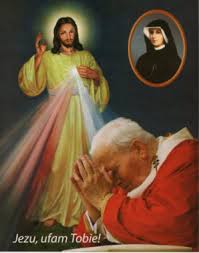
Canonizing Sister Faustina and Divine Mercy
HOMILY OF THE HOLY FATHER MASS IN ST PETER’S SQUARE FOR THE CANONIZATION OF SR MARY FAUSTINA KOWALSKA Sunday, 30 April 2000 1. “Confitemini Domino quoniam bonus, quoniam in saeculum misericordia eius”; “Give thanks to the Lord for he is good; his steadfast love endures for ever” (Ps 118: 1). So the Church sings on the Octave of[…]Continue reading→
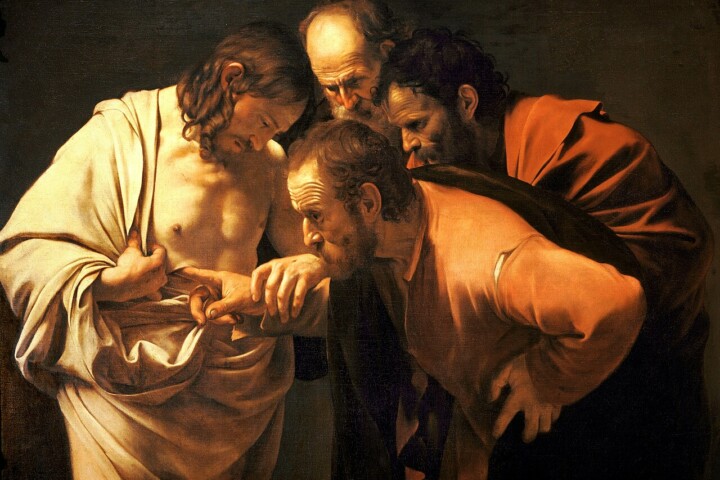
Divine Mercy Sunday – An Echo of Every Mass
Reach out your hand and put it in my side. Do not doubt but believe’… ‘My Lord and my God!’ (Jn. 20:18)). Today is Divine Mercy Sunday, and as we celebrate the end of the Easter Octave, we contemplate the wounded side of our Saviour, the Church’s source of life. On Good Friday in the[…]Continue reading→

Saint Stanislaus of Szczepanów
We celebrate Saint Stanislaus today (+ April 11, 1079), in light of this Easter Octave, a bishop and martyr who accepted the episcopacy only at the direct order of Pope Alexander II. He proved a wise and courageous leader of his flock, put to death by his own king, Boleslaus, for rebuking the monarch’s ‘immoral[…]Continue reading→
First Holy Communion: Sermon from May 16, 1943
Here is a sermon from the good old days by +Rev. Msgr. Vincent Nicholas Foy (August 14, 1915 – March 13, 2017), from 1943. Readers may recall that Pope Saint Pius X, by the decree Quam Singulari in 1910, lowered the customary age of reception of Holy Communion – after the rigours of the plague[…]Continue reading→
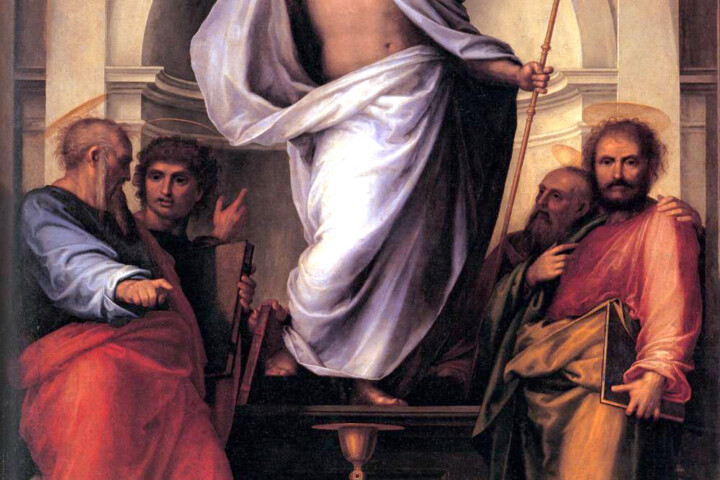
In the Glorious Light of Easter, Alleluia!
Set your minds on things that are above, not on things that are on earth, for you have died, and your life is hidden with Christ in God. When Christ who is your life is revealed, then you also will be revealed with him in glory (Col. 3:3-4). The Resurrection of Our Lord and Saviour[…]Continue reading→
An Ancient Homily for Holy Saturday
The time between Good Friday and Easter Sunday is one of waiting, in silence, as the world wonders – anticipates – what will happen, after the death of Christ. We re-live this time each year in the anamnesis of our liturgy, and in turn look forward to the glorious re-creation of all things at the[…]Continue reading→
Europe’s Long Descent
(As we meditate on this day on Christ’s burial, and His descent into hell, it is fitting to ponder here with contributor Peter Marcus how the world seems to be heading there as well. The difference is that, although God cannot ‘redeem’ hell, nor those therein, He can and did redeem the world. There is[…]Continue reading→