
Saint Lawrence O’Toole and His Irish Heart
November 14th marks the memorial of Saint Lawrence O’Toole (Lorcán Ua Tuathail, in the original Gaelic, 1125 – 1180). Lawrence was an Irish monk, abbot and, eventually, Archbishop of Dublin, helping to further establish the Church at the dawn of the high Middle Ages in Ireland, as united with the Pope – the era of cathedrals and chapters, universities and colleges, new religious orders and friars. He was canonized in 1225, the year that saw the birth of Thomas Aquinas. I have something of a devotion to this Celt, not only sharing his Irish lineage, but Saint Lawrence is also the patron of the ‘other’ parish in the town in which I live. (There are two in this small town – one built by the Polish, Saint Hedwig’s, and the other by the Irish).
Like all saints, Lawrence lived an ascetical life, bringing his body and its wayward desires under the control of reason and grace. He never ate meat, fasted on Fridays, and drank almost no wine. But he always provided for his guests, and would join them in their feasts, hiding his own abstemiousness, sipping water that was coloured to look like wine.
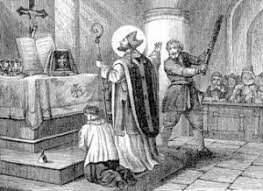
Lawrence had his exterior struggles: First, with the invading Normans, who were ravaging the coastal towns. And, like Thomas a Becket, whose contemporary he was, he had his controversies with the headstrong English king, Henry II, as the latter strove to extend his dominion over all of ‘Great Britain’, including Ireland, a tension continues into our own day. In one of those ironies of providence, a madman did try to murder Bishop O’Toole, as he prayed on the very spot in Canterbury’s great cathedral (centuries before its usurpation by the Protestants) where Becket had been martyred by minions of the king, hoping to send Lawrence to an early grave and heavenly reward. But the good bishop poured some holy water on the wound, and not only survived the blow to the head, but continued with his Mass, right as rain, without any apparent ill-effects.
(As an aside, I too prayed on that very spot in that cathedral, usurped by the Anglicans since Henry VIII’s depredation. I managed to recite a whole Rosary, but no one, for better or worse, tried to martyr me. An opportunity missed, I suppose).
Lawrence died while on a mission to England and France, Normandy. His relics were dispersed: His grave is in France; his head was sent to England, but his heart to Ireland, were it now resides in Christ Church cathedral in Dublin, whose construction he began and oversaw, but which now belongs to the Protestant ‘Church of Ireland’. Although the Protestants are not much into relics, they have kept his heart, fittingly enough. It was stolen in 2017, by thieves who thought the relic had ‘cursed their family’, causing ‘mental illness’. Quite the contrary, one would think. The sanity of the saints is what brings us back from sickness and death, of mind and body. In fact, miracles abounded soon after Saint Lawrence’s death, and likely continue to this day, if we had but a smidgen of faith, and eyes to see.
A tip led to the heart being found in a park, and now resides in its resting place, until the Christ that Lawrence loved so much should come again, and reunite all those relics in the resurrection.
Saint Lawrence O’Toole, ora pro nobis!

Carney’s Amoral Majority
After five defections – euphemistically described as ‘crossing the floor’ – and three by-elections, Mark Carney and his Liberals how have their coveted majority. One wonders what bowls of pottage were offered in back-room deals. In the archaic monarchical system that is the Dominion of Canada, this majority allows the newly-minted Prime Minister to rule[…]Continue reading→

Saint Kateri , Canada’s Protectress
This was the title given to Saint Kateri Tekakwitha, by Pope Benedict XVI, when he canonized her on October 28th, 2012, along with six others, in Saint Peter’ Square (she had been beatified by Pope John Paul II back in 1980). With Saint Joseph as our protector, along with the Canadian martyrs, we seem to[…]Continue reading→

A Tale of Two Benedicts
A grace-filled Holy Week to all our readers! As we await and prepare for the Resurrection about to dawn upon us, we might keep in mind two Benedicts: Pope Emeritus Benedict XVI, requiescat in pace, elected on this day in 2005; and today’s commemoration of the mystic pilgrim, Benedict Joseph Labre, who died on this[…]Continue reading→

My Name is Bernadette
April 16th is a propitious day, for besides the anniversary of Father de Valk’s death, who founded Catholic Insight in its print form decades ago, and the commemoration of the ‘two Benedicts’, mentioned in accompanying posts, today we also recall Saint Bernadette Soubirous, the young visionary to whom the Virgin Mary appeared numerous times at[…]Continue reading→

Saint Lydwina of Schiedam and Suffering Joyfully
Saint Lydwina of Schiedam (1380 – 1433) was one of the countless and glorious ‘victim souls’ in the history of the Church, those whose lives are filled with suffering, often of an unimaginable intensity, but who suffer joyfully. She was a fifteen-year old Dutch girl, out skating one day, when she fell and broke one[…]Continue reading→

The Glorious Martyrdoms of Martin and Maximus
As we enter into Eastertide, we recall on this 13th of April Pope Saint Martin I (+655), one of the noblest, if most tragic, of the successors of Saint Peter. Born in Umbria, Italy, he was of noble lineage, with great intelligence combined with charity and love of the poor and the Church. While still[…]Continue reading→

Canonizing Sister Faustina and Divine Mercy
HOMILY OF THE HOLY FATHER MASS IN ST PETER’S SQUARE FOR THE CANONIZATION OF SR MARY FAUSTINA KOWALSKA Sunday, 30 April 2000 1. “Confitemini Domino quoniam bonus, quoniam in saeculum misericordia eius”; “Give thanks to the Lord for he is good; his steadfast love endures for ever” (Ps 118: 1). So the Church sings on the Octave of[…]Continue reading→

Saint Stanislaus of Szczepanów
We celebrate Saint Stanislaus today (+ April 11, 1079), in light of this Easter Octave, a bishop and martyr who accepted the episcopacy only at the direct order of Pope Alexander II. He proved a wise and courageous leader of his flock, put to death by his own king, Boleslaus, for rebuking the monarch’s ‘immoral[…]Continue reading→

Saint Gemma Galgani
On this April 11th, in 1903 – the same year that the Italian Guiseppe Sarto was elected Pope later that summer as Pius X – a lovely, young Italian woman died, by the name of Gemma Galgani. She lived a brief life of 24 years, as did a number of other young saints, including Pier[…]Continue reading→

An Ideological and Improper Translation
I noticed something odd with the psalm reading at Mass the other day. Our bishops’ conference here in Canada has decreed that the Mass in English – Novus Ordo – use the ‘NRSV’, the ‘New Revised Standard Version’, an ‘updated’ translation of the original RSV, first published in 1952. This ‘new translation’ has the tendency[…]Continue reading→