
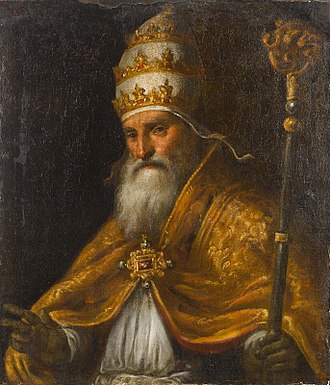
Saint Pius V: Between Heaven and Earth
Michel Ghislieri was born as Anton in 1504, but took the name of the Archangel ‘who is like God’ when he joined the Dominican Order at the age of 14, and never looked back. Fitting, for his whole life was a spiritual battle, first, against his own sinful tendencies – against which he was merciless, and which should always be our first concern – and then against those external disorders ravaging sixteenth century Europe and even the Church – moral laxity, sexual licence, homosexuality amongst the laity and even the highest members of the clergy; liturgical disorder; heresies, rebellions and revolutions against the truth and goodness; and the threat of Islam, as embodied in the militaristic Ottoman Turks, set to overwhelm Europe. What is old is new again.
We should see stern attitudes in this light: It was a war to the death. Hence, as sometime master of the Inquisition, using coercive methods with which we would now demur, his intention was to bring others back to the truth, and, by the standards then customary, the Inquisition was a fair and balanced court. Far more coercive and unjust were the methods used outside the Church – the agents of Queen Elizabeth and others – who used debilitating and crippling torture. Pius was later to excommunicate Elizabeth in 1570 as a heretic by the decree Regnans in Excelsis – a controversial decision, as it led to the full-blown persecution of Catholics as potential traitors. But God has His ways that are not our, ways and martyrdom is not a bad way to enter eternity.
But political power and potentates were never Father Michel’s primary focus, which was always of the things of heaven, prayer, meditation, recollection, study and focus upon God and eternity. His goodness and discipline, although oft resented as he moved up the ranks of the Dominican Order and the Church’s hierarchy, were widely recognized, and people desired a reformer – nay, even a saint – to save them from the chaos into which the world was sliding.
He was elected Pope in the conclave of 1566, with the support of the influential cardinal Charles Borromeo. He was the fifth to take the name Pius, and reigned until his death on the first day of May, 1572.
His discipline did not abate in what was then the luxury of the post-renaissance papal court. Pius imposed a more holy and serene – even monastic – environment in the Vatican, Rome, Italy and beyond. With a hairshirt under his white Dominican habit, he was oft seen barefoot, living in simplicity, immune to corruption, and no respecter of persons due to their rank or privilege.
It was Pius’ task to implement the decrees of the Council of Trent, which had wrapped up three years before his election. He reformed the Liturgy, promulgating the Roman Missal, which was to be used universally, with little revision, until Pope Paul VI’s reform in 1969 (and more on that in other posts). He also began the process of codifying the Latin Vulgate – which would come to fruition under his successors Sixtus and Clement – as well as the Breviary, and, not least, the Catechism of the Council of Trent, known as the ‘Roman Catechism’, the first universally binding summary of Christian Doctrine, and still an invaluable and authoritative resource. He canonized his fellow Dominican Thomas Aquinas, and advocated that his theology be taught, as the Doctor Communis, or universal teacher of the Church. And Pope Pius funded and supported the crusade against the onslaught of the Islamic Turks, praying as Don Juan led the battle of Lepanto on October, 7th, 1571. He saw by heavenly vision the victory, giving thanks to God, and instituting the feast of the Holy Rosary in thanksgiving, to be celebrated on that day ever since, the prayer to which he attributed the miraculous triumph, which saved Europe from Muslim conquest – for a time, perchance.
Saint Pius stood in the breach, like Moses of old, interceding for and defending the people over which God gave him charge, and fulfilled his duty to the end. He died in 1572, the year after Lepanto, leaving a memory of what a saint can do in the papal chair – as Christ’s Vicar, quite literally moving heaven and earth. He was canonized by Pope Clement XI on May 22nd, 1712, and his remains reside, quite appropriately, in the highest church dedicated to Our Lady, Santa Maria Maggiore, where Pope Francis was also recently laid to rest. They were two quite different successors of the fisherman, but shared a devotion to the Virgin, perhaps also in their own particular ways. We may trust that God works somehow, in some way, through them all.
Saint Pius V, ora pro nobis! +

Carney’s Amoral Majority
After five defections – euphemistically described as ‘crossing the floor’ – and three by-elections, Mark Carney and his Liberals how have their coveted majority. One wonders what bowls of pottage were offered in back-room deals. In the archaic monarchical system that is the Dominion of Canada, this majority allows the newly-minted Prime Minister to rule[…]Continue reading→

Saint Kateri , Canada’s Protectress
This was the title given to Saint Kateri Tekakwitha, by Pope Benedict XVI, when he canonized her on October 28th, 2012, along with six others, in Saint Peter’ Square (she had been beatified by Pope John Paul II back in 1980). With Saint Joseph as our protector, along with the Canadian martyrs, we seem to[…]Continue reading→

A Tale of Two Benedicts
A grace-filled Holy Week to all our readers! As we await and prepare for the Resurrection about to dawn upon us, we might keep in mind two Benedicts: Pope Emeritus Benedict XVI, requiescat in pace, elected on this day in 2005; and today’s commemoration of the mystic pilgrim, Benedict Joseph Labre, who died on this[…]Continue reading→

My Name is Bernadette
April 16th is a propitious day, for besides the anniversary of Father de Valk’s death, who founded Catholic Insight in its print form decades ago, and the commemoration of the ‘two Benedicts’, mentioned in accompanying posts, today we also recall Saint Bernadette Soubirous, the young visionary to whom the Virgin Mary appeared numerous times at[…]Continue reading→

Saint Lydwina of Schiedam and Suffering Joyfully
Saint Lydwina of Schiedam (1380 – 1433) was one of the countless and glorious ‘victim souls’ in the history of the Church, those whose lives are filled with suffering, often of an unimaginable intensity, but who suffer joyfully. She was a fifteen-year old Dutch girl, out skating one day, when she fell and broke one[…]Continue reading→

The Glorious Martyrdoms of Martin and Maximus
As we enter into Eastertide, we recall on this 13th of April Pope Saint Martin I (+655), one of the noblest, if most tragic, of the successors of Saint Peter. Born in Umbria, Italy, he was of noble lineage, with great intelligence combined with charity and love of the poor and the Church. While still[…]Continue reading→

Canonizing Sister Faustina and Divine Mercy
HOMILY OF THE HOLY FATHER MASS IN ST PETER’S SQUARE FOR THE CANONIZATION OF SR MARY FAUSTINA KOWALSKA Sunday, 30 April 2000 1. “Confitemini Domino quoniam bonus, quoniam in saeculum misericordia eius”; “Give thanks to the Lord for he is good; his steadfast love endures for ever” (Ps 118: 1). So the Church sings on the Octave of[…]Continue reading→

Saint Stanislaus of Szczepanów
We celebrate Saint Stanislaus today (+ April 11, 1079), in light of this Easter Octave, a bishop and martyr who accepted the episcopacy only at the direct order of Pope Alexander II. He proved a wise and courageous leader of his flock, put to death by his own king, Boleslaus, for rebuking the monarch’s ‘immoral[…]Continue reading→

Saint Gemma Galgani
On this April 11th, in 1903 – the same year that the Italian Guiseppe Sarto was elected Pope later that summer as Pius X – a lovely, young Italian woman died, by the name of Gemma Galgani. She lived a brief life of 24 years, as did a number of other young saints, including Pier[…]Continue reading→

An Ideological and Improper Translation
I noticed something odd with the psalm reading at Mass the other day. Our bishops’ conference here in Canada has decreed that the Mass in English – Novus Ordo – use the ‘NRSV’, the ‘New Revised Standard Version’, an ‘updated’ translation of the original RSV, first published in 1952. This ‘new translation’ has the tendency[…]Continue reading→