
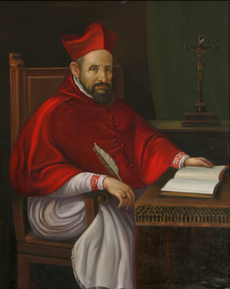
Saint Robert Bellarmine’s Clarity of Mind and Soul
In the midst of the theological and cultural confusion in which our Church is mired, we could use a few more men with the clear, disciplined, Thomistic mind of Robert Bellarmine (+1621), bishop, cardinal, doctor of the Church, and, yes, a Jesuit. But this was back in the days when the Order was young and, shall we say, more united in their original mission to evangelize in the truth. Bellarmine was one of the most influential and attractive figures in what has unfortunately been termed the Catholic ‘counter-reformation’, which was really the Catholic Reformation in response to the ‘Protestant’ revolt of those who threw off any number of dogmas and disciplines of the Church, most of them apostate Catholic priests themselves (Luther, Calvin, Zwingli, Menno…).
Bellarmine was from a noble family, received an excellent formation in the humanities – he had memorized Virgil as a boy – and soon turned to the more foundational and important science of theology, steeping himself in the thought of Saint Thomas Aquinas, on whose Summa Theologica he lectured for years as a professor at the Jesuit Roman College, now the Gregorian University. There is no better way to form a theological mind than the scholastic method as perfected by Thomas Aquinas, and by ‘theological mind’ we mean a mind trained to make the proper distinctions in accord with reality, so the truth behind the words may be perceived as clearly as possible. And, to be clear, this is still the method prescribed at the highest levels of Church teaching, right up to the Second Vatican Council in its decree of the formation of priests, Optatam Totius, as well as the 1983 Code of Canon Law, and a hundred or so other papal decrees prior to these.
Appointed a Cardinal in 1599, Robert Bellarmine saw what was stake in the issues of the day. For all of his other achievements, he is perhaps more known for his role in the early stages of the complex Galileo affair, mired in a clash of human personalities. The cardinal realized how difficult it would be for people to accept that the Earth was spinning on its axis, all the while hurtling around the Sun at fantastic velocities – they knew even back then that our planet, if such were true, had to be moving at many thousands of miles per hour. Not only Scripture, but our very senses evince otherwise, that the Earth seems quite stationary and stable. But the key word is ‘seems’, for those same senses oft deceive us. As Bellarmine concluded after meeting with Galileo in February of 1616, soon after the scientist began his championing of Copernicanism, if irrefutable scientific evidence were presented for the motion of the Earth, we would have to accept it, and in the meantime be open to the possibility of its truth:
I say that if there were a true demonstration that the sun is at the center of the world and the earth in the third heaven, and that the sun does not circle the earth but the earth circles the sun, then one would have to proceed with great care in explaining the Scriptures that appear contrary, and say rather that we do not understand them, than that what is demonstrated is false.
Galileo could not produce such a ‘true demonstration’, and neither could anyone else in his day. In fact, proof for the Earth’s movement would have to wait until Frederic Bessel’s 1838 discovery of stellar parallax in the star Cygni – a phenomenon for which Galileo sought in vain, for his telescopes were not powerful enough, and the stars simply too far away (far farther than anyone imagined at the time). Hence, two centuries earlier, Bellarmine urged Galileo, whom he admired and saw as a kindred spirit in pursuit of truth, to put forward Copernicansim and its heliocentric model as a workable and worthy hypothesis until he had irrefutable evidence, and all would be well.
But the hubristic Galileo could not wait, and he acted as though he did have such proof when he did not. His evidence produced in his 1632 Dialogue on Two Chief World Systems, argued that the tides a result of the ‘sloshing’ of the oceans from the Earth’s double motion. Galileo must at some level known this is patently false, ironically, based on the same laws of dynamics Galileo would later formulate.
The stubborn scientist was bent on foisting the Copernican model on all and sundry (which, in accord with Galileo’s Pythagorean principles, still relied on mathematically, perfectly circular orbits and uniform motion of the planets, both of which Galileo claimed to be absolutely true, and which are in fact quite false), mocking derisively those who disagreed with him, and, hence, forcing the issue towards its unfortunate and tragic finale. Galileo’s was the pride of scientists that continues into our own day. Things may well have turned out differently, and more felicitously, had Bellarmine lived a bit longer. But God has His ways, sometimes rather long and torturous from our temporal perspective, of allowing the truth to be known.
Bellarmine was involved in much of the work of the Church in the post-Protestant era of the 17th century, especially in implementing the decrees of the Council of Trent, which had its closing sessions just as Bellarmine was beginning his theological studies. As Pope Clement VIII remarked, “the Church of God had not his equal in learning”. In many ways, one is reminded of the future Cardinal Josef Ratzinger. Even the philosopher Thomas Hobbes – no lover of Catholicism – saw him in his visit to Rome in 1614, and, from his more secular perspective, was struck by something about the ‘lean, little old man’, who ‘lived more retired’ than the other prelates. Ironically, it was his very being a Jesuit – they have always been viewed with some suspicion since the days of Saint Ignatius himself – prevented Robert Bellarmine from ever being elected Pope. After all, Ignatius did not want his men to receive any ecclesiastical dignities, and I’m rather sure the saint was quite relieved.
What Hobbes saw in that ‘little, old man’ was holiness, the fruit of a life of prayer, discipline and charity, even if was a full three centuries before Robert Bellarmine was canonized, by Pius XI in 1930, and declared one of the 36 Doctors of the Church the following year.
May more Bellarmines rise up from the ranks of young, idealistic priests, steeped in Scripture, Saint Thomas, the lives of the saints. Holiness is eminently attainable, if we but give our assent to the prevenient grace of the good and merciful God.
Saint Robert Bellarmine, ora pro nobis!
Carney’s Amoral Majority
After five defections – euphemistically described as ‘crossing the floor’ – and three by-elections, Mark Carney and his Liberals how have their coveted majority. One wonders what bowls of pottage were offered in back-room deals. In the archaic monarchical system that is the Dominion of Canada, this majority allows the newly-minted Prime Minister to rule[…]Continue reading→

Saint Kateri , Canada’s Protectress
This was the title given to Saint Kateri Tekakwitha, by Pope Benedict XVI, when he canonized her on October 28th, 2012, along with six others, in Saint Peter’ Square (she had been beatified by Pope John Paul II back in 1980). With Saint Joseph as our protector, along with the Canadian martyrs, we seem to[…]Continue reading→
A Tale of Two Benedicts
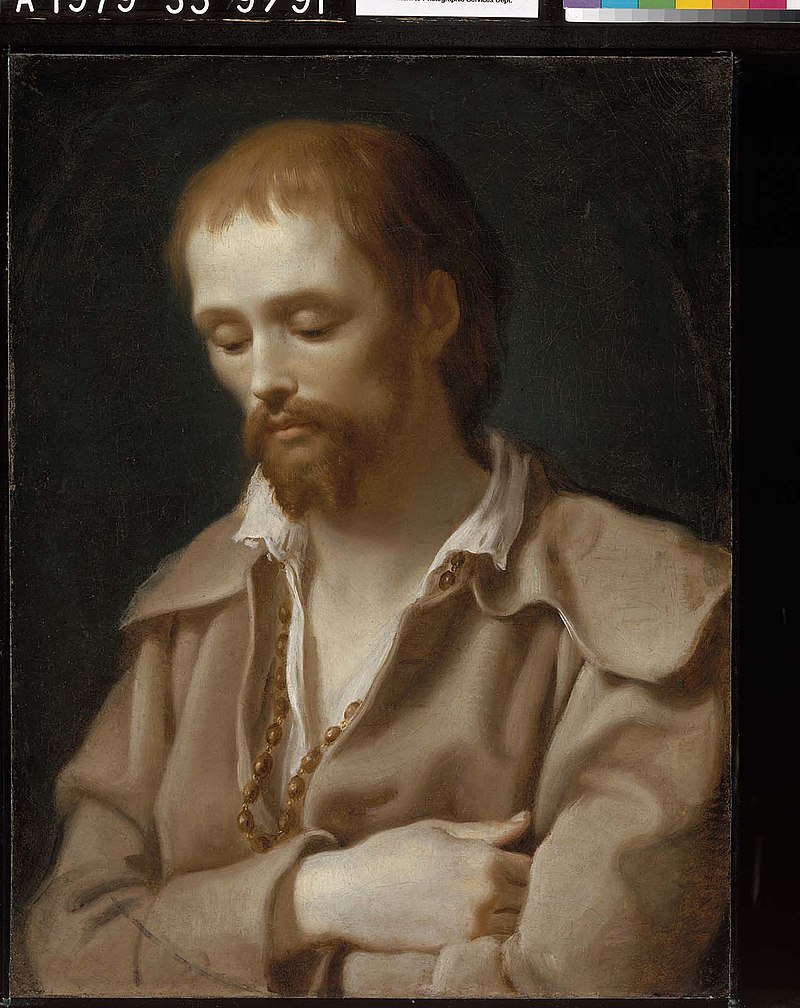
A grace-filled Holy Week to all our readers! As we await and prepare for the Resurrection about to dawn upon us, we might keep in mind two Benedicts: Pope Emeritus Benedict XVI, requiescat in pace, elected on this day in 2005; and today’s commemoration of the mystic pilgrim, Benedict Joseph Labre, who died on this[…]Continue reading→

My Name is Bernadette
April 16th is a propitious day, for besides the anniversary of Father de Valk’s death, who founded Catholic Insight in its print form decades ago, and the commemoration of the ‘two Benedicts’, mentioned in accompanying posts, today we also recall Saint Bernadette Soubirous, the young visionary to whom the Virgin Mary appeared numerous times at[…]Continue reading→
Saint Lydwina of Schiedam and Suffering Joyfully
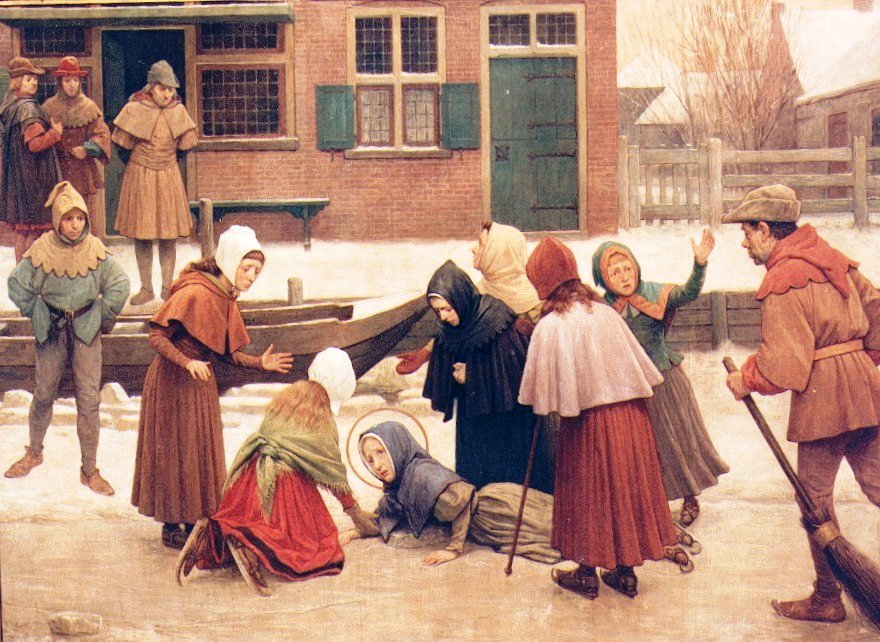
Saint Lydwina of Schiedam (1380 – 1433) was one of the countless and glorious ‘victim souls’ in the history of the Church, those whose lives are filled with suffering, often of an unimaginable intensity, but who suffer joyfully. She was a fifteen-year old Dutch girl, out skating one day, when she fell and broke one[…]Continue reading→
The Glorious Martyrdoms of Martin and Maximus
As we enter into Eastertide, we recall on this 13th of April Pope Saint Martin I (+655), one of the noblest, if most tragic, of the successors of Saint Peter. Born in Umbria, Italy, he was of noble lineage, with great intelligence combined with charity and love of the poor and the Church. While still[…]Continue reading→
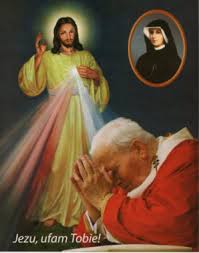
Canonizing Sister Faustina and Divine Mercy
HOMILY OF THE HOLY FATHER MASS IN ST PETER’S SQUARE FOR THE CANONIZATION OF SR MARY FAUSTINA KOWALSKA Sunday, 30 April 2000 1. “Confitemini Domino quoniam bonus, quoniam in saeculum misericordia eius”; “Give thanks to the Lord for he is good; his steadfast love endures for ever” (Ps 118: 1). So the Church sings on the Octave of[…]Continue reading→

Saint Stanislaus of Szczepanów
We celebrate Saint Stanislaus today (+ April 11, 1079), in light of this Easter Octave, a bishop and martyr who accepted the episcopacy only at the direct order of Pope Alexander II. He proved a wise and courageous leader of his flock, put to death by his own king, Boleslaus, for rebuking the monarch’s ‘immoral[…]Continue reading→
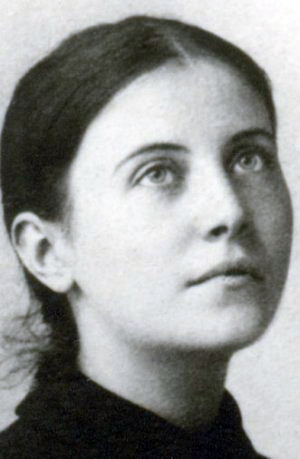
Saint Gemma Galgani
On this April 11th, in 1903 – the same year that the Italian Guiseppe Sarto was elected Pope later that summer as Pius X – a lovely, young Italian woman died, by the name of Gemma Galgani. She lived a brief life of 24 years, as did a number of other young saints, including Pier[…]Continue reading→
An Ideological and Improper Translation
I noticed something odd with the psalm reading at Mass the other day. Our bishops’ conference here in Canada has decreed that the Mass in English – Novus Ordo – use the ‘NRSV’, the ‘New Revised Standard Version’, an ‘updated’ translation of the original RSV, first published in 1952. This ‘new translation’ has the tendency[…]Continue reading→