
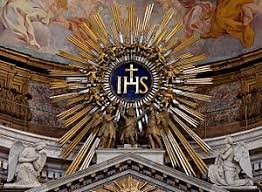
The Holy Name of Jesus
Therefore God has highly exalted him and bestowed on him the name which is above every name, that at the name of Jesus every knee should bow, in heaven and on earth and under the earth, and every tongue confess that Jesus Christ is Lord, to the glory of God the Father. (Philippians, 2:9-11)
And you shall call his name Jesus, for he will save his people from their sins (Matthew 1:21)
On this third day of the new calendar year, the Church celebrates the Holy Name of Jesus on this third of January, with the whole month dedicated to this devotion, the name above all other names, by which all men are saved, and to which every knee shall bend and every tongue proclaim that Jesus Christ is Lord. The power of the holy name is great indeed, as the Catechism makes clear:
The name “Jesus” signifies that the very name of God is present in the person of his Son, made man for the universal and definitive redemption from sins. It is the divine name that alone brings salvation, and henceforth all can invoke his name, for Jesus united himself to all men through his Incarnation, so that “there is no other name under heaven given among men by which we must be saved.”
Jesus’ Resurrection glorifies the name of the Saviour God, for from that time on it is the name of Jesus that fully manifests the supreme power of the “name which is above every name”. The evil spirits fear his name; in his name his disciples perform miracles, for the Father grants all they ask in this name. (#432, 434)
This was the name given by the angel, in the vision to Saint Joseph, Jesus – in Hebrew, Ye-shua – literally, ‘the Lord saves’, the one who would save His people from their sins. The soon-to-be Christian Constantine conquered the pagan Maxentius at the Milvian Bridge in 313 in the divine name, inspired by a vision, inscribing the first three letters of Christ’s name in Greek, IHS, in his ensign and shields, which in Latin, can also signify the acronym for ‘in hoc signum‘ – in this sign, thou shalt conquer.
Given its holiness and power, it is also in His name that we pray:
The name of Jesus is at the heart of Christian prayer. All liturgical prayers conclude with the words “through our Lord Jesus Christ”. The Hail Mary reaches its high point in the words “blessed is the fruit of thy womb, Jesus.” The Eastern prayer of the heart, the Jesus Prayer, says: “Lord Jesus Christ, Son of God, have mercy on me, a sinner.” Many Christians, such as St. Joan of Arc, have died with the one word “Jesus” on their lips. (#435)
In 1597, Pope Sixtus V granted an indulgence to anyone reverently saying, “Praised be Jesus Christ!”, which still holds as a partial indulgence for anyone devoutly praying in the divine name. Today’s feast, suppressed in the post-Vatican II enthusiasm to ‘simplify everything’, was reinstituted by Pope Saint John Paul II in the 2002 revision of the Roman Missal.
Even Hollywood sort of gets it, for when a character blasphemes in a film, it is invariably in Christ’s name, not Mohammad, or Buddha, or Vishnu, or any of the panoply of Roman and Greeks Gods, even if ‘by Jove’ is murmured by some old school Brits.
Taking the Lord’s name in vain is a sin, and can be a grave one. This, only because the Holy Name has such great power, and should be used with reverence, signifying the Person on Whom that name is bestowed is the Holy One of God, the Second Person of the Blessed Trinity, Who took our human nature and form to save us from our sins, and lead to eternal life.
The Incarnation is the most important event in history, God become Man, and His message is that we should live for eternity, to use our time well in building up that ‘treasure’ for the Kingdom. That is why we divide history into two eras: Before and after Christ, a custom that began with the monk Dionysius Exiguus in 525. The God-Man lived but 33 years, enough to accomplish His mission. Some are given less, some far more. The key is that whatever weeks, months and years we are given, we should see and use as a gift, to do good to those around us, in all the panoply of ways in accord with our vocation and path. So, as Pope John Paul proclaimed, cast forth into the deep, be bold, be not afraid, and, in a spiritual sense, conquer the world.
So rejoice; as Chesterton would say, and as Scrooge found out just in the nick of time, each new day is a gift, and what better Christmas present for God than to offer ourselves at the close of each one back to Him, a little bit better, and with a little more good in the world, than when we awoke? Carpe diem, Christianus!
Praised be Jesus Christ, heri, hodie et in aeternum. Yesterday, today and forever. +

Carney’s Amoral Majority
After five defections – euphemistically described as ‘crossing the floor’ – and three by-elections, Mark Carney and his Liberals how have their coveted majority. One wonders what bowls of pottage were offered in back-room deals. In the archaic monarchical system that is the Dominion of Canada, this majority allows the newly-minted Prime Minister to rule[…]Continue reading→

Saint Kateri , Canada’s Protectress
This was the title given to Saint Kateri Tekakwitha, by Pope Benedict XVI, when he canonized her on October 28th, 2012, along with six others, in Saint Peter’ Square (she had been beatified by Pope John Paul II back in 1980). With Saint Joseph as our protector, along with the Canadian martyrs, we seem to[…]Continue reading→

A Tale of Two Benedicts
A grace-filled Holy Week to all our readers! As we await and prepare for the Resurrection about to dawn upon us, we might keep in mind two Benedicts: Pope Emeritus Benedict XVI, requiescat in pace, elected on this day in 2005; and today’s commemoration of the mystic pilgrim, Benedict Joseph Labre, who died on this[…]Continue reading→

My Name is Bernadette
April 16th is a propitious day, for besides the anniversary of Father de Valk’s death, who founded Catholic Insight in its print form decades ago, and the commemoration of the ‘two Benedicts’, mentioned in accompanying posts, today we also recall Saint Bernadette Soubirous, the young visionary to whom the Virgin Mary appeared numerous times at[…]Continue reading→

Saint Lydwina of Schiedam and Suffering Joyfully
Saint Lydwina of Schiedam (1380 – 1433) was one of the countless and glorious ‘victim souls’ in the history of the Church, those whose lives are filled with suffering, often of an unimaginable intensity, but who suffer joyfully. She was a fifteen-year old Dutch girl, out skating one day, when she fell and broke one[…]Continue reading→

The Glorious Martyrdoms of Martin and Maximus
As we enter into Eastertide, we recall on this 13th of April Pope Saint Martin I (+655), one of the noblest, if most tragic, of the successors of Saint Peter. Born in Umbria, Italy, he was of noble lineage, with great intelligence combined with charity and love of the poor and the Church. While still[…]Continue reading→

Saint Stanislaus of Szczepanów
We celebrate Saint Stanislaus today (+ April 11, 1079), in light of this Easter Octave, a bishop and martyr who accepted the episcopacy only at the direct order of Pope Alexander II. He proved a wise and courageous leader of his flock, put to death by his own king, Boleslaus, for rebuking the monarch’s ‘immoral[…]Continue reading→

Saint Gemma Galgani
On this April 11th, in 1903 – the same year that the Italian Guiseppe Sarto was elected Pope later that summer as Pius X – a lovely, young Italian woman died, by the name of Gemma Galgani. She lived a brief life of 24 years, as did a number of other young saints, including Pier[…]Continue reading→
An Ideological and Improper Translation
I noticed something odd with the psalm reading at Mass the other day. Our bishops’ conference here in Canada has decreed that the Mass in English – Novus Ordo – use the ‘NRSV’, the ‘New Revised Standard Version’, an ‘updated’ translation of the original RSV, first published in 1952. This ‘new translation’ has the tendency[…]Continue reading→
Saint Jean-Baptiste de la Salle: A Teacher for Teachers
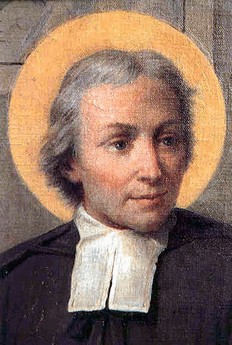
Jean-Baptiste de la Salle (1651 – 1719), a French nobleman, ordained a priest, founded the first order in the Church’s history entirely without priests, and this came about almost by accident. I say ‘almost’, for, of course, there are no accidents with God. Destined for ordination from an early age, Jean-Baptiste never looked back, even[…]Continue reading→