
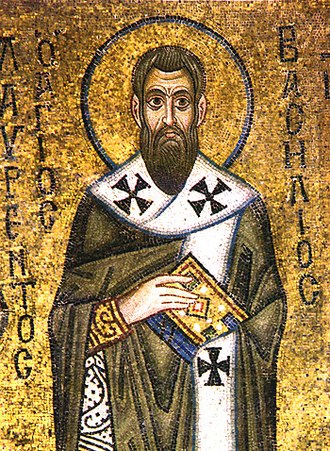
Pope Benedict and Saint Basil the Great
BENEDICT XVI
GENERAL AUDIENCE
Paul VI Audience Hall
Wednesday, 4 July 2007
Saint Basil (1)
Dear Brothers and Sisters,
Let us remember today one of the great Fathers of the Church, St Basil, described by Byzantine liturgical texts as “a luminary of the Church”.
He was an important Bishop in the fourth century to whom the entire Church of the East, and likewise the Church of the West, looks with admiration because of the holiness of his life, the excellence of his teaching and the harmonious synthesis of his speculative and practical gifts.
He was born in about 330 A.D. into a family of saints, “a true domestic Church”, immersed in an atmosphere of deep faith. He studied with the best teachers in Athens and Constantinople.
Unsatisfied with his worldly success and realizing that he had frivolously wasted much time on vanities, he himself confessed: “One day, like a man roused from deep sleep, I turned my eyes to the marvellous light of the truth of the Gospel…, and I wept many tears over my miserable life” (cf. Letter 223: PG 32, 824a).
Attracted by Christ, Basil began to look and listen to him alone (cf. Moralia, 80, 1: PG 31, 860bc). He devoted himself with determination to the monastic life through prayer, meditation on the Sacred Scriptures and the writings of the Fathers of the Church, and the practice of charity (cf. Letters 2, 22), also following the example of his sister, St Macrina, who was already living the ascetic life of a nun. He was then ordained a priest and finally, in the year 370, Bishop of Caesarea in Cappadocia in present-day Turkey.
Through his preaching and writings, he carried out immensely busy pastoral, theological and literary activities.
With a wise balance, he was able to combine service to souls with dedication to prayer and meditation in solitude. Availing himself of his personal experience, he encouraged the foundation of numerous “fraternities”, in other words, communities of Christians consecrated to God, which he visited frequently (cf. Gregory of Nazianzus, Oratio 43, 29, in laudem Basilii: PG 36, 536b).
He urged them with his words and his writings, many of which have come down to us (cf. Regulae brevius tractatae, Proemio: PG 31, 1080ab), to live and to advance in perfection.
(To continue reading, please see here).
BENEDICT XVI
GENERAL AUDIENCE
Paul VI Audience Hall
Wednesday, 1st August 2007
Saint Basil (2)
Dear Brothers and Sisters,
After this three-week break, we are continuing with our Wednesday meetings. Today, I would simply like to resume my last Catechesis, whose subject was the life and writings of St Basil, a Bishop in present-day Turkey, in Asia Minor, in the fourth century A.D. The life and works of this great Saint are full of ideas for reflection and teachings that are also relevant for us today.
First of all is the reference to God’s mystery, which is still the most meaningful and vital reference for human beings. The Father is “the principal of all things and the cause of being of all that exists, the root of the living” (Hom. 15, 2 de fide: PG 31, 465c); above all, he is “the Father of Our Lord Jesus Christ” (Anaphora Sancti Basilii). Ascending to God through his creatures, we “become aware of his goodness and wisdom” (Basil, Adversus Eunomium 1, 14: PG 29, 544b).
The Son is the “image of the Father’s goodness and seal in the same form” (cf. Anaphora Sancti Basilii). With his obedience and his Passion, the Incarnate Word carried out his mission as Redeemer of man (cf. Basil, In Psalmum 48, 8; PG 29, 452ab; cf. also De Baptismo 1, 2: SC 357, 158).
Lastly, he spoke fully of the Holy Spirit, to whom he dedicated a whole book. He reveals to us that the Spirit enlivens the Church, fills her with his gifts and sanctifies her.
The resplendent light of the divine mystery is reflected in man, the image of God, and exalts his dignity. Looking at Christ, one fully understands human dignity.
Basil exclaims: “[Man], be mindful of your greatness, remembering the price paid for you: look at the price of your redemption and comprehend your dignity!” (In Psalmum 48, 8: PG 29, 452b).
Christians in particular, conforming their lives to the Gospel, recognize that all people are brothers and sisters; that life is a stewardship of the goods received from God, which is why each one is responsible for the other, and whoever is rich must be as it were an “executor of the orders of God the Benefactor” (Hom 6 de avaritia: PG 32, 1181-1196). We must all help one another and cooperate as members of one body (Ep 203, 3).
And on this point, he used courageous, strong words in his homilies. Indeed, anyone who desires to love his neighbour as himself, in accordance with God’s commandment, “must possess no more than his neighbour” (Hom. in divites: PG 31, 281b).
In times of famine and disaster, the holy Bishop exhorted the faithful with passionate words “not to be more cruel than beasts… by taking over what people possess in common or by grabbing what belongs to all (Hom. tempore famis: PG 31, 325a).
Basil’s profound thought stands out in this evocative sentence: “All the destitute look to our hands just as we look to those of God when we are in need”.
Therefore, Gregory of Nazianzus’ praise after Basil’s death was well-deserved. He said: “Basil convinces us that since we are human beings, we must neither despise men nor offend Christ, the common Head of all, with our inhuman behaviour towards people; rather, we ourselves must benefit by learning from the misfortunes of others and must lend God our compassion, for we are in need of mercy” (Gregory Nazianzus, Orationes 43, 63; PG 36, 580b).
These words are very timely. We see that St Basil is truly one of the Fathers of the Church’s social doctrine.
(To continue reading, please see here).

Saint Kateri , Canada’s Protectress
This was the title given to Saint Kateri Tekakwitha, by Pope Benedict XVI, when he canonized her on October 28th, 2012, along with six others, in Saint Peter’ Square (she had been beatified by Pope John Paul II back in 1980). With Saint Joseph as our protector, along with the Canadian martyrs, we seem to[…]Continue reading→

Remembering Father Alphonse de Valk
(Today marks the sixth anniversary of the death of Father Alphonse de Valk, C.S.B., a faithful, courageous and indefatigable Basilian priest, pro-life-and-family apostle, and the founder of Catholic Insight magazine. Here is what we wrote those on his entering into eternity five years ago, as we continue to remember him in our prayers and thoughts)[…]Continue reading→

A Tale of Two Benedicts
A grace-filled Holy Week to all our readers! As we await and prepare for the Resurrection about to dawn upon us, we might keep in mind two Benedicts: Pope Emeritus Benedict XVI, requiescat in pace, elected on this day in 2005; and today’s commemoration of the mystic pilgrim, Benedict Joseph Labre, who died on this[…]Continue reading→

My Name is Bernadette
April 16th is a propitious day, for besides the anniversary of Father de Valk’s death, who founded Catholic Insight in its print form decades ago, and the commemoration of the ‘two Benedicts’, mentioned in accompanying posts, today we also recall Saint Bernadette Soubirous, the young visionary to whom the Virgin Mary appeared numerous times at[…]Continue reading→

Saint Lydwina of Schiedam and Suffering Joyfully
Saint Lydwina of Schiedam (1380 – 1433) was one of the countless and glorious ‘victim souls’ in the history of the Church, those whose lives are filled with suffering, often of an unimaginable intensity, but who suffer joyfully. She was a fifteen-year old Dutch girl, out skating one day, when she fell and broke one[…]Continue reading→

The Glorious Martyrdoms of Martin and Maximus
As we enter into Eastertide, we recall on this 13th of April Pope Saint Martin I (+655), one of the noblest, if most tragic, of the successors of Saint Peter. Born in Umbria, Italy, he was of noble lineage, with great intelligence combined with charity and love of the poor and the Church. While still[…]Continue reading→

Canonizing Sister Faustina and Divine Mercy
HOMILY OF THE HOLY FATHER MASS IN ST PETER’S SQUARE FOR THE CANONIZATION OF SR MARY FAUSTINA KOWALSKA Sunday, 30 April 2000 1. “Confitemini Domino quoniam bonus, quoniam in saeculum misericordia eius”; “Give thanks to the Lord for he is good; his steadfast love endures for ever” (Ps 118: 1). So the Church sings on the Octave of[…]Continue reading→

Divine Mercy Sunday – An Echo of Every Mass
Reach out your hand and put it in my side. Do not doubt but believe’… ‘My Lord and my God!’ (Jn. 20:18)). Today is Divine Mercy Sunday, and as we celebrate the end of the Easter Octave, we contemplate the wounded side of our Saviour, the Church’s source of life. On Good Friday in the[…]Continue reading→

Saint Gemma Galgani
On this April 11th, in 1903 – the same year that the Italian Guiseppe Sarto was elected Pope later that summer as Pius X – a lovely, young Italian woman died, by the name of Gemma Galgani. She lived a brief life of 24 years, as did a number of other young saints, including Pier[…]Continue reading→
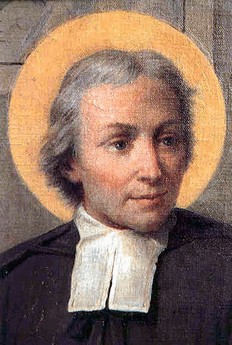
Saint Jean-Baptiste de la Salle: A Teacher for Teachers
Jean-Baptiste de la Salle (1651 – 1719), a French nobleman, ordained a priest, founded the first order in the Church’s history entirely without priests, and this came about almost by accident. I say ‘almost’, for, of course, there are no accidents with God. Destined for ordination from an early age, Jean-Baptiste never looked back, even[…]Continue reading→