
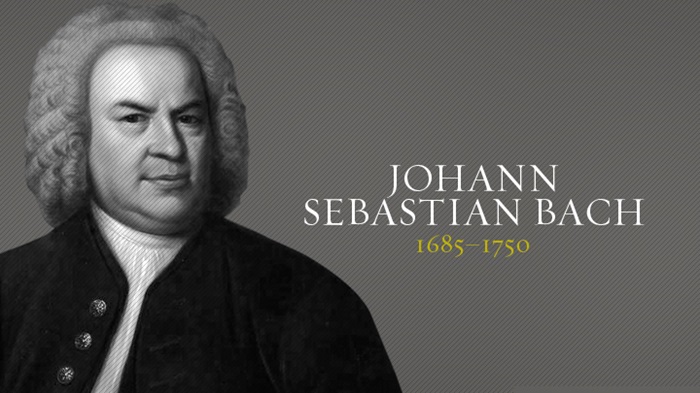
Bach’s Musical Offering
Today marks the 267th anniversary of the death of Johann Sebastian Bach, who passed into eternity this day in 1750, after a rather barbaric and unsuccessful attempt at eye surgery to heal his progressive blindness.
Somewhat underappreciated during his lifetime, Bach is now recognized as one of the greatest composer in history, to some the greatest. Of course, as the Roman adage has it, de gustatibus, non disputandum est, but however one’s tastes run, from adages and adagios to arias, there is no disputing that Bach was one of the most gifted by what muses there be with unparalleled musical genius, assimilating the music came before him, from Italians such as Palestrina and Pergolesi, to his fellow Germans, Pachelbel and Buxtehude, influencing those who came after, Mozart, Haydn, and he continues to shape the course of music up to our present day.
Bach wrote in almost every musical genre: Concertos, chorales, organ, lute, harpsichord, clavier, violin, sonatas, hymns, counting well over a thousand works crafted with a mysterious skill and perfection that is still being unpacked and enjoyed. His Mass in B minor is considered the greatest chorale work ever presented. And what would we do without his foundational compositions for what we now know as the pianoforte, invented during Bach’s lifetime? The two-volume Well Tempered Clavier is the basis for all the key signatures in which future keyboard works would be written.
Bach lived a full and dramatic life, fathering twenty children by two wives (his first wife died while the composer was still relatively young), a number of whom became worthy musicians, conducting and performing many of his own and others’ works, especially on the organ, what Bach called the ‘instrument of instruments’, at which he was a master performer. Gladly enough, the Church has adopted the organ as her own: As Sacrosanctum Concilium, the Constitution on Sacred Liturgy, declares, the pipe organ is to be held in high esteem (magno in honore habeatur), for it is the traditional musical instrument which adds a wonderful splendor to the Church’s ceremonies and powerfully lifts up man’s mind to God and to higher things. (#120). Bach’s compositions are an essential part of what ‘lift out mind to God and higher things’.
We may lament the fact that Bach was not a Catholic, being raised as a devout Lutheran, but his ‘Catholic’ sympathies ran deep, and of all the Protestant religions, Lutheranism maintained perhaps most of the Catholic devotions and liturgical forms, even a belief in the Real Presence; hence, Bach’s Masses, chorales and even his unsurpassed Magnificat.
I will leave you with a thought from an address by Pope Emeritus Benedict who, as Cardinal Raztinger, in the midst of an address to the Communion and Liberation movement on beauty in 2002, wrote:
The encounter with the beautiful can become the wound of the arrow that strikes the heart and in this way opens our eyes, so that later, from this experience, we take the criteria for judgement and can correctly evaluate the arguments. For me an unforgettable experience was the Bach concert that Leonard Bernstein conducted in Munich after the sudden death of Karl Richter. I was sitting next to the Lutheran Bishop Hanselmann. When the last note of one of the great Thomas-Kantor-Cantatas triumphantly faded away, we looked at each other spontaneously and right then we said: “Anyone who has heard this, knows that the faith is true”. The music had such an extraordinary force of reality that we realized, no longer by deduction, but by the impact on our hearts, that it could not have originated from nothingness, but could only have come to be through the power of the Truth that became real in the composer’s inspiration.
Amen to that. Thank you for the musical offerings, Maestro Johann, and requiescat in pace.
Carney’s Amoral Majority
After five defections – euphemistically described as ‘crossing the floor’ – and three by-elections, Mark Carney and his Liberals how have their coveted majority. One wonders what bowls of pottage were offered in back-room deals. In the archaic monarchical system that is the Dominion of Canada, this majority allows the newly-minted Prime Minister to rule[…]Continue reading→

Saint Kateri , Canada’s Protectress
This was the title given to Saint Kateri Tekakwitha, by Pope Benedict XVI, when he canonized her on October 28th, 2012, along with six others, in Saint Peter’ Square (she had been beatified by Pope John Paul II back in 1980). With Saint Joseph as our protector, along with the Canadian martyrs, we seem to[…]Continue reading→

Remembering Father Alphonse de Valk
(Today marks the sixth anniversary of the death of Father Alphonse de Valk, C.S.B., a faithful, courageous and indefatigable Basilian priest, pro-life-and-family apostle, and the founder of Catholic Insight magazine. Here is what we wrote those on his entering into eternity five years ago, as we continue to remember him in our prayers and thoughts)[…]Continue reading→

A Tale of Two Benedicts
A grace-filled Holy Week to all our readers! As we await and prepare for the Resurrection about to dawn upon us, we might keep in mind two Benedicts: Pope Emeritus Benedict XVI, requiescat in pace, elected on this day in 2005; and today’s commemoration of the mystic pilgrim, Benedict Joseph Labre, who died on this[…]Continue reading→

My Name is Bernadette
April 16th is a propitious day, for besides the anniversary of Father de Valk’s death, who founded Catholic Insight in its print form decades ago, and the commemoration of the ‘two Benedicts’, mentioned in accompanying posts, today we also recall Saint Bernadette Soubirous, the young visionary to whom the Virgin Mary appeared numerous times at[…]Continue reading→

Saint Lydwina of Schiedam and Suffering Joyfully
Saint Lydwina of Schiedam (1380 – 1433) was one of the countless and glorious ‘victim souls’ in the history of the Church, those whose lives are filled with suffering, often of an unimaginable intensity, but who suffer joyfully. She was a fifteen-year old Dutch girl, out skating one day, when she fell and broke one[…]Continue reading→

The Glorious Martyrdoms of Martin and Maximus
As we enter into Eastertide, we recall on this 13th of April Pope Saint Martin I (+655), one of the noblest, if most tragic, of the successors of Saint Peter. Born in Umbria, Italy, he was of noble lineage, with great intelligence combined with charity and love of the poor and the Church. While still[…]Continue reading→

Canonizing Sister Faustina and Divine Mercy
HOMILY OF THE HOLY FATHER MASS IN ST PETER’S SQUARE FOR THE CANONIZATION OF SR MARY FAUSTINA KOWALSKA Sunday, 30 April 2000 1. “Confitemini Domino quoniam bonus, quoniam in saeculum misericordia eius”; “Give thanks to the Lord for he is good; his steadfast love endures for ever” (Ps 118: 1). So the Church sings on the Octave of[…]Continue reading→

Divine Mercy Sunday – An Echo of Every Mass
Reach out your hand and put it in my side. Do not doubt but believe’… ‘My Lord and my God!’ (Jn. 20:18)). Today is Divine Mercy Sunday, and as we celebrate the end of the Easter Octave, we contemplate the wounded side of our Saviour, the Church’s source of life. On Good Friday in the[…]Continue reading→

Saint Stanislaus of Szczepanów
We celebrate Saint Stanislaus today (+ April 11, 1079), in light of this Easter Octave, a bishop and martyr who accepted the episcopacy only at the direct order of Pope Alexander II. He proved a wise and courageous leader of his flock, put to death by his own king, Boleslaus, for rebuking the monarch’s ‘immoral[…]Continue reading→