
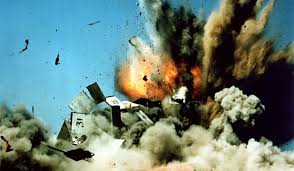
Trump’s Tomahawks
There is not much profit, in more ways than one, in commenting on international affairs, but that does not stop so many, myself included, from trying. (To comment, that is, not so much to profit). I am surprised that most of the feedback on Trump’s ordering Tomahawk missiles to destroy a Syrian air base (at least in the pages of our own homegrown National Post). This attack was in apparent retaliation for an alleged gassing by Basha al-Assad, apparently of his own citizens, including women and children (that is, insofar as Syria can still be said to have ‘citizens’, for there is not much civility, nor cities, left).
As you may have noticed, there is a lot of supposition in that preceding sentence, as there were when in many of the statements of Trump’s sometime predecessor, George W. Bush, who ordered a ‘shock and awe’ attack on Iraq back in 2002, in retaliation for the country, or at least Saddam Hussein, being in some way responsible for, or complicit with, the attacks on the World Trade Centre in Semptember of the previous year. Of course, we know, and knew, that it was Osama Bin-Laden who was behind the attacks, a Saudi citizen, as were almost all of the plane hijackers, and that Osama was hiding out in Afghanistan somewhere (another whole story).
But even if Sadam Hussein had little or nothing to do with 9-11, he was, so it goes, a ‘bad guy’, an autocrat and despot, and America had a God-given duty to make the world ‘safe for democracy’.
It is certainly at least a very debatable point whether the world is any ‘safer for democracy’ now than it was back then.
There are at least two problems with Trump’s Tomahawk attack, besides all the accidental fallout, no pun intended:
Any act of war contemplated by the President requires congressional support. Given that destroying an airbase in a sovereign nation may be considered such an ‘act of war’ (would it not be considered so on American territory?), this support from the democratic representatives of the United States was neither solicited, nor offered.
At a deeper, moral level, the only just war is a defensive war, since war itself is an extension of the principle of self-defense, when there is no other way to ensure the survival and well-being of the nation being attacked. In other words, war should be a final, and tragic, last resort. And I, for one, wonder, in what way is the survival or well-being of American citizens contingent upon what happens in Syria?
This is not to say that what is ‘happening in Syria’, is not evil, nor defensible. It’s just that, why is it America’s fight? I heard an interview with Assad once, and found him an amicable person, agreeing with many of his statements. He did not come across as a ‘madman’, nor even as a despot. Of course, people can hide what they truly are, and I know not his secrect, and not-so-secret, crimes. What is portrayed and alleged in the media may or may not be true, for it is a fallible formal object of trust. But even if Assad is a ‘worse’ man than Hussein was (requiescat in pace, and I hope he found peace in his final moments), is the United States the world’s universal policeman, arbitrer of justice throughout the planet, like the mythical Superman? Does technological and military superiority, at least so far, bestow that right upon it?
This is to say nothing of what this will do to relations with Russia and Iran, also not the ‘best of guys’, but, then, who on the world stage is? Politics is the art of the possible and the practical, achieving as much good, and avoiding as much evil, as is requisite in the circumstances.
And Mark Steyn is correct that the U.S. and Trump had better have an end-game to all of this, for headless states in the Middle East, upon the principle that nature abhors a vacuum, tend to attract the less-savoury elements of the Islamic world. In other words, Syria would become another Iraq and Libya, with the metastasis of ISIS, radicals, anarachists, and other opportunists of the most amoral variety. Even more chaos, bloodshed and mayhem will reign. There are often seven devils waiting when one is driven out, unless a stable and lasting regime, built on justice and virtue, with a powerful military and police presence to ensure compliance, along with enough decent people to put what we know as ‘civilization’ back into effect..
And, from what many can see, there is very little justice, civilization and virtue going around, on any side.
Carney’s Amoral Majority
After five defections – euphemistically described as ‘crossing the floor’ – and three by-elections, Mark Carney and his Liberals how have their coveted majority. One wonders what bowls of pottage were offered in back-room deals. In the archaic monarchical system that is the Dominion of Canada, this majority allows the newly-minted Prime Minister to rule[…]Continue reading→

Saint Kateri , Canada’s Protectress
This was the title given to Saint Kateri Tekakwitha, by Pope Benedict XVI, when he canonized her on October 28th, 2012, along with six others, in Saint Peter’ Square (she had been beatified by Pope John Paul II back in 1980). With Saint Joseph as our protector, along with the Canadian martyrs, we seem to[…]Continue reading→

A Tale of Two Benedicts
A grace-filled Holy Week to all our readers! As we await and prepare for the Resurrection about to dawn upon us, we might keep in mind two Benedicts: Pope Emeritus Benedict XVI, requiescat in pace, elected on this day in 2005; and today’s commemoration of the mystic pilgrim, Benedict Joseph Labre, who died on this[…]Continue reading→

My Name is Bernadette
April 16th is a propitious day, for besides the anniversary of Father de Valk’s death, who founded Catholic Insight in its print form decades ago, and the commemoration of the ‘two Benedicts’, mentioned in accompanying posts, today we also recall Saint Bernadette Soubirous, the young visionary to whom the Virgin Mary appeared numerous times at[…]Continue reading→

Saint Lydwina of Schiedam and Suffering Joyfully
Saint Lydwina of Schiedam (1380 – 1433) was one of the countless and glorious ‘victim souls’ in the history of the Church, those whose lives are filled with suffering, often of an unimaginable intensity, but who suffer joyfully. She was a fifteen-year old Dutch girl, out skating one day, when she fell and broke one[…]Continue reading→

The Glorious Martyrdoms of Martin and Maximus
As we enter into Eastertide, we recall on this 13th of April Pope Saint Martin I (+655), one of the noblest, if most tragic, of the successors of Saint Peter. Born in Umbria, Italy, he was of noble lineage, with great intelligence combined with charity and love of the poor and the Church. While still[…]Continue reading→

Saint Stanislaus of Szczepanów
We celebrate Saint Stanislaus today (+ April 11, 1079), in light of this Easter Octave, a bishop and martyr who accepted the episcopacy only at the direct order of Pope Alexander II. He proved a wise and courageous leader of his flock, put to death by his own king, Boleslaus, for rebuking the monarch’s ‘immoral[…]Continue reading→
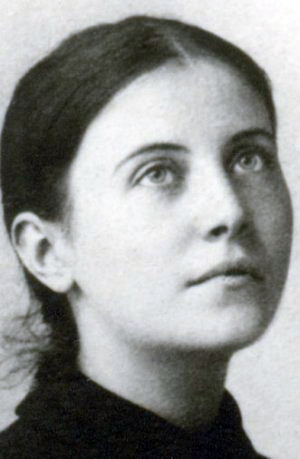
Saint Gemma Galgani
On this April 11th, in 1903 – the same year that the Italian Guiseppe Sarto was elected Pope later that summer as Pius X – a lovely, young Italian woman died, by the name of Gemma Galgani. She lived a brief life of 24 years, as did a number of other young saints, including Pier[…]Continue reading→
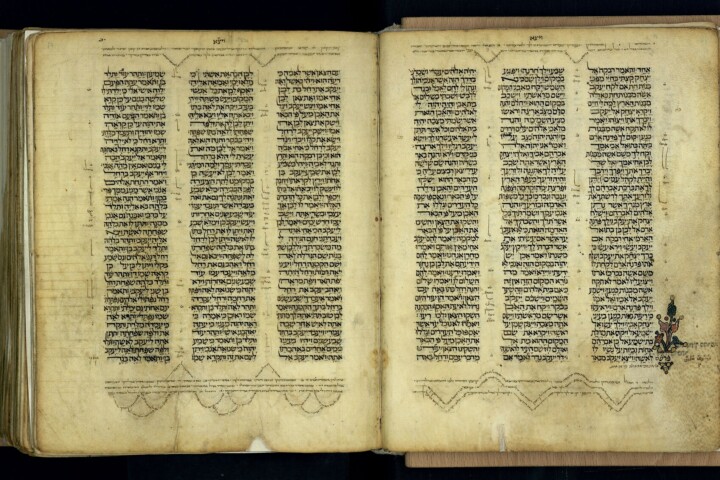
An Ideological and Improper Translation
I noticed something odd with the psalm reading at Mass the other day. Our bishops’ conference here in Canada has decreed that the Mass in English – Novus Ordo – use the ‘NRSV’, the ‘New Revised Standard Version’, an ‘updated’ translation of the original RSV, first published in 1952. This ‘new translation’ has the tendency[…]Continue reading→
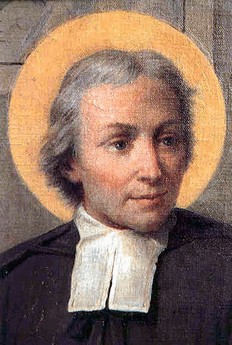
Saint Jean-Baptiste de la Salle: A Teacher for Teachers
Jean-Baptiste de la Salle (1651 – 1719), a French nobleman, ordained a priest, founded the first order in the Church’s history entirely without priests, and this came about almost by accident. I say ‘almost’, for, of course, there are no accidents with God. Destined for ordination from an early age, Jean-Baptiste never looked back, even[…]Continue reading→