
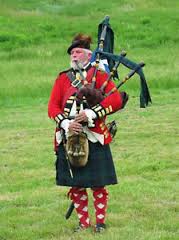
Beware Bagpiping Scotsmen
A bag piping Scotsman was recently fined in Montreal for carrying an ‘illegal weapon’, namely, his sgian-duh, literally his ‘black’, but more properly his ‘hidden’ knife, tucked into his thick Highland socks. I wondered at the triple standard: Sikhs are permitted by law to carry their own ceremonial daggers, so why not bagpipers? And the police in Montreal are still engaged in their own work defiance, wearing camouflage pants to protest a proposed change to their (unrealistic) pension plan, signifying a petulance and a defiance of their own law, unbecoming an officer of said law.
This is, as are most things, part of a bigger picture, namely, the selective application of the burdens of law. Saint Thomas states that a promulgated law must be applicable to many, and if it is not proportionately applied in a reasonable way, it ceases to be a just law. One cannot have a curfew, or a ban, or any limitation, for only a select group of people, with some ‘getting away with it’, unless there is clear, a priori and verifiable reasons why they should be so limited, such as 13 year olds driving, drinking or voting (and especially not at the same time).
So why Sikhs, and not Scots? Are Sikhs naturally more careful, or less prone or random, unpredictable violence, with their daggers? Then again, I suppose Scots are a volatile people, so perhaps should be more rigorously controlled. Next thing you know, they’ll be coming after our claymores…
The sad reality is that police, nor any security procedure, can rarely ever stop crimes a priori, especially of the random variety. There is a serious side to knives and daggers, as the apparently random horrific killing of an Abbotsford teenager by a random drifter, and the wounding of another student, demonstrate (God rest her soul). How does one protect oneself against such aberrant acts of free will or, more properly, liberum arbitrium? The mystery of the human heart, and its capacity for evil, know no limits. Again, as Saint Thomas states, following Aristotle, as man is the most noble of animals if he be perfect in virtue, so is he the lowest of all, if he be severed from law and righteousness; because man can use his reason to devise means of satisfying his lusts and evil passions, which other animals are unable to do. The only way to stop such crimes is to instill virtue in the citizens, which is accomplished through the gradual evangelization of the culture through Christian principles of morality. Canadian ‘values’, and ever-greater police presence, cannot stop our descent into mayhem.
That is why the upcoming election in the United States, although significant, will not really solve anyone’s problems. The difficulties with our society run deeper than that which can be ‘fixed’ by new laws and policies (although these may help). Again, back to Thomas, who declares that custom, our ‘mores’ which flow from our culture, has the force of a law, abolishes law, and is the interpreter of law. Trump may help instantiate better laws, which will ameliorate our customs, and Clinton will likely vitiate them, but it is ultimately up to us, each individual in the depths of his conscience, to choose between good and evil, truth and falsity, and so live in the light. As John Paul II declared in his very first encyclical, that the Church’s focus is upon precisely this man in all the truth of his life, in his conscience, in his continual inclination to sin and at the same time in his continual aspiration to truth, the good, the beautiful, justice and love.
So let us too focus upon each and every ‘this man’ who enters the ambit of our influence. For only such will truth, goodness and light grow, dispelling the darkness that is spreading over our land.

Carney’s Amoral Majority
After five defections – euphemistically described as ‘crossing the floor’ – and three by-elections, Mark Carney and his Liberals how have their coveted majority. One wonders what bowls of pottage were offered in back-room deals. In the archaic monarchical system that is the Dominion of Canada, this majority allows the newly-minted Prime Minister to rule[…]Continue reading→

Saint Kateri , Canada’s Protectress
This was the title given to Saint Kateri Tekakwitha, by Pope Benedict XVI, when he canonized her on October 28th, 2012, along with six others, in Saint Peter’ Square (she had been beatified by Pope John Paul II back in 1980). With Saint Joseph as our protector, along with the Canadian martyrs, we seem to[…]Continue reading→

A Tale of Two Benedicts
A grace-filled Holy Week to all our readers! As we await and prepare for the Resurrection about to dawn upon us, we might keep in mind two Benedicts: Pope Emeritus Benedict XVI, requiescat in pace, elected on this day in 2005; and today’s commemoration of the mystic pilgrim, Benedict Joseph Labre, who died on this[…]Continue reading→

My Name is Bernadette
April 16th is a propitious day, for besides the anniversary of Father de Valk’s death, who founded Catholic Insight in its print form decades ago, and the commemoration of the ‘two Benedicts’, mentioned in accompanying posts, today we also recall Saint Bernadette Soubirous, the young visionary to whom the Virgin Mary appeared numerous times at[…]Continue reading→

Saint Lydwina of Schiedam and Suffering Joyfully
Saint Lydwina of Schiedam (1380 – 1433) was one of the countless and glorious ‘victim souls’ in the history of the Church, those whose lives are filled with suffering, often of an unimaginable intensity, but who suffer joyfully. She was a fifteen-year old Dutch girl, out skating one day, when she fell and broke one[…]Continue reading→

The Glorious Martyrdoms of Martin and Maximus
As we enter into Eastertide, we recall on this 13th of April Pope Saint Martin I (+655), one of the noblest, if most tragic, of the successors of Saint Peter. Born in Umbria, Italy, he was of noble lineage, with great intelligence combined with charity and love of the poor and the Church. While still[…]Continue reading→

Saint Stanislaus of Szczepanów
We celebrate Saint Stanislaus today (+ April 11, 1079), in light of this Easter Octave, a bishop and martyr who accepted the episcopacy only at the direct order of Pope Alexander II. He proved a wise and courageous leader of his flock, put to death by his own king, Boleslaus, for rebuking the monarch’s ‘immoral[…]Continue reading→

Saint Gemma Galgani
On this April 11th, in 1903 – the same year that the Italian Guiseppe Sarto was elected Pope later that summer as Pius X – a lovely, young Italian woman died, by the name of Gemma Galgani. She lived a brief life of 24 years, as did a number of other young saints, including Pier[…]Continue reading→

An Ideological and Improper Translation
I noticed something odd with the psalm reading at Mass the other day. Our bishops’ conference here in Canada has decreed that the Mass in English – Novus Ordo – use the ‘NRSV’, the ‘New Revised Standard Version’, an ‘updated’ translation of the original RSV, first published in 1952. This ‘new translation’ has the tendency[…]Continue reading→
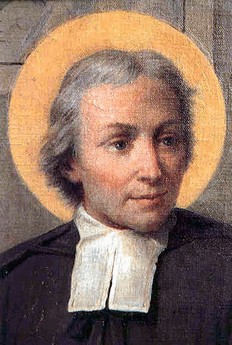
Saint Jean-Baptiste de la Salle: A Teacher for Teachers
Jean-Baptiste de la Salle (1651 – 1719), a French nobleman, ordained a priest, founded the first order in the Church’s history entirely without priests, and this came about almost by accident. I say ‘almost’, for, of course, there are no accidents with God. Destined for ordination from an early age, Jean-Baptiste never looked back, even[…]Continue reading→