
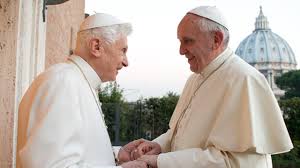
One Papacy, Two Popes: A Brief Reflection
It is a curious situation in the Church that we have two living Popes, one of them a resigned, retired Pope ’emeritus’. One is reminded of the situation from 1294 to 1296, when Pope Celestine V, a monk whom the cardinals had made Pope to help reform the papacy, resigned, with the new Pope, Boniface VIII, locking him up in the Vatican to avoid his kidnapping, and possible schism. Celestine did not mind, seeing his imprisonment as a different kind of monasticism.
In the current case, there is much that could be said of our new two Popes, but one thing we may ponder are the two primal gifts they display: Francis, from the ”charismatic area of the Church” and Benedict XVI from the magisterial (hierarchical) area of the Church.
In his presentation of the Letter to Bishops, “The Church rejuvenates”, on the relationship between hierarchical and charismatic gifts for the life and mission of the Church, Cardinal Marc Ouellet, prefect for the Congregation for Bishops, said that ”the growing vitality of new movements, groups of faithful and ecclesial communities, along with the need to specify the collocation of consecrated life within the Church” has led the post-Conciliar Magisterium to multiply its interventions in this regard. He recalled that ‘”St. John Paul II coined the principle of the ‘co-essentiality’ of these gifts, which was reaffirmed and explored further by Benedict XVI and by Pope Francis when he reiterated that these gifts have the same origin in the Holy Spirit, which actuates the ‘harmony’ between them, ensuring their ecclesial integration and their missionary openness.”
Cardinal Ouellet concluded his presentation by saying that “If anyone were still to doubt the relevance of the charismatic dimension in the Church, (he) would invite them to reflect on the fact that fifty years after Vatican Council II, the Holy Spirit and the cardinals chose a supreme pastor who comes from the charismatic area of the Church.” Of course, Cardinal Ouellet was referring to Pope Francis. Could we not also say that Benedict XVI, who is still part of the papacy, although not as the Sovereign Pontiff responsible for the administration of the Church, remains endowed with the supreme magisterial gift necessary for the edification of the Church, the Body of Christ?
When Pope Francis visited Naples in March of last year, the coagulated blood of the martyred bishop Saint Januarius liquefied in its ampule even though this miracle traditionally happens only on September 19, December 16 and the Saturday before the first Sunday of May. There might have been a meaning attached to this anachronism, but more significant, in my view, is that only half of the blood contained in the glass ampule liquefied. Is it possible to attribute this half-liquification to Pope Francis’ papacy, indicating that it is only half of the whole, which includes that of Pope Benedict’s?
It is said that ”the Church must breathe with two lungs” those of the Catholic and Orthodox Churches. Pope Francis has only one lung. Could the allegory of the Church’s ‘lungs’ be extended to the two popes? Could it be said that the papacy (in its present and actual sense) is one and that each pope is half the papacy?
Also, one might wonder if Benedict XVI is the pope emeritus of the Catholic Church or simply the bishop emeritus of Rome?
Another question: In the case of an eventual reunion with the Orthodox churches, what would be, then, the significance of the Pope of the Coptic Orthodox Church of Alexandria? Would we make reference to him as ‘”the Pope who is in Alexandria”? Is the name-loan ”pope” merely a title or a word having the same extension as ‘father’?
I would think that, given the ramifications, the theological and canonical implications of having two or more validly elected and concurrently reigning popes should be examined.

Saint Kateri , Canada’s Protectress
This was the title given to Saint Kateri Tekakwitha, by Pope Benedict XVI, when he canonized her on October 28th, 2012, along with six others, in Saint Peter’ Square (she had been beatified by Pope John Paul II back in 1980). With Saint Joseph as our protector, along with the Canadian martyrs, we seem to[…]Continue reading→

Remembering Father Alphonse de Valk
(Today marks the sixth anniversary of the death of Father Alphonse de Valk, C.S.B., a faithful, courageous and indefatigable Basilian priest, pro-life-and-family apostle, and the founder of Catholic Insight magazine. Here is what we wrote those on his entering into eternity five years ago, as we continue to remember him in our prayers and thoughts)[…]Continue reading→

My Name is Bernadette
April 16th is a propitious day, for besides the anniversary of Father de Valk’s death, who founded Catholic Insight in its print form decades ago, and the commemoration of the ‘two Benedicts’, mentioned in accompanying posts, today we also recall Saint Bernadette Soubirous, the young visionary to whom the Virgin Mary appeared numerous times at[…]Continue reading→
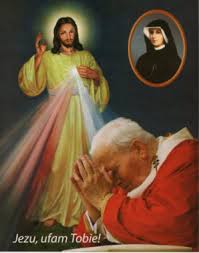
Canonizing Sister Faustina and Divine Mercy
HOMILY OF THE HOLY FATHER MASS IN ST PETER’S SQUARE FOR THE CANONIZATION OF SR MARY FAUSTINA KOWALSKA Sunday, 30 April 2000 1. “Confitemini Domino quoniam bonus, quoniam in saeculum misericordia eius”; “Give thanks to the Lord for he is good; his steadfast love endures for ever” (Ps 118: 1). So the Church sings on the Octave of[…]Continue reading→
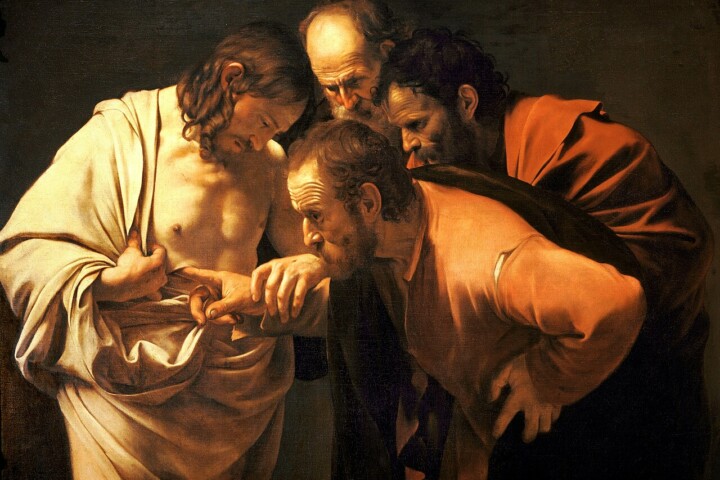
Divine Mercy Sunday – An Echo of Every Mass
Reach out your hand and put it in my side. Do not doubt but believe’… ‘My Lord and my God!’ (Jn. 20:18)). Today is Divine Mercy Sunday, and as we celebrate the end of the Easter Octave, we contemplate the wounded side of our Saviour, the Church’s source of life. On Good Friday in the[…]Continue reading→

Saint Stanislaus of Szczepanów
We celebrate Saint Stanislaus today (+ April 11, 1079), in light of this Easter Octave, a bishop and martyr who accepted the episcopacy only at the direct order of Pope Alexander II. He proved a wise and courageous leader of his flock, put to death by his own king, Boleslaus, for rebuking the monarch’s ‘immoral[…]Continue reading→
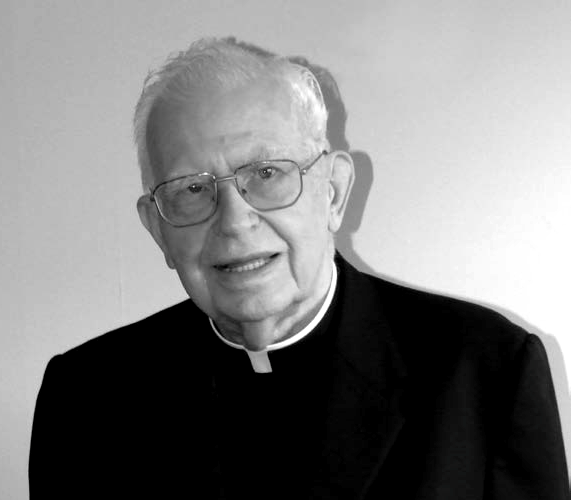
First Holy Communion: Sermon from May 16, 1943
Here is a sermon from the good old days by +Rev. Msgr. Vincent Nicholas Foy (August 14, 1915 – March 13, 2017), from 1943. Readers may recall that Pope Saint Pius X, by the decree Quam Singulari in 1910, lowered the customary age of reception of Holy Communion – after the rigours of the plague[…]Continue reading→
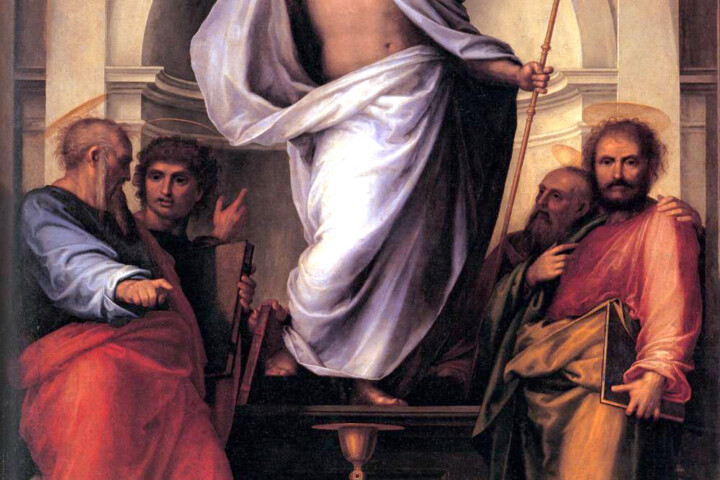
In the Glorious Light of Easter, Alleluia!
Set your minds on things that are above, not on things that are on earth, for you have died, and your life is hidden with Christ in God. When Christ who is your life is revealed, then you also will be revealed with him in glory (Col. 3:3-4). The Resurrection of Our Lord and Saviour[…]Continue reading→
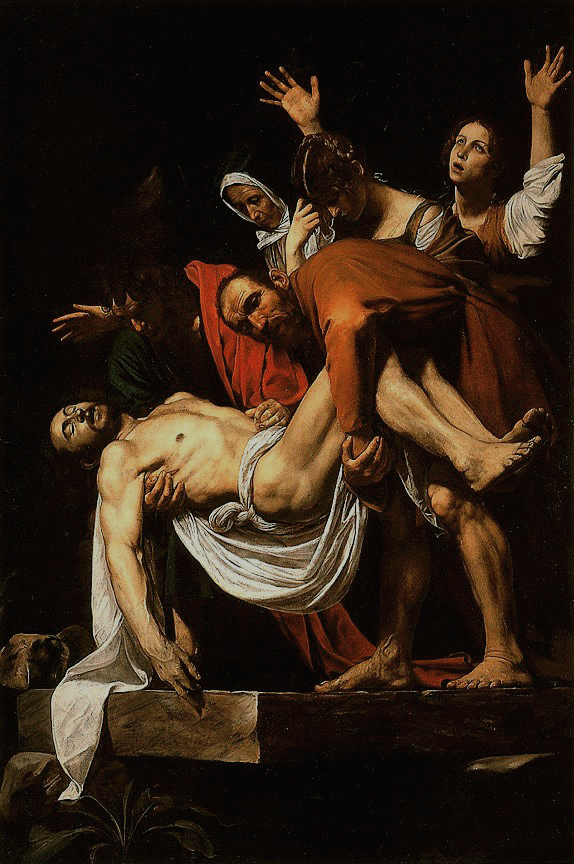
An Ancient Homily for Holy Saturday
The time between Good Friday and Easter Sunday is one of waiting, in silence, as the world wonders – anticipates – what will happen, after the death of Christ. We re-live this time each year in the anamnesis of our liturgy, and in turn look forward to the glorious re-creation of all things at the[…]Continue reading→
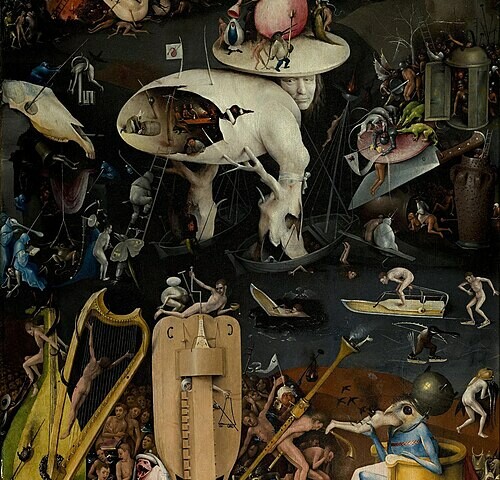
Europe’s Long Descent
(As we meditate on this day on Christ’s burial, and His descent into hell, it is fitting to ponder here with contributor Peter Marcus how the world seems to be heading there as well. The difference is that, although God cannot ‘redeem’ hell, nor those therein, He can and did redeem the world. There is[…]Continue reading→