
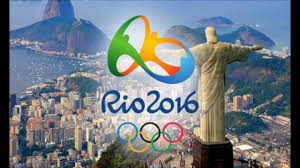
The Neo-Pagan Limits of the Olympics
The much-awaited Olympics is now upon us in Rio, a city in a country in a continent mired in unmanageable debt and corruption. Surrounded by poverty-stricken favelas, the city has poured billions into Olympic venues, security, advertisement, all to watch a few thousand overhyped young athletes strive to excel at their chosen sport.
Don’t get me wrong: I do not harbour any dislike, to say nothing of hatred, for athletics. In fact, I have enjoyed many pleasant hours playing various kinds of games at a recreational level, even though, partly due to the circumstances of my life, I mostly enjoy solitary physical activities, cycling, kayaking and hiking. Perhaps I find them more conducive to prayer and reflection, or perhaps it is connected in some subconscious way to the memory that no one wanted to pick me for a team as a wee lad. You know, past traumas and all that.
So allow me to clarify that I find it very difficult to care about professional sports which have, by and large, become a bloated, idolatrous entity, blown vastly out of proportion to their importance to our culture. As the well-worn analogy goes, sports arenas are our new cathedrals, and the players our new panoply of saints, to whom we offer devotion and praise. Grown men quite literally weep and gnash their teeth when their team seems to be on the verge of losing, or winning; people riot in the streets regardless of the outcome. Much of our lives revolves around sports, and even those who are not ‘fans’ (short, of course, for ‘fanatics’) are caught up in the hype of the big events, the current Olympics, the World Cup, the Stanley Cup, the Super Bowl, and so on.
I have never been one for this charade, not least for the reason that I would rather ride a bike than watch another man do so.
Of course, watching sports does give one a sense of vicarious enjoyment, especially if one participates in the sport in question. Seeing the cyclists of the Tour de France pedalling through the glorious scenery of the Pyrenees, one can imagine oneself doing the same thing, perhaps a tad slower, of course, on a less expensive bike, and with a bit more clothing.
Yet what have sports become? We may judge the value with which we hold a thing by how much money and time we are willing to spend on it, and we as a culture spend far too much of these valuable entities on this ultimately rather utilitarian activity. Parents devote their entire weekends driving their children, boys and now girls, from game to game, tournament to tournament. Sunday Mass? Prayer? Cultural activities? Reading? Music? Family time? Do most modern families even consider such a scale of priorities?
At the professional level, sports have become a money-driven machine, with their millionaire players selling their set of skills to the highest bidder amongst the billionaire owners. Team loyalty? So long as they pay me enough; and if ‘my team’ does not perform well, I can be traded before the playoffs. Geographical loyalty, and rooting for the ‘home team’? How many players are actually from, or care a fig for, the town or city whose name the team adopts, or even from a contiguous region or country, for which they play? How many actually even live there?
The Olympics brings this charade to its apogee, or nadir as the case may be, with untold billions now thrown into its gaping, insatiable maw (at the last venue, the impoverished Russians will be paying off the $15 billion tag for Sochi perhaps until judgement day, and Rio will be no different. Montreal just finished paying off its own debt from the more-sober era of the 1976 Olympics a few years ago).
We watch the desperate athletes, after spending their entire lives training, trying to shave quite literally a thousandths of a second off the last recorded time, a result dependent upon so many other factors (wind, a cold virus, altitude, cloud cover, climate change, you name it) that ‘chance’ has about as large a role as ‘effort’. Their whole lives revolve around their body and its training until, in their mid-twenties, it is worn out, and they are often left injured, disillusioned and depressed as they drift into sedentary middle-age. I wonder especially of the female athletes, delaying marriage and family, as they pummel and morph their bodies into lean, muscular male-like physiques, all for the sake of a gold bauble, or something far less.
Here is something to ponder: No matter how much humans train, some animal will always beat them handily. The world record holder for the 100 metre dash, Usain Bolt, ran it in 9.58 seconds. Compare the fastest human with Sarah the 11 year old cheetah, well into late-middle age for the large cat, who lies around most of the day, and who can run the same distance easily in 5.95 seconds. No one will ever out-wrestle a chimpanzee, even if defanged and declawed, for they have four times the strength of an adult male, nor out bench-press a gorilla, who could probably lift a humvee with ease and can bend tempered steel; and who will ever out-swim a dolphin, which can clock speeds of 25 miles per hour (Michael Phelps, the Olympic prodigy whose feats will likely never be repeated, swims at his best 6 miles per hour). And none of these animals ‘train’ in our sense of the word. They’re just born that way.
Higher, faster, stronger? Scientists estimate that we are perhaps shaving off 1/100 of a second on records each Olympics, and one physiologist claims the fastest any human can ever possibly run the 100 metres is 9.44 seconds, and the same asymptotic limits apply to most other timed sports. And, as we have witnessed of late, many of these records are tainted by doping and other nefarious activities.
Whatever ‘excellence’ the Olympians are striving after, it is not specifically human excellence.
There was a reason why the Olympics were, until recently, limited to amateurs, and forbidden to professionals. The originators of the Olympic ideal thought it unseemly and inhuman to devote one’s whole life and existence to ‘sport’, which should be a leisurely activity, done on the side. After all, there are many other higher, specifically human pastimes and virtues, music, art, science, literature, contemplation, which we do not share with animals, and which are far more fitting to cultivate. That was part of the sub-plot of the great 1981 Olympic film Chariots of Fire: Beware of making sports professional and all-consuming, for we risk a loss of a significant part of our humanity.
The Church has always warned against the danger of such a ‘cult of the body’, a “neo-pagan notion” leading one “to sacrifice everything for (the body’s) sake, to idolize physical perfection and success at sports” (cf., CCC, #2289). Along with this idolization of the body goes a perverse hedonism, as we see in the spike in Tinder usage in the Olympic village, a smartphone app which allows its users to ‘hook up’ with those whom one finds immediately attractive, by swiping their photo. To ‘facilitate’ this fornicatory process, 450,000 condoms were handed out to the athletes. Given there are about 11,000 competitors, that’s about 41 condoms per person, or 82 per couple, which is saying something for a two week event.
I would have thought sexual incontinence would decrease one’s athletic performance, draining one’s focus, attention and determination (as you may recall from the first Rocky film, and, more historically, Roman legionaries).
Of course, I hope and presume most athletes do develop other skills and virtues besides sports and ‘hooking up’, particularly virtues of the mind and soul, to which the body is most definitely subordinate, so they can thrive in terms of what it really means to be human, beyond their brief, all-too-short athletic careers, over almost before they begin.
We must always bring ourselves back to reality and realize with the full focus of our intellect that most sports are simply a bunch of guys, and now girls, running, swimming, fighting, or throwing, hitting and chasing a piece of rubber around various kinds of surfaces, which animals (and now robots) can do far better. Such activities are not the point of life, at least of human life.
Yet much of our time, our energy, our focus, are consumed by them, and many men quite religiously spend their entire weekends and time off watching younger, fitter men (and women) do things they only wish they could do. Harmless fun, to an extent, I suppose; a vicarious form of warfare sublimating our aggression, perhaps; a way to perfect one’s body, yes, but only if one participates in ‘real life’, getting out of Plato’s illusory cave of televised entertainment, into the real world where we can live and move and have our being. It is all a matter of perspective, and we in our artificial modern age have sadly put the last things first, and first things last.
With the many positive aspects of sports, let us always bring things back to such a real perspective, and what it truly means to be human.
Carney’s Amoral Majority
After five defections – euphemistically described as ‘crossing the floor’ – and three by-elections, Mark Carney and his Liberals how have their coveted majority. One wonders what bowls of pottage were offered in back-room deals. In the archaic monarchical system that is the Dominion of Canada, this majority allows the newly-minted Prime Minister to rule[…]Continue reading→

Saint Kateri , Canada’s Protectress
This was the title given to Saint Kateri Tekakwitha, by Pope Benedict XVI, when he canonized her on October 28th, 2012, along with six others, in Saint Peter’ Square (she had been beatified by Pope John Paul II back in 1980). With Saint Joseph as our protector, along with the Canadian martyrs, we seem to[…]Continue reading→

Remembering Father Alphonse de Valk
(Today marks the sixth anniversary of the death of Father Alphonse de Valk, C.S.B., a faithful, courageous and indefatigable Basilian priest, pro-life-and-family apostle, and the founder of Catholic Insight magazine. Here is what we wrote those on his entering into eternity five years ago, as we continue to remember him in our prayers and thoughts)[…]Continue reading→
A Tale of Two Benedicts
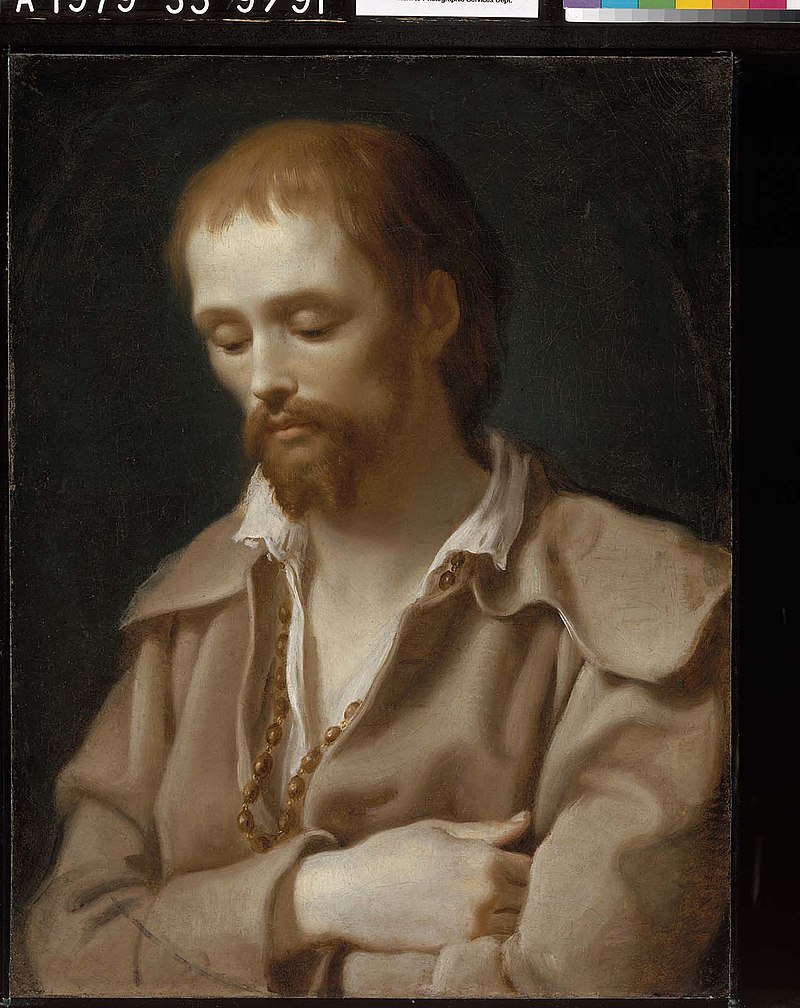
A grace-filled Holy Week to all our readers! As we await and prepare for the Resurrection about to dawn upon us, we might keep in mind two Benedicts: Pope Emeritus Benedict XVI, requiescat in pace, elected on this day in 2005; and today’s commemoration of the mystic pilgrim, Benedict Joseph Labre, who died on this[…]Continue reading→

My Name is Bernadette
April 16th is a propitious day, for besides the anniversary of Father de Valk’s death, who founded Catholic Insight in its print form decades ago, and the commemoration of the ‘two Benedicts’, mentioned in accompanying posts, today we also recall Saint Bernadette Soubirous, the young visionary to whom the Virgin Mary appeared numerous times at[…]Continue reading→
Saint Lydwina of Schiedam and Suffering Joyfully
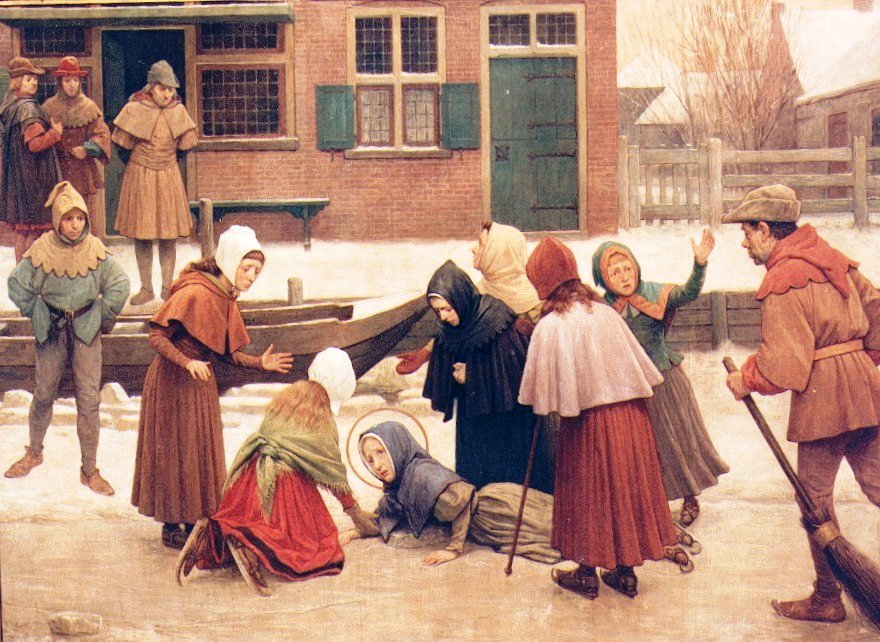
Saint Lydwina of Schiedam (1380 – 1433) was one of the countless and glorious ‘victim souls’ in the history of the Church, those whose lives are filled with suffering, often of an unimaginable intensity, but who suffer joyfully. She was a fifteen-year old Dutch girl, out skating one day, when she fell and broke one[…]Continue reading→
The Glorious Martyrdoms of Martin and Maximus
As we enter into Eastertide, we recall on this 13th of April Pope Saint Martin I (+655), one of the noblest, if most tragic, of the successors of Saint Peter. Born in Umbria, Italy, he was of noble lineage, with great intelligence combined with charity and love of the poor and the Church. While still[…]Continue reading→

Canonizing Sister Faustina and Divine Mercy
HOMILY OF THE HOLY FATHER MASS IN ST PETER’S SQUARE FOR THE CANONIZATION OF SR MARY FAUSTINA KOWALSKA Sunday, 30 April 2000 1. “Confitemini Domino quoniam bonus, quoniam in saeculum misericordia eius”; “Give thanks to the Lord for he is good; his steadfast love endures for ever” (Ps 118: 1). So the Church sings on the Octave of[…]Continue reading→

Divine Mercy Sunday – An Echo of Every Mass
Reach out your hand and put it in my side. Do not doubt but believe’… ‘My Lord and my God!’ (Jn. 20:18)). Today is Divine Mercy Sunday, and as we celebrate the end of the Easter Octave, we contemplate the wounded side of our Saviour, the Church’s source of life. On Good Friday in the[…]Continue reading→

Saint Stanislaus of Szczepanów
We celebrate Saint Stanislaus today (+ April 11, 1079), in light of this Easter Octave, a bishop and martyr who accepted the episcopacy only at the direct order of Pope Alexander II. He proved a wise and courageous leader of his flock, put to death by his own king, Boleslaus, for rebuking the monarch’s ‘immoral[…]Continue reading→