
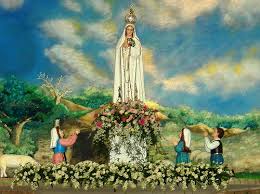
Fatima, Prayer and Private Revelation
Today is the commemoration of Our Lady of Fatima, a title given to the Virgin Mary after she appeared ‘brighter than the sun, shedding rays of light’ to three shepherd children in the summer of 1917 (no painting ever did Our Lady justice) just outside the village of Fatima, in central Portugal, about 76 miles north of Lisbon.
The accounts of the visions, along with the still-as-yet-unexplained miracle of the dancing and twirling Sun, which took place, with one or two exceptions, on the 13th of each month until October of that year, can be found in countless books and articles. What we as Catholics should keep in mind is that today’s memorial does not canonize everything within these appearances, nor all the locutions and revelations. There are many things mysterious and, one might say, confusing about Fatima that one is free to accept, or not, or accept with some degree of reservation and explanation.
Just ponder a few examples of questions we may ask: Are numerous souls really falling into hell like burning embers, shrieking in anguish? Did the Sun really become unmoored from its astronomical course and whirl around the cosmos? Did God suspend the law of nature, in particular gravity, for this occurrence? Or was it an optical illusion of sorts, a ‘vision’ given to all the people, to teach them the power of God over nature? Did the children receive Holy Communion from an angel, and what sort of ‘Communion’ was this, without the apparent species of bread? What is the status of the ‘three secrets’, which were supposed to be revealed in 1960, but instead were made public in the Jubilee Year 2000 by Cardinal Ratzinger? Did Our Lady really ‘guide’ Ali Agca’s bullet that should have killed Pope John Paul on this day in 1981? It seems the Pope himself thought so, and I for one believe she did, as she may well have saved my life more than once.
These are really side issues, for in the midst of all the titillating mystery, we should always go back to the basic and ultimate purpose of private revelation, whether large and approved (Fatima, Guadalupe and Lourdes) or smaller and less well-known, all the way to our own ‘private’ revelations in our personal prayer (and let us not forget that even the most famous of revelations began with a one-to-one encounter):
Private revelations, as the Catechism declares, “do not belong…to the deposit of faith. It is not their role to improve or complete Christ’s definitive Revelation but to help live more fully by it in a certain period of history” (CCC, #67).
That is why the Catechism goes on to make very clear that “Christian faith cannot accept “revelations” that claim to surpass or correct the Revelation of which Christ is the fulfilment”.
Thus, any revelation that supports Christ’s Revelation (found in Scripture and the Church’s Tradition) is good, while any revelation that negates, or even purports to go beyond or improve Christ’s Revelation is bad and must be rejected.
We may think of clear examples outside the Christian fold, like the ‘revelations’ Muhammad claimed to have received, or Joseph Smith and the Mormons, or even Luther in his fevered and enthusiastic soul as he drifted away from the Church, which are obviously false, even if mixed in with some truth.
Rather, the ‘good’ private revelations remind and exhort us to live out more fully and perfectly in a particular era and historical setting what has already been given to us by the Church: Our Lady of Fatima exhorted the children (and us) to be more diligent in praying the Rosary, to do penance for sinners, to pray for peace, especially for an end to the World War, to go to Mass and Communion and so on. Lourdes was much the same, as was Guadalupe and all the other good and approved ‘visions’, all the way down to our own personal prayer, which is itself a kind of private revelation, our own face-to-face time with Christ, Our Lady, the saints who speak to us in their (and our) own way. That is why the Church offers guidelines for our prayer, which should be Christocentric and immersed in the Church’s Tradition and Scripture. Every Catholic should peruse the very apt 1989 instruction Some Aspects of Christian Meditation to learn what is useful, and what is not, and what is downright wrong, as we develop in our prayer life. And let us not forget the dire words in the current Catechism, quoting Saint Alphonsus Ligouri:
Those who pray are certainly saved; those who do not pray are certainly damned. (CCC, #2744)
We may add to this that those who pray well are certainly saved, for it may not always be God who speaks to us in prayer, if we choose to go off on our own, on paths too dark and deep for us.
We should therefore test the spirits, as Saint John tells us, to see which are from God, and which are not. The Church’s teaching is the guide and lodestone, the pillar and bulwark of truth, and Our Lady, or any saint, will always lead us back to Christ, His Church, the moral and ecclesiastical law and the sacraments, and eventually heaven.
Any other revelation is illusory and a wide and easy road to the ‘other’ place of which the children had such a vivid vision in the true revelation of Fatima.
Carney’s Amoral Majority
After five defections – euphemistically described as ‘crossing the floor’ – and three by-elections, Mark Carney and his Liberals how have their coveted majority. One wonders what bowls of pottage were offered in back-room deals. In the archaic monarchical system that is the Dominion of Canada, this majority allows the newly-minted Prime Minister to rule[…]Continue reading→

Saint Kateri , Canada’s Protectress
This was the title given to Saint Kateri Tekakwitha, by Pope Benedict XVI, when he canonized her on October 28th, 2012, along with six others, in Saint Peter’ Square (she had been beatified by Pope John Paul II back in 1980). With Saint Joseph as our protector, along with the Canadian martyrs, we seem to[…]Continue reading→

Remembering Father Alphonse de Valk
(Today marks the sixth anniversary of the death of Father Alphonse de Valk, C.S.B., a faithful, courageous and indefatigable Basilian priest, pro-life-and-family apostle, and the founder of Catholic Insight magazine. Here is what we wrote those on his entering into eternity five years ago, as we continue to remember him in our prayers and thoughts)[…]Continue reading→
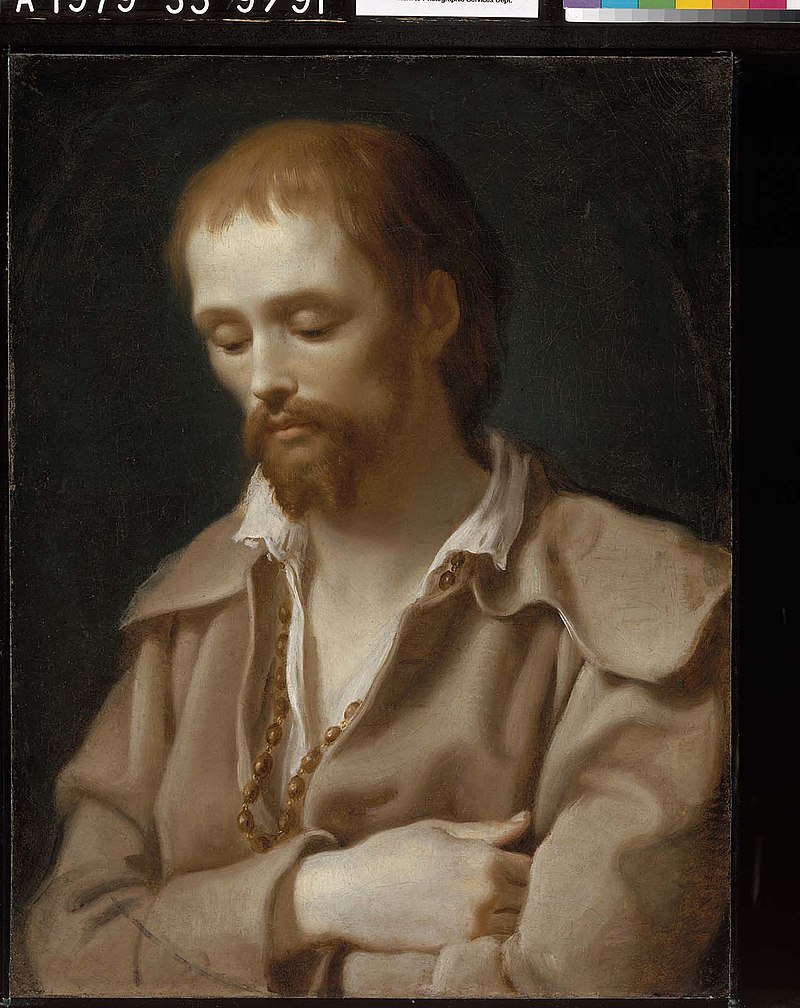
A Tale of Two Benedicts
A grace-filled Holy Week to all our readers! As we await and prepare for the Resurrection about to dawn upon us, we might keep in mind two Benedicts: Pope Emeritus Benedict XVI, requiescat in pace, elected on this day in 2005; and today’s commemoration of the mystic pilgrim, Benedict Joseph Labre, who died on this[…]Continue reading→

My Name is Bernadette
April 16th is a propitious day, for besides the anniversary of Father de Valk’s death, who founded Catholic Insight in its print form decades ago, and the commemoration of the ‘two Benedicts’, mentioned in accompanying posts, today we also recall Saint Bernadette Soubirous, the young visionary to whom the Virgin Mary appeared numerous times at[…]Continue reading→
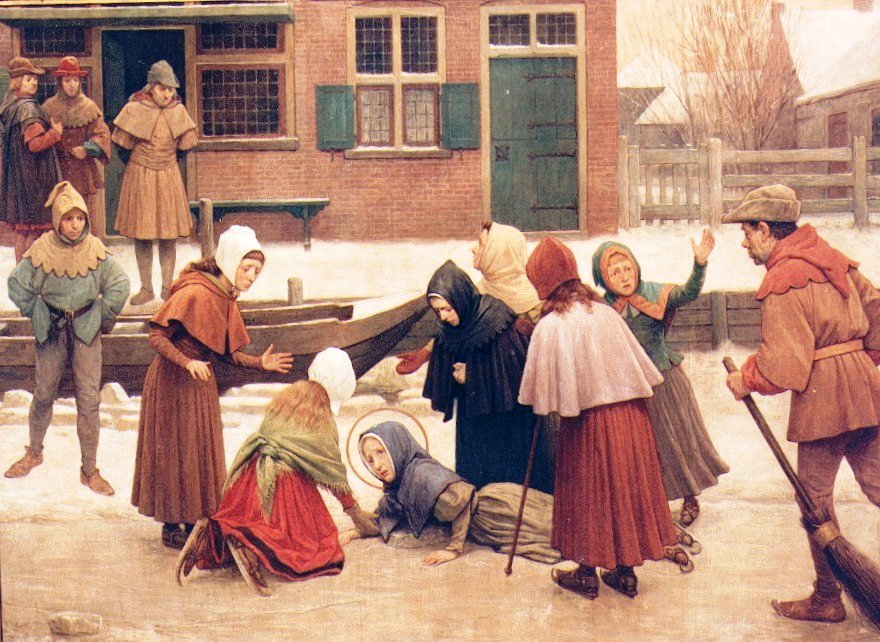
Saint Lydwina of Schiedam and Suffering Joyfully
Saint Lydwina of Schiedam (1380 – 1433) was one of the countless and glorious ‘victim souls’ in the history of the Church, those whose lives are filled with suffering, often of an unimaginable intensity, but who suffer joyfully. She was a fifteen-year old Dutch girl, out skating one day, when she fell and broke one[…]Continue reading→
The Glorious Martyrdoms of Martin and Maximus
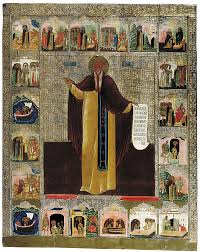
As we enter into Eastertide, we recall on this 13th of April Pope Saint Martin I (+655), one of the noblest, if most tragic, of the successors of Saint Peter. Born in Umbria, Italy, he was of noble lineage, with great intelligence combined with charity and love of the poor and the Church. While still[…]Continue reading→
Canonizing Sister Faustina and Divine Mercy
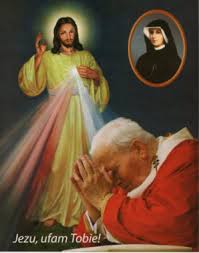
HOMILY OF THE HOLY FATHER MASS IN ST PETER’S SQUARE FOR THE CANONIZATION OF SR MARY FAUSTINA KOWALSKA Sunday, 30 April 2000 1. “Confitemini Domino quoniam bonus, quoniam in saeculum misericordia eius”; “Give thanks to the Lord for he is good; his steadfast love endures for ever” (Ps 118: 1). So the Church sings on the Octave of[…]Continue reading→

Divine Mercy Sunday – An Echo of Every Mass
Reach out your hand and put it in my side. Do not doubt but believe’… ‘My Lord and my God!’ (Jn. 20:18)). Today is Divine Mercy Sunday, and as we celebrate the end of the Easter Octave, we contemplate the wounded side of our Saviour, the Church’s source of life. On Good Friday in the[…]Continue reading→

Saint Stanislaus of Szczepanów
We celebrate Saint Stanislaus today (+ April 11, 1079), in light of this Easter Octave, a bishop and martyr who accepted the episcopacy only at the direct order of Pope Alexander II. He proved a wise and courageous leader of his flock, put to death by his own king, Boleslaus, for rebuking the monarch’s ‘immoral[…]Continue reading→