
Till We Have Faces: To Niqab, or Not?
In an interesting turn of events, the niqab, the face-covering veil worn by certain Muslim women, has become a defining election issue in Canada. Just today, Zunera Ishaq, who had petitioned for the right to take her citizenship oath wearing the veil, took that very oath, yes, with her face covered (she received a court order allowing her to do so which, apparently, our elected government could do nothing to stop).
I wonder if they would let me take the oath wearing a Mike Meyers Hallowe’en mask, or even a bandana?
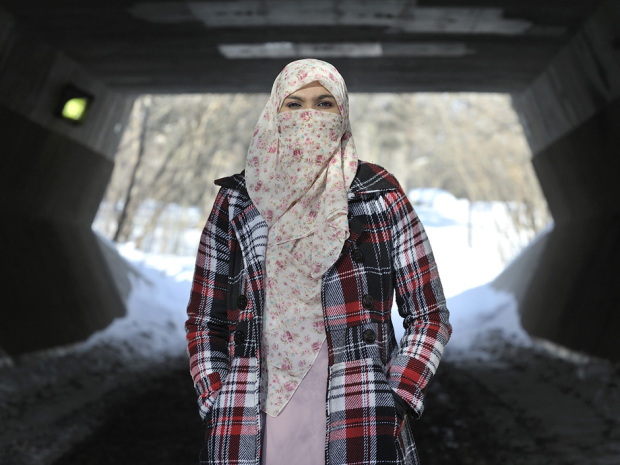
Stretched analogies aside, people do get emotional about this. Recently, a niqab-ed woman, Safira Merriman, had an elbow violently ‘shoved’ into her shoulder in Quebec by an unknown male assailant, while entering a store. (From the photo, she was wearing the full burqa plus niqab).

Apparently, Tom Mulcair’s support for the niqab has cost him dearly in the polls, especially in Quebec, which, anecdotally and statistically, has an aversion for foreigners, particularly those not assimilating to its culture. Not so, it seems, Justin Trudeau, riding high in the polls, not least due to his cosseted treatment by the lapdog media (not least the publicly-funded CBC), who also supports the niqab as an expression of the ‘freedom’ of a culture to express itself, under his father’s vaunted Charter of Rights and Freedoms.
It is curious that both Mulcair and Trudeau frame opposition to the niqab in terms of ‘racism’ when it has nothing really to do with race, but with culture and religion. Safira Merriman is of French-Canadian stock “going back to the 1600’s” as the article states, about as Canadian as maple syrup and the canoe. She has chosen with her own free-will, with what coercion we know not, to cover her face in public.
And this, I believe, is the root of the problem, of which the niqab is a symbol. Some people are aware that there is a radical cultural ‘shift’, and, one might say ‘clash’, occurring in Europe, and more slowly here in Canada, with the ongoing and increasing Muslim ‘migration’ (or whatever term one wants to apply).
Why a clash? Why cannot we, like the immigrants of yesteryear (amongst whom I count myself), not all just go along and get along, live and let be? Well, the short answer is that if there is one thing consistent in the widely differing forms of Islam, it is the almost universal refusal to assimilate. In fact, it is a central tenet of Islam, as the name itself implies (‘submission’) that you must assimilate to them and, ultimately, ‘submit’ to Islam, to Allah and his prophet.
This applies two ways, both to foreigners living in Islamic countries, and to Muslims living in non-Islamic (nominally Christian) countries.
In the former, such as Saudi Arabia, the visitor, or immigrant, must abide by Islamic rules, and may only practice one’s culture (primarily one’s religion, but also certain ways of dressing and acting) in the privacy of one’s home, and even here the freedom is limited. Try walking around Saudi Arabia with a cross on one’s neck, or make the sign of the cross at a market, or try even to speak about your religion and culture. If you are a woman, try driving a car, or wearing ‘Western’ clothes in public, or, gasp, catching the eye of a Muslim man.
We place no such rules on Muslims in our midst, who are free to dress and act pretty much how they see fit. Yet, even in their ‘host’ countries, Muslims petition to have the resident citizens assimilate to their beliefs and codes. Witness the campaign, for one example amongst many, against alcohol and Christmas (which go together like milk and honey) by Muslims in Birmingham, England (yes, merrie olde England, the land of Dickens and Scrooge). This is not yet widespread, and the moderate Muslims condemn such behaviour, but the radicals, the fervent and the violent, have a way of dominating the culture and getting their way (as we have seen in the fear of ever drawing or portraying any image of ‘the prophet’ Muhammad).
Even the few minor restrictions we might, just might, consider placing on their freedom, like revealing your face during a citizenship oath, are castigated as racist and bigoted, a denial of religious freedom.
Adam Gopnik, a Canadian, has a recent article on this debate wherein, in true ‘liberal’ fashion, he defends the rights of Muslim women to dress as they please, just as we permit Orthodox Jews, the Amish and, I might add, even Catholic nuns and sisters to cover up in religious habits of various sorts.
The difference that Mr. Gopnik, along with Mulcair and Trudeau, do not seem to grasp is that none of these styles of female dress cover the face, upon which Islam is insistent, and the stricter the interpretation of the Qur’an, the more covering is demanded. Sure, Ms. Ishaq’s niqab is  somewhat minimal, a kerchief around the head, with some covering of the nose and mouth, like a Torontonian battling the summer smog. You can still see her eyes. But look at the photo here of a woman you might ‘see’ in Saudi Arabia, as an example of what might be around the corner should a more strict version of Islam assert itself.
There is something deeply significant about a face. When asked to send a picture of ourselves, we, of course, send a photo of our visages, not our arms, hands or various less-mentionables. The face signifies who we are as persons. In fact the original Greek word for face, prosopon, was adopted into Latin as persona, which in turn developed into our philosophical, theological and legal notion of ‘person’. Curiously, this term was originally applied to God in His nature as a Trinity of Persons, which led, as Joseph Ratzinger argued persuasively in a 1991 essay in Communio, to the development of the human notion of person, an individual with an inviolable dignity, made in the very image of God Himself.
Islam, in its theological doctrine (such as it is) does not have much place for the dignity of the human person. We are not made in God’s image, and Allah is not even a ‘personal’ God, but a distant figure, whose decrees, whether for good or ill, cannot and must not be questioned. He exists not in a relationship with his human creatures, but as a law-giver, a punisher of sin and a rewarder of virtue (as they define them). Prayer is an act of obeisance, to be carried out externally, at least in their five times a day prostrations toward Mecca. In office buildings and hospitals across the land, they demand prayer mats, separate rooms, female segregation and so on. We are, of course, free to join them.
If human beings are not persons made in God’s image, they have no inviolable rights, and this especially applies to ‘infidels’ who have not submitted to Allah and his prophet. We hear of the extremes of this daily from Syria and Libya, as Christians, along with less-observant Muslims, are enslaved, tortured and martyred. No one is free from the inscrutable decrees of Allah.
I wonder whether Mr. Mulcair and Trudeau have ever stopped to wonder why Muslim men ask (dare I say compel) their women to cover their faces with the niqab? Whether the women do so ‘freely’ or not is beside the point (the National Post claims that modern Islamic women want to wear these veils, as part of a modern trend, but I don’t think that is entirely true). The real question is what the veil says about the personal status, the very identity, of these women, who declare themselves practically anonymous in public by veiling the very face that signifies their personhood.
Till We Have Faces is the title of a curious and rather allegorical novel by C.S. Lewis, in which the main character, a disfigured woman, spends most of the story wearing a veil. She is a person ‘with no face’, the morale being, if I read it correctly, that we must first find, and reveal, our true identity before we can achieve happiness and peace.
What is Islam saying about women when compelling them to wear a veil? That they are not really persons? That their faces ‘belong’ only to their husbands, which only he has a right to see? Are they implying that we, as non-Muslim ‘infidels’ if you will, are not ‘persons’ enough to look upon them?
A final thought: As I mentioned, the woman in the ‘elbow shoving’ incident, behind her niqab and burqa, is French Canadian, and, we presume, culturally Catholic. I wonder why, when she married her Muslim husband, did he not convert to her religion? Why is that almost never the case, in Italy, Germany, Sweden, wherever Muslim men marry Christian women? Why are they not a couple raising their children (if they have any) in the full truth of the Catholic Church? One laughs at the very thought, but that is the point. If Ms. Merriman is a typical Quebecer, she was not practising her faith, and was likely never raised in its tenets and practice, or perhaps in any religion. And, as I have written before, one cannot have a culture without a religion. La langue francaise, poutine and hockey do not a culture make.
Whatever one says about Islam, they do have a culture, disordered in many ways, but dominant and confident, for they do seem to believe, and believe religiously, in what they profess to be true.
Not so, alas, Quebec, along with just about the entirety of what we call ‘the West’, quickly becoming a religious and moral void. As I have written before, as our religion withers, so too does our culture. We can scarcely be said to have a culture anymore, for we do not have a shared, binding core set of religious beliefs, a common transcendent faith. Quebec used to, and may even fifty years ago have resisted Islam. But now? What is holding us together? What is the foundation for Trudeau’s vaunted ‘Canadian values’? The vague and incoherent Charter and its notions of ‘tolerance’? I fear that will not stand up to the stern dictates of the Qur’an.
Europe has even less to hold itself together, as witnessed, amongst innumerable examples from which I could draw, in the ghastly and embarrassing fin de siecle Eurovision song contests, won last year by a bearded transgendered ‘woman’, Conchita Wurst. No wonder the  Muslims are just walking in by the thousands, and, I dare predict, will soon take over. Who is going to stop them? I don’t think Ms/Mr Wurst and her ilk are up to the task. Perhaps the more fervent amongst our Muslim brethren think they are doing us a favour by saving us from ourselves.
To resist a culture, one must first have a culture, strong, vibrant, cohesive, and, I will repeat, the only way this is possible is to have it founded on religion and the family, two things almost completely missing from the face of modern Europe, Canada and, yes, Quebec.
We must again rediscover our own identity in our Christian Catholic roots, but, to put it mildly, that will be a long, uphill struggle, and, as things now stand, distant on the horizon. However, it is only by doing so that we will resist assimilation, and the loss of our own identity as persons made in God’s image, along with all the dignity, rights and freedoms so dearly bought through the centuries that go along with that.
Carney’s Amoral Majority
After five defections – euphemistically described as ‘crossing the floor’ – and three by-elections, Mark Carney and his Liberals how have their coveted majority. One wonders what bowls of pottage were offered in back-room deals. In the archaic monarchical system that is the Dominion of Canada, this majority allows the newly-minted Prime Minister to rule[…]Continue reading→

Saint Kateri , Canada’s Protectress
This was the title given to Saint Kateri Tekakwitha, by Pope Benedict XVI, when he canonized her on October 28th, 2012, along with six others, in Saint Peter’ Square (she had been beatified by Pope John Paul II back in 1980). With Saint Joseph as our protector, along with the Canadian martyrs, we seem to[…]Continue reading→

Remembering Father Alphonse de Valk
(Today marks the sixth anniversary of the death of Father Alphonse de Valk, C.S.B., a faithful, courageous and indefatigable Basilian priest, pro-life-and-family apostle, and the founder of Catholic Insight magazine. Here is what we wrote those on his entering into eternity five years ago, as we continue to remember him in our prayers and thoughts)[…]Continue reading→
A Tale of Two Benedicts
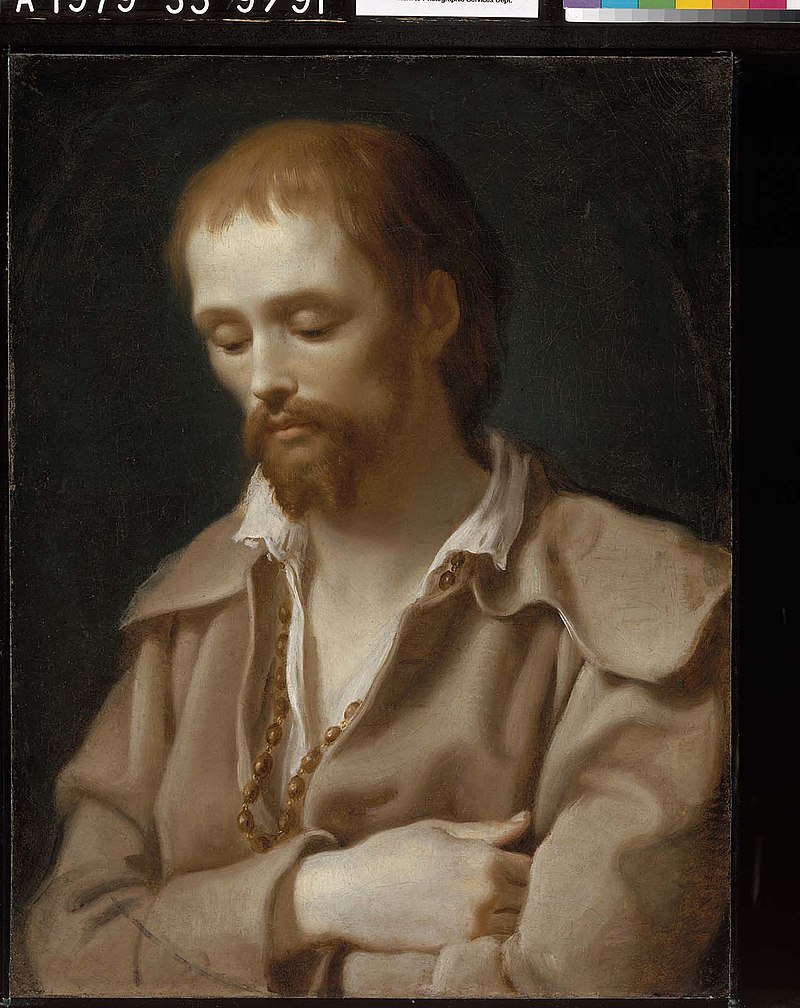
A grace-filled Holy Week to all our readers! As we await and prepare for the Resurrection about to dawn upon us, we might keep in mind two Benedicts: Pope Emeritus Benedict XVI, requiescat in pace, elected on this day in 2005; and today’s commemoration of the mystic pilgrim, Benedict Joseph Labre, who died on this[…]Continue reading→

My Name is Bernadette
April 16th is a propitious day, for besides the anniversary of Father de Valk’s death, who founded Catholic Insight in its print form decades ago, and the commemoration of the ‘two Benedicts’, mentioned in accompanying posts, today we also recall Saint Bernadette Soubirous, the young visionary to whom the Virgin Mary appeared numerous times at[…]Continue reading→
Saint Lydwina of Schiedam and Suffering Joyfully
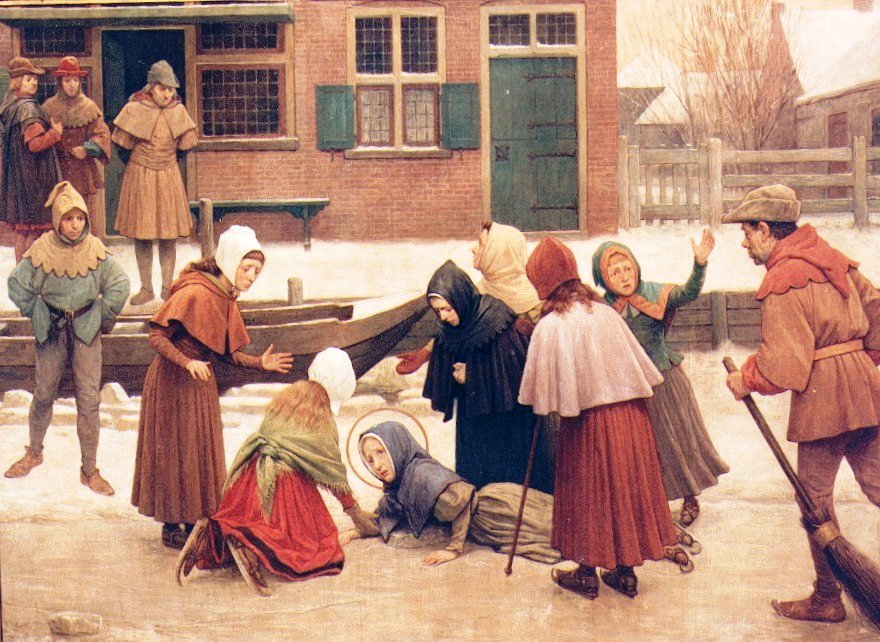
Saint Lydwina of Schiedam (1380 – 1433) was one of the countless and glorious ‘victim souls’ in the history of the Church, those whose lives are filled with suffering, often of an unimaginable intensity, but who suffer joyfully. She was a fifteen-year old Dutch girl, out skating one day, when she fell and broke one[…]Continue reading→
The Glorious Martyrdoms of Martin and Maximus
As we enter into Eastertide, we recall on this 13th of April Pope Saint Martin I (+655), one of the noblest, if most tragic, of the successors of Saint Peter. Born in Umbria, Italy, he was of noble lineage, with great intelligence combined with charity and love of the poor and the Church. While still[…]Continue reading→

Canonizing Sister Faustina and Divine Mercy
HOMILY OF THE HOLY FATHER MASS IN ST PETER’S SQUARE FOR THE CANONIZATION OF SR MARY FAUSTINA KOWALSKA Sunday, 30 April 2000 1. “Confitemini Domino quoniam bonus, quoniam in saeculum misericordia eius”; “Give thanks to the Lord for he is good; his steadfast love endures for ever” (Ps 118: 1). So the Church sings on the Octave of[…]Continue reading→
Divine Mercy Sunday – An Echo of Every Mass
Reach out your hand and put it in my side. Do not doubt but believe’… ‘My Lord and my God!’ (Jn. 20:18)). Today is Divine Mercy Sunday, and as we celebrate the end of the Easter Octave, we contemplate the wounded side of our Saviour, the Church’s source of life. On Good Friday in the[…]Continue reading→

Saint Stanislaus of Szczepanów
We celebrate Saint Stanislaus today (+ April 11, 1079), in light of this Easter Octave, a bishop and martyr who accepted the episcopacy only at the direct order of Pope Alexander II. He proved a wise and courageous leader of his flock, put to death by his own king, Boleslaus, for rebuking the monarch’s ‘immoral[…]Continue reading→