
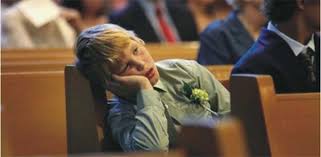
Boring Sermons: A Thomistic Take
Why Sermons are Boring
Daniel Callam, C.S.B.
In moving offices recently I found, between my copies of Harry Potter and Lord of the Rings, a long-lost fragment from the unfinished third part of the Summa theologiae of Saint Thomas Aquinas. The manuscript, consisting of a single article, was headed Utrum sermones semper taediosi sint: “Whether sermons are always boring.” Anyone acquainted with the literary form of the Summa will know at once that this title reveals Thomas’s conviction that sermons always are boring. He begins, typically, with arguments (“Objections”) for their being interesting and then shows from Scripture, Tradition and reason that they are not in fact so. In closing, he replies to the objections by refining or refuting them. Given the importance of preaching and the general conviction that sermons are poor, there is no need for me to stress the relevance of Saint Thomas’s discussion. Documentation, obviously, has been provided by the translator.
Objection 1: By ordination, the priest is another Christ. But Christ was the perfect preacher. Therefore sermons are always interesting.
Objection 2: Jesus promised the Holy Spirit would inspire his followers when they needed his assistance: “The Holy Spirit will teach you at that moment all that should be said.”[1] But the faithful need to be instructed. Therefore the Spirit will provide the preacher with all necessary eloquence.
Objection 3: The content of the sermon, as based on the text of Scripture, is an extension of the Gospel. Therefore, as John Henry Newman noted, “all sermons are good.”[2]
Objection 4: Because Scripture is infinitely rich there will always be something new and engrossing to say about every text. Therefore sermons are always interesting.
Objection 5: An exalted subject matter calls for the greatest eloquence. But our salvation is “the greatest story ever told.”[3] Furthermore, Jane Austen says, “A thoroughly good sermon, thoroughly well delivered, is a capital gratification. I can never hear such a one without the greatest admiration and respect.”[4] Therefore sermons, as the most eloquent of all addresses, cannot be boring.
On the Contrary[5]
Jesus said, speaking of religious leaders, “They bind up heavy loads, hard to carry, to lay on other men’s shoulders, while they themselves will not lift a finger to budge them.”[6] Since boring sermons make religious observance itself a burden, Jesus’ words apply most fittingly to preachers. Flannery O’Connor confirms this view: “My cousin’s husband came into the Church last week. . . . We asked how he got interested, and his answer was that the sermons were so horrible, he knew there must be something else there to make the people come.”[7] Therefore Scripture and Tradition alike prove that sermons are always boring.[8]
Argumentation[9]
I reply by saying that sermons may be divided into two categories: the boring and the entertaining. Each of these may be further subdivided, for a sermon may be boring in two ways or entertaining in two ways.
First, therefore, I say that a sermon may be both boring and good. The origin of boredom is repetition.[10] But repetition will be boring only to an uninterested, idle listener. Where there is affection and engagement, repetition will never be tedious, for a man will enter into a fuller understanding of sublime truths with each hearing. This is demonstrated by Saint John in his old age saying over and over again to his devoted flock: “Little children, love one another.”[11] As a musician never wearies of performing a masterpiece or a scholar of reading the classics, so the devout never tire of hearing the message of Scripture or the Creed repeated in the simplest, most direct language while the casual dabbler in religion will be irritated at a second hearing of even the most sublime mysteries of the faith. Thus good sermons are boring, but only secundum quid.[12]
On the other hand, a sermon may be boring and bad. It will be bad, not because it repeats the Gospel message in familiar language but because the preacher belies his message by his manner. If it convinces the congregation that he himself is bored with what he repeats, his manner of teaching will deprive even devout hearers of that contact with Scripture and Tradition which alone can make their repetition of interest and profit. He commits the further fault of making religious truths seem irrelevant, as Rose Macaulay noted in London at the beginning of the Second World War:
I went in for 20 minutes yesterday to the R.C. church near here, where there was a sermon going on. It was all about how the Supreme Being had created various orders of Angels, good and bad. I cannot think why we have endured all these centuries all this lifeless nonsense. I thought as I sat there, what if the congregation all rose up and mobbed the preacher, and beat him up and the women scratched his face and the men kicked him, saying, “We want something to the purpose, not angels & devils: give us bread, not stones.” Why don’t they?[13]
In theory, entertaining sermons could be either good or bad, and if good they could be so in two ways. The first would occur when a sermon provided some fresh insight into the infinitely rich text of Scripture, as we find in the sermons of Saint Augustine, Bishop Bossuet and John Henry Newman. Jane Austen describes such men:
The preacher who can touch and affect a heterogeneous mass of hearers on subjects limited and long worn threadbare in all common hands; who can say anything new or striking, anything that rouses the attention with-out offending the taste or wearing out the feeling of his hearers, is a man whom one could not (in his public capacity) honour enough.[14]
Unfortunately, there are no such sermons today because great preaching ceased with the disappearance of high rhetoric.
There is a second way in which a sermon could be both entertaining and good: if the personality of the priest were to disappear into his role of purveyor of the Gospel. This approach to liturgy would emphasize that Jesus Christ himself is the agent in the sacred action. Hence even the most awkward presentation of the truths of faith would still engross his hearers so that his preaching could be called “entertaining” in an extended sense of the term. That there are no such preachers now us confirmed by Thomas Day’s observation, “Today, ‘the priest’ is almost gone. He has been replaced by Mr. Nice Guy. . . . ‘The priest’ develops a stage character. A star is born.”[15]
It follows from the above that entertaining sermons will always be bad, and they are so in two ways. In the first sort, the preacher entertains his congregation by propounding novelty from the pulpit. At best his ideas will be idiosyncratic and irrelevant; at worst they will be heretical. And in both cases the priest will have broken his promise to preach, as the bishop’s proxy, the Catholic faith, which the faithful have assembled to hear, as is their right. Entertaining sermons will be bad in a second way when the priest draws attention to himself rather than his message, as was described above in the quotation from Thomas Day.
Replies to the Objections
To the first, I say that the sermon of a priest who faithfully conveys the message of Jesus Christ without eloquence will always be of interest to the faithful and so boring only to those without faith.
To the second, I say that by the grace of ordination the Holy Spirit first assures the validity of the sacramental action. The effect of grace, therefore, is not to make a naturally inept speaker eloquent but to confirm his allegiance to the Gospel. As we have already stated, “Grace does not remove nature but perfects it.”[16] Furthermore, no eloquence is necessary when truth is conveyed, as the Apostle says: “I did not come proclaiming to you the testimony of God in lofty words or wisdom. For I decided to know nothing among you except Jesus Christ and him crucified.”[17]
To the third, I say that all sermons are good insofar as they proclaim the Gospel. Therefore, as was stated in “To the second,” rhetoric is not necessary for good preaching.
To the fourth, I say that the riches of Scripture are revealed not only in the words of the sermon but also to the understanding heart. Hence, whenever biblical truth is presented the well-disposed listener will uncover something new and wonderful, like the man in the Gospel who found a treasure hidden in a field.[18] Therefore, fidelity, not eloquence, is the primary quality of the preacher of the Gospel, as has been noted above.
To the fifth, I say that this objection merely states that every preacher worthy of the name will use and even exceed his natural gifts in his high service, not that all will be extraordinarily eloquent.
[1] Lk 12.12.
[2] Loss and Gain, ch. 2.
[3] Cf. Fulton Oursler, The Greatest Story Ever Told (New York: DoubleDay, 1949).
[4] Jane Austen, Mansfield Park, ch. 34. May I note that Henry Crawford’s being the speaker of these words somewhat weakens their effect?
[5] In “On the Contrary” Saint Thomas cites an authoritative statement from Scripture or Tradition to establish his position, in this case that sermons are always boring.
[6] Mtt 23.4.
[7] Flannery O’Connor, Letters: The Habit of Being, edited by Sally Fitzgerald (New York: Farrar Straus Giroux, 1979), p. 348.
[8] That this “On the Contrary” is longer than most indicates Saint Thomas’s strong conviction on the matter.
[9] The Latin term commonly used for this section of the article is corpus, i.e., “body.” I have translated it as “Argumentation” because in the corpus Thomas demonstrates his position by reason.
[10] Repetitio mater taedii.
[11] Jerome, Comm. in epistolam ad Galatas, 6.10.
[12] I.e., “in a way” or “from one point of view.”
[13] Rose Macauley, Letters to a Sister (New York: Atheneum, 1953), p. 95.
[14] Austen, ch. 34.
[15] Thomas Day, Why Catholic Can’t Sing (New York: Crossroad, 1990), p. 133.
[16] Summa I.1.8.ad 2.
[17] I Cor 2.2-3.
[18] Mtt 13.44.

Saint Kateri , Canada’s Protectress
This was the title given to Saint Kateri Tekakwitha, by Pope Benedict XVI, when he canonized her on October 28th, 2012, along with six others, in Saint Peter’ Square (she had been beatified by Pope John Paul II back in 1980). With Saint Joseph as our protector, along with the Canadian martyrs, we seem to[…]Continue reading→

Remembering Father Alphonse de Valk
(Today marks the sixth anniversary of the death of Father Alphonse de Valk, C.S.B., a faithful, courageous and indefatigable Basilian priest, pro-life-and-family apostle, and the founder of Catholic Insight magazine. Here is what we wrote those on his entering into eternity five years ago, as we continue to remember him in our prayers and thoughts)[…]Continue reading→

My Name is Bernadette
April 16th is a propitious day, for besides the anniversary of Father de Valk’s death, who founded Catholic Insight in its print form decades ago, and the commemoration of the ‘two Benedicts’, mentioned in accompanying posts, today we also recall Saint Bernadette Soubirous, the young visionary to whom the Virgin Mary appeared numerous times at[…]Continue reading→

Canonizing Sister Faustina and Divine Mercy
HOMILY OF THE HOLY FATHER MASS IN ST PETER’S SQUARE FOR THE CANONIZATION OF SR MARY FAUSTINA KOWALSKA Sunday, 30 April 2000 1. “Confitemini Domino quoniam bonus, quoniam in saeculum misericordia eius”; “Give thanks to the Lord for he is good; his steadfast love endures for ever” (Ps 118: 1). So the Church sings on the Octave of[…]Continue reading→

Divine Mercy Sunday – An Echo of Every Mass
Reach out your hand and put it in my side. Do not doubt but believe’… ‘My Lord and my God!’ (Jn. 20:18)). Today is Divine Mercy Sunday, and as we celebrate the end of the Easter Octave, we contemplate the wounded side of our Saviour, the Church’s source of life. On Good Friday in the[…]Continue reading→

Saint Stanislaus of Szczepanów
We celebrate Saint Stanislaus today (+ April 11, 1079), in light of this Easter Octave, a bishop and martyr who accepted the episcopacy only at the direct order of Pope Alexander II. He proved a wise and courageous leader of his flock, put to death by his own king, Boleslaus, for rebuking the monarch’s ‘immoral[…]Continue reading→
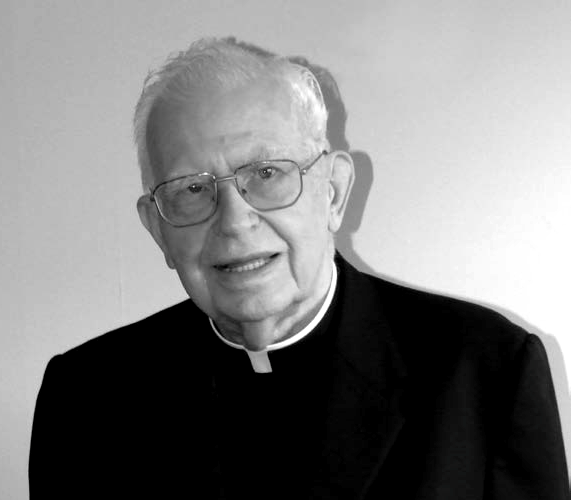
First Holy Communion: Sermon from May 16, 1943
Here is a sermon from the good old days by +Rev. Msgr. Vincent Nicholas Foy (August 14, 1915 – March 13, 2017), from 1943. Readers may recall that Pope Saint Pius X, by the decree Quam Singulari in 1910, lowered the customary age of reception of Holy Communion – after the rigours of the plague[…]Continue reading→
In the Glorious Light of Easter, Alleluia!
Set your minds on things that are above, not on things that are on earth, for you have died, and your life is hidden with Christ in God. When Christ who is your life is revealed, then you also will be revealed with him in glory (Col. 3:3-4). The Resurrection of Our Lord and Saviour[…]Continue reading→
An Ancient Homily for Holy Saturday
The time between Good Friday and Easter Sunday is one of waiting, in silence, as the world wonders – anticipates – what will happen, after the death of Christ. We re-live this time each year in the anamnesis of our liturgy, and in turn look forward to the glorious re-creation of all things at the[…]Continue reading→
Europe’s Long Descent
(As we meditate on this day on Christ’s burial, and His descent into hell, it is fitting to ponder here with contributor Peter Marcus how the world seems to be heading there as well. The difference is that, although God cannot ‘redeem’ hell, nor those therein, He can and did redeem the world. There is[…]Continue reading→