
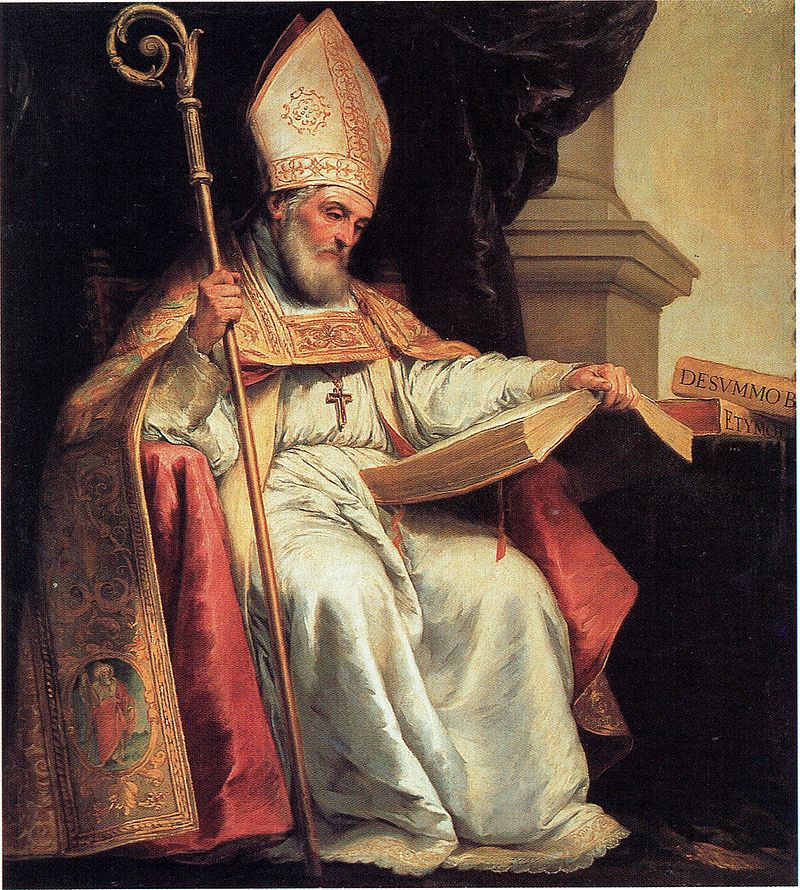
Saint Isidore of Seville, the Internet and Industriousness
Today, April 4th, muted this year by Holy Saturday, is the commemoration of Saint Isidore of Seville (560-636) a bishop and doctor of the Church during a tumultuous age, when civilization was crumbling, coming apart at its very seams, which may sound sort of au courant. Then again, the form of this world has always been passing away. Through it all, Isidore guided his diocese for three fruitful decades, which he had assumed after the death of his brother and fellow bishop, Leander.
Called the most learned man of his time, Isidore was famous for many things: the holiness of his life, the prudence with which he oversaw his flock, his voluminous writings, the shoring up of education. Having been educated himself in the ancient ‘trivium and quadrivium’, Saint Isidore helped shore up what was known as the ‘liberal arts’, and helped found schools, which inspired future universities and colleges.
He was also renowned for his voluminous writings, the most famous of which were his Etymologies, a twenty volume (!) early encyclopedia/dictionary summarizing all the knowledge that was then known, much used right up until the early Middle Ages, and oft-quoted by Saint Thomas Aquinas in his Summa Theologica. This remarkable work of erudition (containing, as a contemporary put it, everything one needed to know, albeit, with some ‘etymologies’ that were a bit fanciful) provided the basis for all the encyclopedias, summaries and anthologies that were to dot the intellectual landscape in the centuries to follow. We may even surmise, if one wants to think in such terms, that Isidore’s endeavour to encapsulate all erudition in one place has reached its end point in the vast repertoire of knowledge known as ‘Wikipedia’.
One may further surmise that is why Saint Isidore has officially been proclaimed the patron saint of the Internet, or the World Wide Web, even if it was invented a millennium and a half after his death – but a very fitting intercessor for our age.
It is a curious paradox (so sayeth the aforementioned Wikipedia article!) that although Isidore’s Etymologies preserved the substance of ancient works that have been irrevocably lost, the work also helped lead to the same very loss of those works. That is, so the argument goes, scholars relied so much on Isidore’s summaries, that many works were not copied, or copied enough to be handed on to posterity.
The same could be said for the modern internet, upon which we – students, teachers, researchers and everyone else – rely, perhaps, too heavily, ignoring the very primary and secondary sources that they summarize, describe and collate. It is far easier to read a summary of Sea Wolf, the Iliad, any of Jane Austen’s romantic escapades, or, dare I say it, even the Fathers of the Church, the Summa, and, yes, the Holy Scripture themselves, than it is to read the actual primary sources. But the latter are so much more fruitful and rewarding.
As Isidore puts it in his Book of Sentences, from Today’s Office:
See also the reviews in these pages on Nicholas Carr’s book (here as well) about the Internet dumbing us down. Isidore would be mortified if his own works were to have done the same!
I suppose the moral is that we should use what tools we may for the purpose for which they were created. Bishop Isidore of course meant for his readers to have read or read the original works that he himself summarized, if at all possible. And the internet which he now oversees from heaven should be used for the same purpose: To lead us to deeper knowledge, to appropriate what we read, and make it our own, and not take the too easy path too often taken. This requires the oft-overlooked virtue of industriousness, the capacity to stay on the task at hand, stick-with-it-ness, perseverance. We must cultivate, as Cardinal Newman exhorted in his Idea of a University, a magnanimous mind and soul, one that sees the broader and wider, even the eternal perspective, and not focus only on the hic et nunc, the here and now, or, what is worse, what is presented as the ‘consensus’, without doing the work to make up our own minds.
As Alexander Pope would warn in 1709:
A little learning is a dangerous thing;
drink deep, or taste not the Pierian spring:
there shallow draughts intoxicate the brain,
and drinking largely sobers us again.
So, dear reader, pull yourself for a time away from the news, posts and tweets, and tolle, lege – pick up those books you’ve always wanted to read, pore over them, take the time to read and absorb, and live a little of the spirit of Saint Isidore, and exhort those around you – family, friends – to do the same.
Who knows what small role you may have in saving our culture and civilization; even in giving hope to our children and youth, whom we, by God’s grace, may inspire?
Saint Isidore, bishop and doctor, ora pro nobis!

Carney’s Amoral Majority
After five defections – euphemistically described as ‘crossing the floor’ – and three by-elections, Mark Carney and his Liberals how have their coveted majority. One wonders what bowls of pottage were offered in back-room deals. In the archaic monarchical system that is the Dominion of Canada, this majority allows the newly-minted Prime Minister to rule[…]Continue reading→

Saint Kateri , Canada’s Protectress
This was the title given to Saint Kateri Tekakwitha, by Pope Benedict XVI, when he canonized her on October 28th, 2012, along with six others, in Saint Peter’ Square (she had been beatified by Pope John Paul II back in 1980). With Saint Joseph as our protector, along with the Canadian martyrs, we seem to[…]Continue reading→
A Closed, Unsustainable, Descending Loop
As a follow-up to my thoughts on Payette’s payout, here be a stark image of where are here in Canada. As the graph shows in, well, graphic terms, since 2025, the public sector has contributed to 95.5% of economic growth. The private sector – which funds the public sector, or is supposed to – has[…]Continue reading→
A Tale of Two Benedicts
A grace-filled Holy Week to all our readers! As we await and prepare for the Resurrection about to dawn upon us, we might keep in mind two Benedicts: Pope Emeritus Benedict XVI, requiescat in pace, elected on this day in 2005; and today’s commemoration of the mystic pilgrim, Benedict Joseph Labre, who died on this[…]Continue reading→

My Name is Bernadette
April 16th is a propitious day, for besides the anniversary of Father de Valk’s death, who founded Catholic Insight in its print form decades ago, and the commemoration of the ‘two Benedicts’, mentioned in accompanying posts, today we also recall Saint Bernadette Soubirous, the young visionary to whom the Virgin Mary appeared numerous times at[…]Continue reading→
Presidential Pardon of Weronika Krawczyk
As a good news, follow-up to our story from Poland, of the persecution of Weronika Krawczyk for her pro-life views, we heard that she has been granted a presidential pardon. One might still wonder why one needs a presidential pardon for simply holding the long-held belief that the child within the womb is a child,[…]Continue reading→
Saint Lydwina of Schiedam and Suffering Joyfully
Saint Lydwina of Schiedam (1380 – 1433) was one of the countless and glorious ‘victim souls’ in the history of the Church, those whose lives are filled with suffering, often of an unimaginable intensity, but who suffer joyfully. She was a fifteen-year old Dutch girl, out skating one day, when she fell and broke one[…]Continue reading→

The Glorious Martyrdoms of Martin and Maximus
As we enter into Eastertide, we recall on this 13th of April Pope Saint Martin I (+655), one of the noblest, if most tragic, of the successors of Saint Peter. Born in Umbria, Italy, he was of noble lineage, with great intelligence combined with charity and love of the poor and the Church. While still[…]Continue reading→

Canonizing Sister Faustina and Divine Mercy
HOMILY OF THE HOLY FATHER MASS IN ST PETER’S SQUARE FOR THE CANONIZATION OF SR MARY FAUSTINA KOWALSKA Sunday, 30 April 2000 1. “Confitemini Domino quoniam bonus, quoniam in saeculum misericordia eius”; “Give thanks to the Lord for he is good; his steadfast love endures for ever” (Ps 118: 1). So the Church sings on the Octave of[…]Continue reading→
Pope Leo and a Rosary for Peace
Pope Leo XIV has asked Catholics across the world to join him in a Rosary for peace today, at 18:00 Rome time (6 pm), which would be noon from where I write (EST). If you are able, whether at that time or another, and in whatever way you pray, to join in intercession with the[…]Continue reading→