
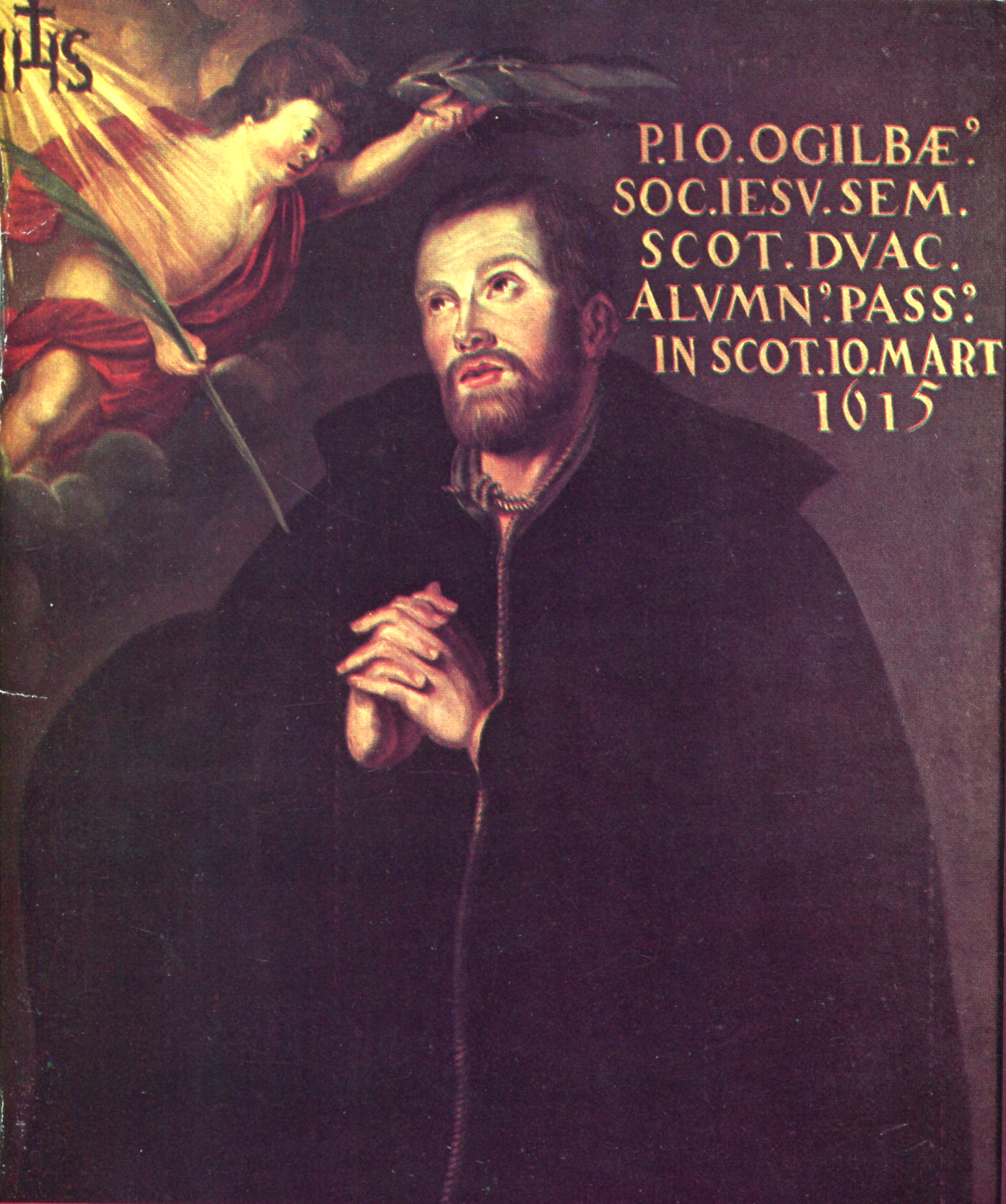
Saint John Ogilvie, the Last Martyr of Scotland
John Ogilvie was born in 1579, just as the Protestant ‘reformation’ was taking hold in Britain, including his native land of Scotland, led by the fiery apostate priest John Knox. Catholicism would soon be all-but wiped out in dear Alba, signified by the death of our saint.
Although raised in his first formative years by a Calvinist father, he was sent, with many young noblemen, to the Continent to be educated by the recently-founded Jesuits, who had already made a name for themselves for having the best schools and curricula, with their tried-and-true Catholic liberal arts program, the famous ratio studiorium.
In the midst of his studies, young John soon realized the truth of Catholicism, in contrast to the obvious errors, theological, historical and spiritual, of the dour doom of Knox’s Presbyterian Calvinism. At the age of 17, he was received into the Church. Soon afterwards, in 1559, he joined the Jesuits themselves, and after a solid decade of formation, was ordained in 1610.
Father Ogilvie spent his all-too brief priestly ministry as a missionary first in London, then Paris, and finally amongst his own people in Scotland, where Catholicism and the sacraments were outlawed under pain of death; it was here, not far from where he was born, after working for a year clandestinely as a priest under the pseudonym ‘John Watson, horse-trader’ that he was betrayed.
His virtue and discipline shone forth during his brutal imprisonment, and his patience and kindness converted many. The King’s Men strove to coerce him to betray his confidants, renounce his faith, and swear allegiance to King James the First. (The latter was also James the Sixth of Scotland, the son of the Catholic Mary, Queen of Scots, put to death when James was but an infant by the tragic Elizabeth the First, last of the Tudors. James had been raised a staunch Protestant, and led the charge in extirpating the Faith from once-Catholic Great Britain).
Father Ogilvie underwent a number of tortures, being put in the ‘boots’, which crushed his feet, and the jailers were ordered to keep him awake for a full ‘novena’ of nine days and nights without sleep, towards the end of which they had to slash him with knives and drop him on the floor to keep him awake. Physicians who examined him afterward declared that one more sleepless night would have killed him, and the priest was never the same afterward; as he confessed, his once-sharp mind was now somewhat confused.
During all of this inhuman treatment, Father Ogilvie remained steadfast; the rumour that he ‘gave away names’ (repeated on Wikipedia) is at the very least debatable, and what he said during sleep deprivation was not under the sway of reason. Through it all, Father Ogilvie refused to submit to the King or accept his heretical faith, declaring that the James was playing ‘runagate from God’, and that he would no more recognize him in his spiritual authority than an ‘old hat’.
Ogilvie was condemned to the brutal death of being ‘hung, drawn and quartered’, a sentence carried out on this day, March 10, 1615, at the age of 36, ten years before another Jesuit by the name of John, de Brebeuf, was sent on his own missionary work to New France, where he would, in 1649, meet a similar fate.
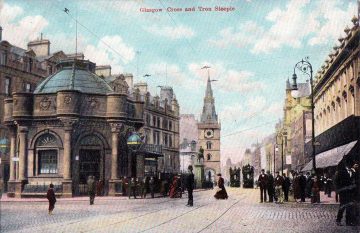
As Father Ogilvie ascended the scaffold at Glasgow Cross (where a monument to the saint now stands), the priest embraced the hangman, urging him to ‘be of good cheer’, confessing before the expectant crowd,
“In every duty which I owe the King’s majesty I will show myself a most obedient subject; for if any invade his temporal rights I would shed my last drop of blood in his defence”
Like Thomas More a century before and four hundred miles south, Ogilvie died the King’s good servant, but God’s first.
Father John Ogilvie was canonized in 1976, becoming the last post-Reformation Scottish saint (so far!). As Cardinal John Henry Newman was to predict two centuries afterward, no country can keep its Christian identity without being fully Catholic, since Protestantism, having no locus of authority and no principle of cohesion, eventually fragments into agnosticism and secularism, in which Scotland, the rest of the ‘United Kingdom’, and all of Europe, come to think of it, are now almost completely immersed.
We pray for the return of the faith to that beautiful and bonnie land, once so Catholic. The blood of martyrs is the seed of faith, which, like the nation itself, may yet rise again, some way, or another.
Saint John Ogilvie, ora pro nobis!

Carney’s Amoral Majority
After five defections – euphemistically described as ‘crossing the floor’ – and three by-elections, Mark Carney and his Liberals how have their coveted majority. One wonders what bowls of pottage were offered in back-room deals. In the archaic monarchical system that is the Dominion of Canada, this majority allows the newly-minted Prime Minister to rule[…]Continue reading→

Saint Kateri , Canada’s Protectress
This was the title given to Saint Kateri Tekakwitha, by Pope Benedict XVI, when he canonized her on October 28th, 2012, along with six others, in Saint Peter’ Square (she had been beatified by Pope John Paul II back in 1980). With Saint Joseph as our protector, along with the Canadian martyrs, we seem to[…]Continue reading→

A Tale of Two Benedicts
A grace-filled Holy Week to all our readers! As we await and prepare for the Resurrection about to dawn upon us, we might keep in mind two Benedicts: Pope Emeritus Benedict XVI, requiescat in pace, elected on this day in 2005; and today’s commemoration of the mystic pilgrim, Benedict Joseph Labre, who died on this[…]Continue reading→

My Name is Bernadette
April 16th is a propitious day, for besides the anniversary of Father de Valk’s death, who founded Catholic Insight in its print form decades ago, and the commemoration of the ‘two Benedicts’, mentioned in accompanying posts, today we also recall Saint Bernadette Soubirous, the young visionary to whom the Virgin Mary appeared numerous times at[…]Continue reading→

Saint Lydwina of Schiedam and Suffering Joyfully
Saint Lydwina of Schiedam (1380 – 1433) was one of the countless and glorious ‘victim souls’ in the history of the Church, those whose lives are filled with suffering, often of an unimaginable intensity, but who suffer joyfully. She was a fifteen-year old Dutch girl, out skating one day, when she fell and broke one[…]Continue reading→

The Glorious Martyrdoms of Martin and Maximus
As we enter into Eastertide, we recall on this 13th of April Pope Saint Martin I (+655), one of the noblest, if most tragic, of the successors of Saint Peter. Born in Umbria, Italy, he was of noble lineage, with great intelligence combined with charity and love of the poor and the Church. While still[…]Continue reading→

Canonizing Sister Faustina and Divine Mercy
HOMILY OF THE HOLY FATHER MASS IN ST PETER’S SQUARE FOR THE CANONIZATION OF SR MARY FAUSTINA KOWALSKA Sunday, 30 April 2000 1. “Confitemini Domino quoniam bonus, quoniam in saeculum misericordia eius”; “Give thanks to the Lord for he is good; his steadfast love endures for ever” (Ps 118: 1). So the Church sings on the Octave of[…]Continue reading→

Saint Stanislaus of Szczepanów
We celebrate Saint Stanislaus today (+ April 11, 1079), in light of this Easter Octave, a bishop and martyr who accepted the episcopacy only at the direct order of Pope Alexander II. He proved a wise and courageous leader of his flock, put to death by his own king, Boleslaus, for rebuking the monarch’s ‘immoral[…]Continue reading→
Saint Gemma Galgani
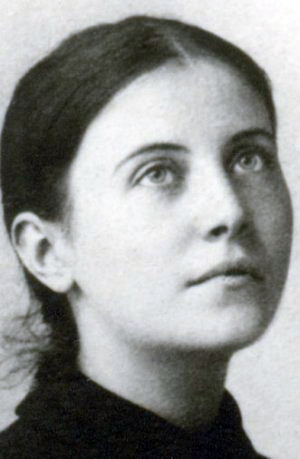
On this April 11th, in 1903 – the same year that the Italian Guiseppe Sarto was elected Pope later that summer as Pius X – a lovely, young Italian woman died, by the name of Gemma Galgani. She lived a brief life of 24 years, as did a number of other young saints, including Pier[…]Continue reading→
An Ideological and Improper Translation
I noticed something odd with the psalm reading at Mass the other day. Our bishops’ conference here in Canada has decreed that the Mass in English – Novus Ordo – use the ‘NRSV’, the ‘New Revised Standard Version’, an ‘updated’ translation of the original RSV, first published in 1952. This ‘new translation’ has the tendency[…]Continue reading→