
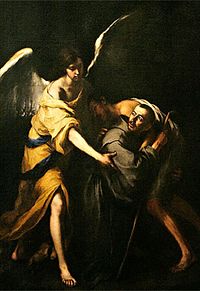
The Radical Prodigal, Saint John of God
Saints are by definition ‘extreme’, for they live a liminal life, on the very threshold of eternity, seeing past the veil of this world. Hence, they act as though all that mattered were the next life, which, in the end, is true. Contrary to John Lennon, they more than imagine – they fully believe, and know – that there is a heaven, and a hell, and that all depends on how we live hic et nunc. Hence, one of the things looked for in a person who dies with a reputation for sanctity is ‘heroic virtue’, that goes far above and beyond the call of duty, so to speak, and the more ‘above and beyond’, the better, all things considered.
One of those who practised such ‘extreme’ charity is Saint John of God (+1550), a sort of an early Mother Teresa, who devoted the last decade of his short life – he died on his 55th birthday, March 8th – helping the poorest of the poor and the sickest of the sick, in an era when many of these were left to wallow in their own misery, dying in the gutter, or wasting away wherever they could find a bed. It was not unlike Calcutta when the Mother Teresa arrived there. The misery she witnessed moved her to found the Sisters of Charity.
Before his last decade which launched him into holiness and then heaven, John had led a turbulent, dissolute life. He ran away, or was kidnapped, from home at eight years old (!) and left to fend for himself; he begged on the streets, and was eventually taken in by a man, to tend for his sheep and – implausibly enough – marry his daughter.
John would have none of the vita domestica, and ran off again to becomes a soldier-at-arms, a trooper and mercenary, a rough life he lived for 18 years.
But his faith had not left him, nor his latent love of family. Like the prodigal son, he eventually repented, and tried to find his parents, but his mother had died, apparently of grief, soon after he had disappeared from home; and his father, who had joined the Franciscans, was also gone. So John went off to Africa with the vague intent to free Christian slaves and perhaps gain martyrdom; that did not work out so well, and a Franciscan urged him to return to Spain.
It was soon after this that, at the age of 42 – back then, well into middle age – on the feast of Saint Sebastian, January 20th, 1537, during a sermon by the great priest and preacher Saint John of Avila, he had a profound conversion and what may have been a sort of breakdown. The itinerant former soldier wandered out into the streets beating and berating himself, loudly proclaiming sorrow for all his past sins, for all who wanted to hear. And many did not. He was soon put into an asylum, where the ‘treatment’ consisted of being chained, flogged and starved. Not that John minded that much, for in his mind he deserved far worse, but the same John of Avila intervened, and urged the would-be saint to moderate his penance, and begin to work with the sick, the poor, the abandoned.
To this he dedicated himself with the zeal characteristic of his intense nature and, like Mother Teresa five centuries later, others soon joined this radical man in his radical work. He founded an Order of Hospitallers, before his death in 1550. The ‘Brother Hospitallers of Saint John of God’ – officially approved in 1572 – now number 45,000 members, working throughout the world in 53 countries for those most abandoned. They are also deputed with the medical care of the Pope.
Would that we could again practise ‘medicine’ for the mercy and love of God, instead of the love of mammon, which drives all too many in our own over-compensated socialist health-care system. And now, instead of caring for so many of the sick, we offer them an ‘easy’ death – it’s less expensive, in all senses of that word. The medical system – as much good as is still done – is unsustainable without the love of God that John of God lived out to the full.
An excerpt from today’s Office signifies Saint John’s radical trust in God, and we might all likely sympathize with his earthly anxiety, which he offered to the same God. For our hope is not in this world, but the next:
I work here on borrowed money, a prisoner for the sake of Jesus Christ. And often my debts are so pressing that I dare not go out of the house for fear of being seized by my creditors. Whenever I see so many poor brothers and neighbours of mine suffering beyond their strength and overwhelmed with so many physical or mental ills which I cannot alleviate, then I become exceedingly sorrowful; but I trust in Christ, who knows my heart. And so I say: “Woe to the man who trusts in men rather than in Christ.” Whether you like it or not, you will grow apart from men, but Christ is faithful and always with you, for Christ provides all things. Let us always give thanks to him. Amen.
We too should all do what we can for those less fortunate. God can do miracles with those who take His truth to heart and put it into effect, regardless of how late we get to the game. Just so long as we die trying.
Saint John of God, ora pro nobis!

Carney’s Amoral Majority
After five defections – euphemistically described as ‘crossing the floor’ – and three by-elections, Mark Carney and his Liberals how have their coveted majority. One wonders what bowls of pottage were offered in back-room deals. In the archaic monarchical system that is the Dominion of Canada, this majority allows the newly-minted Prime Minister to rule[…]Continue reading→

Saint Kateri , Canada’s Protectress
This was the title given to Saint Kateri Tekakwitha, by Pope Benedict XVI, when he canonized her on October 28th, 2012, along with six others, in Saint Peter’ Square (she had been beatified by Pope John Paul II back in 1980). With Saint Joseph as our protector, along with the Canadian martyrs, we seem to[…]Continue reading→
A Closed, Unsustainable, Descending Loop
As a follow-up to my thoughts on Payette’s payout, here be a stark image of where are here in Canada. As the graph shows in, well, graphic terms, since 2025, the public sector has contributed to 95.5% of economic growth. The private sector – which funds the public sector, or is supposed to – has[…]Continue reading→

A Tale of Two Benedicts
A grace-filled Holy Week to all our readers! As we await and prepare for the Resurrection about to dawn upon us, we might keep in mind two Benedicts: Pope Emeritus Benedict XVI, requiescat in pace, elected on this day in 2005; and today’s commemoration of the mystic pilgrim, Benedict Joseph Labre, who died on this[…]Continue reading→

My Name is Bernadette
April 16th is a propitious day, for besides the anniversary of Father de Valk’s death, who founded Catholic Insight in its print form decades ago, and the commemoration of the ‘two Benedicts’, mentioned in accompanying posts, today we also recall Saint Bernadette Soubirous, the young visionary to whom the Virgin Mary appeared numerous times at[…]Continue reading→
Presidential Pardon of Weronika Krawczyk
As a good news, follow-up to our story from Poland, of the persecution of Weronika Krawczyk for her pro-life views, we heard that she has been granted a presidential pardon. One might still wonder why one needs a presidential pardon for simply holding the long-held belief that the child within the womb is a child,[…]Continue reading→

Saint Lydwina of Schiedam and Suffering Joyfully
Saint Lydwina of Schiedam (1380 – 1433) was one of the countless and glorious ‘victim souls’ in the history of the Church, those whose lives are filled with suffering, often of an unimaginable intensity, but who suffer joyfully. She was a fifteen-year old Dutch girl, out skating one day, when she fell and broke one[…]Continue reading→

The Glorious Martyrdoms of Martin and Maximus
As we enter into Eastertide, we recall on this 13th of April Pope Saint Martin I (+655), one of the noblest, if most tragic, of the successors of Saint Peter. Born in Umbria, Italy, he was of noble lineage, with great intelligence combined with charity and love of the poor and the Church. While still[…]Continue reading→

Canonizing Sister Faustina and Divine Mercy
HOMILY OF THE HOLY FATHER MASS IN ST PETER’S SQUARE FOR THE CANONIZATION OF SR MARY FAUSTINA KOWALSKA Sunday, 30 April 2000 1. “Confitemini Domino quoniam bonus, quoniam in saeculum misericordia eius”; “Give thanks to the Lord for he is good; his steadfast love endures for ever” (Ps 118: 1). So the Church sings on the Octave of[…]Continue reading→
Pope Leo and a Rosary for Peace
Pope Leo XIV has asked Catholics across the world to join him in a Rosary for peace today, at 18:00 Rome time (6 pm), which would be noon from where I write (EST). If you are able, whether at that time or another, and in whatever way you pray, to join in intercession with the[…]Continue reading→