
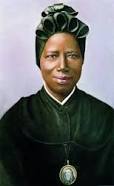
The Formidable Forgiveness of Josephine Bakhita
On this day in 1947, February 8th, Sister Josephine Bakhita completed the long and eventful journey of her life. Born around 1869 – she was never quite sure the precise date or year – her childhood was spent happy and fulfilled growing up in the region of Darfur, Sudan, which was not then the dystopic and dysfunctional warzone it is today. But profound evil still lurked around the corner, as Bakhita (a name given to her by her Islamic captors, meaning, ironically, ‘fortunate’, she having lost the memory of her original name) was kidnapped and sold into slavery, two years after her elder sister (what their parents must have gone through, we can scarcely imagine). As an aside, Islam is historically one of the largest institutions for slavery in the modern world.
Thus began a life of almost indescribable suffering, torture, physical and psychological abuse, whipping, scarring and mutilation for the ‘fortunate one’, all at the hands of her various ‘owners’. The son of one of them beat her so severely, after she inadvertently broke a vase, that she spent a month unable to move. And here is a description of one of Josephine’s punishments:
As her mistress was watching her with a whip in her hand, a dish of white flour, a dish of salt and a razor were brought by a woman. She used the flour to draw patterns on her skin and then she cut deeply along the lines before filling the wounds with salt to ensure permanent scarring. A total of 114 intricate patterns were cut into her breasts, belly and into her right arm.
We may wonder at such evil, and the suffering of the innocent is perhaps the thorniest question in theodicy: Why does God allow such was a question that likely went through the yet-unformed mind and soul of Josephine. Why her?
The travails only ended when a kindly soul, who had ‘bought’ her, brought her to Italy; Bakhita was placed with the Cannosian Sisters; it was the first time she had been treated with kindness and love, and she refused to leave, a decision backed up by the Italian authorities, declaring her slavery null and void. By the grace of God, she soon responded to the fullness of truth that the Faith offered, and converted to Catholicism, being baptized on January 9th, 1890 – taking the full name of Josephine Margaret Fortunata (the Latin translation of her Arabic patronymic Bakhita). We might smile at the irony, but Josephine knew that this was the path God had traced our for her, and it must have been with great joy and peace that she received her first Holy Communion. A few years later Josephine made the final profession of her vows in religious life, fittingly enough, in the presence of none other than Archbishop Guiseppe Sarto, the future Pope Saint Pius X.
Sister Josephine spent the rest of her life as a religious sister in the convent, praying, working, occasionally giving talks, and training to Sisters and others who were embarking on missionary journeys to Muslim territories. She was known for her joy and her kindly demeanour, and, though living a rather hidden existence, was soon renowned throughout Italy as a saint. In her final years, the suffering increased, and she was confined to a wheelchair; when asked how she was, the Sister would reply with a smile, “As the Master desires”. Towards the end, she had flashbacks to the buried horrors of her days in slavery, offering up the trauma in vicarious reparation for the persistence of this nigh-ineradicable evil: Homo lupus hominis. Man is all too often a wolf to his fellow man.
Her sanctity and personality are encapsulated in an anecdote recounted of her: A young student once asked Bakhita: “What would you do, if you were to meet your captors?” Without hesitation she responded: If I were to meet those who kidnapped me, and even those who tortured me, I would kneel and kiss their hands. For, if these things had not happened, I would not have been a Christian and a religious today.
What can one say of such forgiveness and such trust in the winding and mysterious ways of God’s providence?
Her last words, as she lay dying on this February 8th in 1947, a Saturday, were,
Yes, I am so happy: Our Lady… Our Lady.
Would we might say the same on our own deathbeds…
Josephine Bakhita was canonized by a fellow saint, John Paul II, on the memorial of Saint Therese of Lisieux, October 1st, in the great Jubilee year 2000, who had also beatified her eight years earlier. The great Pope chose his saints wisely, leading us into the third millennium. He said of her:
“The law of the Lord is perfect, … it gives wisdom to the simple” (Ps 19: 8).
These words from today’s Responsorial Psalm resound powerfully in the life of Sr Josephine Bakhita. Abducted and sold into slavery at the tender age of seven, she suffered much at the hands of cruel masters. But she came to understand the profound truth that God, and not man, is the true Master of every human being, of every human life. This experience became a source of great wisdom for this humble daughter of Africa.
We must live in hope, and Pope Benedict has his own thoughts on Sister Bakhita in his encyclical, on that theme, Spe Salvi, wherein he writes of her, after she had found a refuge at the convent in Italy:
“Now she had “hope” —no longer simply the modest hope of finding masters who would be less cruel, but the great hope: “I am definitively loved and whatever happens to me—I am awaited by this Love. And so my life is good.”
God can indeed bring the greatest good out of the greatest evil, and Saint Josephine is an invaluable patron in our current battle against all the atrocities done in the name of God.
After her death, her body lay in repose for three days as thousands filed past, seeking her intercession. Her body is in a glass coffin, apparently incorrupt, in the church of the Holy Family at the Canossian convent in Schio, awaiting the resurrection of all the just.
Ora pro nobis, Sister Bakhita!
Carney’s Amoral Majority
After five defections – euphemistically described as ‘crossing the floor’ – and three by-elections, Mark Carney and his Liberals how have their coveted majority. One wonders what bowls of pottage were offered in back-room deals. In the archaic monarchical system that is the Dominion of Canada, this majority allows the newly-minted Prime Minister to rule[…]Continue reading→

Saint Kateri , Canada’s Protectress
This was the title given to Saint Kateri Tekakwitha, by Pope Benedict XVI, when he canonized her on October 28th, 2012, along with six others, in Saint Peter’ Square (she had been beatified by Pope John Paul II back in 1980). With Saint Joseph as our protector, along with the Canadian martyrs, we seem to[…]Continue reading→

A Tale of Two Benedicts
A grace-filled Holy Week to all our readers! As we await and prepare for the Resurrection about to dawn upon us, we might keep in mind two Benedicts: Pope Emeritus Benedict XVI, requiescat in pace, elected on this day in 2005; and today’s commemoration of the mystic pilgrim, Benedict Joseph Labre, who died on this[…]Continue reading→

My Name is Bernadette
April 16th is a propitious day, for besides the anniversary of Father de Valk’s death, who founded Catholic Insight in its print form decades ago, and the commemoration of the ‘two Benedicts’, mentioned in accompanying posts, today we also recall Saint Bernadette Soubirous, the young visionary to whom the Virgin Mary appeared numerous times at[…]Continue reading→

Saint Lydwina of Schiedam and Suffering Joyfully
Saint Lydwina of Schiedam (1380 – 1433) was one of the countless and glorious ‘victim souls’ in the history of the Church, those whose lives are filled with suffering, often of an unimaginable intensity, but who suffer joyfully. She was a fifteen-year old Dutch girl, out skating one day, when she fell and broke one[…]Continue reading→

The Glorious Martyrdoms of Martin and Maximus
As we enter into Eastertide, we recall on this 13th of April Pope Saint Martin I (+655), one of the noblest, if most tragic, of the successors of Saint Peter. Born in Umbria, Italy, he was of noble lineage, with great intelligence combined with charity and love of the poor and the Church. While still[…]Continue reading→

Canonizing Sister Faustina and Divine Mercy
HOMILY OF THE HOLY FATHER MASS IN ST PETER’S SQUARE FOR THE CANONIZATION OF SR MARY FAUSTINA KOWALSKA Sunday, 30 April 2000 1. “Confitemini Domino quoniam bonus, quoniam in saeculum misericordia eius”; “Give thanks to the Lord for he is good; his steadfast love endures for ever” (Ps 118: 1). So the Church sings on the Octave of[…]Continue reading→

Saint Stanislaus of Szczepanów
We celebrate Saint Stanislaus today (+ April 11, 1079), in light of this Easter Octave, a bishop and martyr who accepted the episcopacy only at the direct order of Pope Alexander II. He proved a wise and courageous leader of his flock, put to death by his own king, Boleslaus, for rebuking the monarch’s ‘immoral[…]Continue reading→
Saint Gemma Galgani
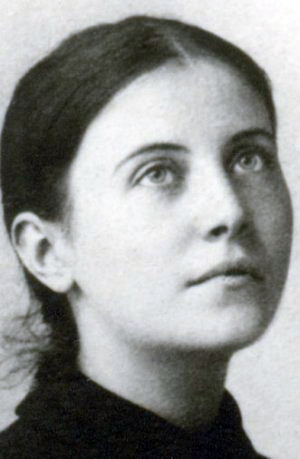
On this April 11th, in 1903 – the same year that the Italian Guiseppe Sarto was elected Pope later that summer as Pius X – a lovely, young Italian woman died, by the name of Gemma Galgani. She lived a brief life of 24 years, as did a number of other young saints, including Pier[…]Continue reading→
An Ideological and Improper Translation
I noticed something odd with the psalm reading at Mass the other day. Our bishops’ conference here in Canada has decreed that the Mass in English – Novus Ordo – use the ‘NRSV’, the ‘New Revised Standard Version’, an ‘updated’ translation of the original RSV, first published in 1952. This ‘new translation’ has the tendency[…]Continue reading→